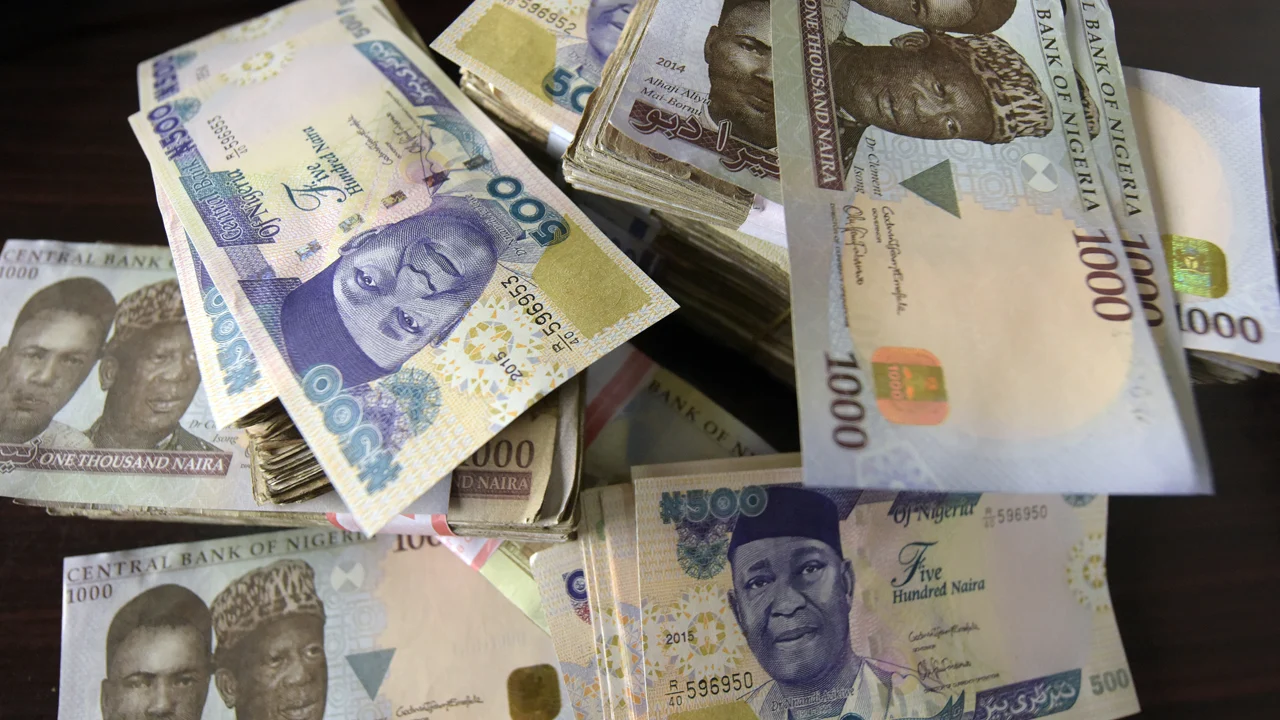
The naira slipped to N1,376 per dollar on Monday as U.S. strikes on Iran triggered a global dollar rally, putting pressure on emerging market currencies, including Nigeria’s.
Data from the Central Bank of Nigeria (CBN) confirmed the local currency’s retreat from N1,368.5 per dollar recorded at the close of trading on Friday—a depreciation of 7.5 kobo in a single session, modest in isolation but significant against the backdrop of a broader global repricing of risk.
For months, analysts had openly questioned whether the greenback could still be relied upon to perform its traditional function as the world’s crisis currency. The dollar had notably failed to rally during a tariff-induced global market sell-off earlier in the year, prompting some economists and investors to wonder whether its safe-haven crown was beginning to slip.
The dollar index—a measure of the currency’s strength against a basket of six major peers—climbed nearly 1% in a single day, its strongest performance in seven months. The catalyst was swift and unmistakable: U.S. military strikes on Iran sent investors scrambling for the perceived safety of dollar-denominated assets, triggering a broad-based rush out of riskier currencies and into the greenback.
“The renewed rally has helped restore the dollar’s traditional role as a crisis-era hedge,” one market analyst noted, reflecting a sentiment that was palpable across trading desks globally. “What we saw today was a reminder that when genuine geopolitical fear enters the market, old instincts die hard.”
Nigeria’s currency was caught squarely in the crossfire of that global repricing. CBN data shows the naira traded in a range of N1,368.5 to N1,397 per dollar during Monday’s session, ultimately closing at N1,376, with a simple mean average exchange rate of N1,378.48 per dollar.
That intraday range—nearly 30 naira wide—underscores the degree of volatility that gripped the market as traders digested rapidly evolving geopolitical headlines from the Middle East.
To put Monday’s movement in a broader context: as recently as February 2, 2026, the naira had closed at N1,384.5 per dollar, having strengthened from N1,391 per dollar on January 30. On that February trading day, the currency oscillated between N1,381 and N1,396, with a mean average of N1,390.54—suggesting that the naira had been on a quiet, tentative recovery path before this week’s external shock disrupted the calm.
Analysts were, however, careful not to overread Monday’s move as a structural breakdown. “The latest movement reflects short-term volatility influenced by global dollar strength rather than a fundamental shift in domestic foreign exchange conditions,” one currency strategist said. In other words, Nigeria’s foreign exchange fundamentals did not deteriorate overnight—the world simply became a more dangerous place, and markets priced accordingly.
What gives policymakers in Abuja a degree of comfort—and what distinguishes today’s episode of naira weakness from previous, more alarming bouts of depreciation—is the remarkable strengthening of Nigeria’s external reserve position over the past 12 months.
According to CBN Governor Olayemi Cardoso, net foreign exchange reserves surged from $23.11 billion at the end of 2024 to $34.80 billion by the close of 2025, an increase of $11.69 billion within a single year. Gross external reserves followed a similar trajectory, rising from $40.19 billion at end-2024 to $45.71 billion at end-2025.
More strikingly, as of February 16, 2026, gross reserves had climbed further still—to $50.45 billion, a figure that represents a substantial war chest by any historical measure for Nigeria and one that affords the CBN considerably more ammunition to defend the naira should conditions deteriorate meaningfully.
The significance of that buffer cannot be overstated. A stronger reserve position translates directly into greater capacity for the central bank to intervene in the foreign exchange market—supplying dollars to meet demand, smoothing out disorderly price movements, and signaling to investors that the monetary authority has both the will and the means to prevent a currency freefall.
“The improved reserve position reflects stronger external liquidity buffers,” the CBN Governor noted, a statement that currency traders and foreign investors will have noted with interest given the turbulence unfolding globally.
The critical question now is whether the geopolitical tensions that ignited Monday’s dollar surge will persist, escalate, or subside—and how long Nigeria’s foreign exchange market will remain in the line of fire.
A prolonged period of dollar strength would tighten global financial conditions broadly, making it more expensive for emerging market economies to service dollar-denominated debt and sustaining downward pressure on currencies like the naira. Nigeria, as a major oil exporter, faces an additional layer of complexity: while higher geopolitical risk can support oil prices—offering some offsetting benefit to government revenues—sustained dollar appreciation tends to complicate the inflation outlook and import costs for ordinary Nigerians.
For now, the CBN appears well-positioned to weather a period of external turbulence, armed with the strongest reserve buffer the country has seen in years. But markets will be watching closely: the next few sessions will reveal whether Monday was a one-day shock or the opening act of a more sustained period of naira stress.
WHAT YOU SHOULD KNOW
The naira’s dip on Monday is a global story, not a Nigerian crisis. U.S. strikes on Iran sent investors fleeing to the dollar, dragging emerging market currencies down with it—the naira was collateral damage, not the cause.
Nigeria’s foreign reserves have never been stronger, sitting at $50.45 billion as of February 2026. The CBN has the firepower to manage this turbulence. Watch the geopolitics—when tensions ease, the pressure on the naira eases with it.