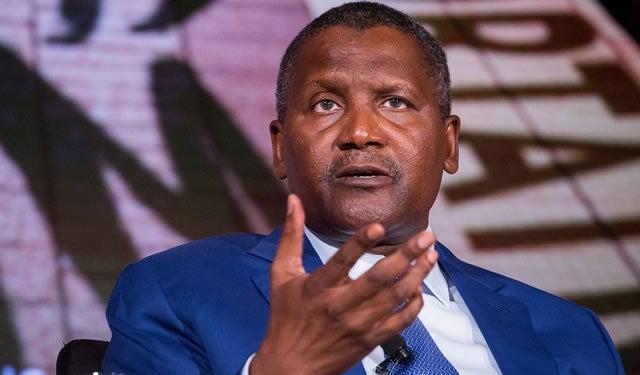
Aliko Dangote, Africa’s wealthiest industrialist and president of the Dangote Group, has revealed ambitious plans to expand his conglomerate into steel production, electricity generation, and port development.
This announcement, part of a broader strategy to accelerate industrialization beyond oil refining, comes amid the ongoing success of his flagship Dangote Petroleum Refinery and Petrochemicals, which has been operational for over two years and is poised for significant growth.
Dangote’s vision extends far beyond his current portfolio, which already includes dominant positions in cement, sugar, salt, fertilizer, and petrochemicals.
Speaking in a recent interview with The New York Times, as detailed in a statement from the Dangote Group, he emphasized the need to build a robust manufacturing base that positions Africa as a global industrial powerhouse. “We have to industrialize Africa,” Dangote declared, highlighting steel, power, and ports as critical next steps to support large-scale manufacturing and trade.
The Dangote Petroleum Refinery, located in Lagos and boasting a capacity of 650,000 barrels per day (bpd), has been producing a range of petroleum products since its commercial startup in 2024.
Dangote anticipates doubling output within the next three years through expansion efforts, including debottlenecking the existing plant by early 2026 and ultimately aiming for 1.4 million bpd by 2028 with a second processing line. This growth aligns with recent developments, such as a $400 million equipment deal with Chinese partners to enhance refining capacity and efficiency.
However, the refinery has faced hurdles, including recurring malfunctions in its residual fluid catalytic cracker since April 2025, underscoring the challenges of operating the world’s largest single-train facility.
Industry analysts quoted in the group’s statement praise the pivot to steel as a strategic entry into a sector vital for infrastructure, housing, and heavy industry. Investments in electricity and ports, meanwhile, target Nigeria’s longstanding bottlenecks—chronic power shortages and inadequate logistics—that have hampered economic progress.
Dangote draws inspiration from India’s Tata Group, citing its diversified model as a blueprint for transforming emerging economies through multi-sector expansion.
Job creation remains at the heart of Dangote’s strategy, especially as Nigeria grapples with a burgeoning youth population projected to require 40 to 50 million new jobs by 2030. The refinery currently employs around 30,000 workers, with 80% being Nigerians, and expansions across new sectors are expected to boost the group’s total workforce to about 65,000.
In a parallel development, reinforcing local talent development, the refinery inducted 330 graduate engineers into its technical workforce during a ceremony at the complex.
These engineers, hailing from top Nigerian institutions and specializing in fields like chemical, electrical, mechanical, and instrumentation engineering, completed rigorous training involving classroom sessions, hands-on rotations, and project defenses focused on refinery processes and operational solutions.
Chief Executive Officer David Bird hailed the induction as a “strategic milestone” in building local capacity and ensuring operational excellence. “This marks another step in our drive to strengthen Nigeria’s engineering talent pool,” Bird said, commending the trainees’ dedication and urging them to prioritize excellence, innovation, and commitment.
Program coordinator Dr. Ebele Oputa echoed this, noting the training’s blend of theory and practice to foster practical and leadership skills. “The structured path boosts their confidence and prepares them for workplace challenges,” she explained, detailing phases from induction and shadowing to supervised coaching.
Dangote also plans to list the refinery’s shares on the Nigerian stock market in 2026, a step aimed at broadening local ownership and participation. Yet, he acknowledges persistent obstacles, including infrastructure gaps, crude supply issues, and logistics bottlenecks in the oil value chain.
To address upstream needs, the group is ramping up efforts in assets like Oil Mining Leases 71 and 72, acquired in 2015, with goals to produce up to 140,000 bpd by 2030—potentially supplying one-fifth of the refinery’s input. Port plans include constructing a new seaport about 100 kilometers from the refinery to serve as a logistics hub.
Undeterred by these challenges, Dangote remains resolute in reducing Africa’s import dependence and retaining economic value on the continent. “Nobody dared to do it, so we did it,” he asserted, underscoring the role of large-scale private investment in revolutionizing Nigeria’s industrial sector. With cement operations spanning multiple African countries and the refinery already altering Nigeria’s downstream dynamics, this latest push signals a transformative era for African manufacturing.
Recent fuel price adjustments at the refinery, which could see petrol reaching N1,000 per liter, reflect broader market pressures but also highlight Dangote’s integrated approach to energy security and industrialization.
As West Africa emerges as a refining hub, Dangote’s endeavors could not only stabilize domestic supplies but also inspire similar ventures across the continent.
WHAT YOU SHOULD KNOW
Aliko Dangote is driving Africa’s industrialization forward with bold, multi-sector expansion beyond oil refining. His next major moves—entering steel production, electricity generation, and port infrastructure—aim to tackle Nigeria’s chronic power and logistics constraints while creating tens of thousands of jobs and reducing import dependence.