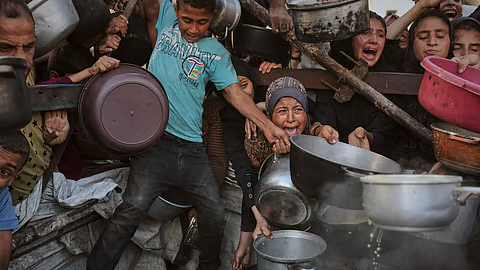
In a significant shift, Israel on Sunday announced a “tactical pause” in military operations across selected areas of the Gaza Strip to enable the flow of desperately needed humanitarian aid, in a bid to address the worsening hunger crisis that has gripped the besieged enclave.
According to the Israeli military, this daily pause — which runs from 10:00 a.m. to 8:00 p.m. local time — will apply to specific regions where Israeli forces are not currently active, including Al-Mawasi, Deir el-Balah, and Gaza City. Secure humanitarian corridors have also been opened across Gaza to permit the safe movement of UN convoys and aid agencies delivering critical food and medical supplies.
While Israel framed the move as a coordinated effort with the United Nations and international aid bodies to increase humanitarian access, UN officials and NGOs operating in Gaza withheld immediate comment, with several expressing private skepticism and opting to observe the implementation before responding.
The Israeli army emphasized that these actions counter “the false claim of deliberate starvation in the Gaza Strip,” rejecting mounting accusations that it has been weaponizing hunger. The military pointed to ongoing efforts such as the airdrop of seven pallets of food into Gaza as proof of its commitment to facilitating humanitarian relief.
Israel had imposed a full blockade on Gaza on March 2 following the breakdown of ceasefire negotiations. A small amount of aid was permitted entry again in late May, but hunger has since escalated dramatically. The United Arab Emirates announced it would resume air drops immediately, and Britain confirmed plans to collaborate with Jordan in similar relief efforts.
Despite these developments, conditions on the ground remain dire. On Saturday alone, more than 50 Palestinians were reportedly killed in Israeli attacks, some of whom were waiting near aid distribution points, according to the Palestinian civil defence agency. A Gaza resident, Hossam Sobh, voiced the desperation felt by many, saying, “We ask God and our Arab brothers to work harder to reach a ceasefire before we all die,” after narrowly retrieving a bag of flour near an Israeli tank.
Meanwhile, Israeli forces intercepted a boat from the Freedom Flotilla Coalition — a pro-Palestinian activist group — attempting to breach the naval blockade by delivering aid via sea. The incident, broadcast briefly online before video feeds were cut, highlighted ongoing restrictions on non-land relief efforts.
The humanitarian crisis has triggered urgent warnings from more than 100 NGOs about the spread of “mass starvation” in Gaza. Philippe Lazzarini, head of the UN agency for Palestinian refugees (UNRWA), criticized airdrops as an inadequate solution, calling them “expensive, inefficient and [potentially deadly] for starving civilians.”
While Israel maintains that it does not restrict aid trucks from entering Gaza, it accuses the UN and NGOs of failing to distribute supplies once they arrive. Aid organizations, however, counter that Israeli forces continue to impose severe logistical hurdles and tight control over road access within the territory.
A separate operation involving the Israeli- and US-backed Gaza Humanitarian Foundation remains underway, although it has been marred by deadly violence, with hundreds of Palestinians reportedly killed near aid distribution points due to Israeli fire.
The broader crisis stems from Israel’s ongoing military campaign in Gaza, launched in response to a Hamas-led attack in October 2023 that killed 1,219 people, mostly civilians. Since then, Israel’s military response has resulted in the deaths of 59,733 Palestinians, the majority of whom are civilians, according to Gaza’s Hamas-run health ministry.
As tensions remain high and humanitarian needs grow more urgent, the global community watches closely to see whether Israel’s announced pause will translate into meaningful relief on the ground — or further deepen the complexities of a conflict with an ever-growing human toll.
What you should know
Israel has announced a daily tactical pause in Gaza to allow humanitarian aid access amid growing international alarm over mass starvation.
The move includes opening secure land routes and beginning limited food airdrops. While Israel insists it’s facilitating aid, humanitarian groups accuse it of restricting relief operations and worsening civilian suffering.
The crisis stems from Israel’s ongoing military response to Hamas’s October 2023 attack, which has since killed nearly 60,000 Palestinians. UN officials remain skeptical about the effectiveness of these new measures, warning that airdrops alone cannot resolve the deepening hunger in Gaza’s besieged communities.