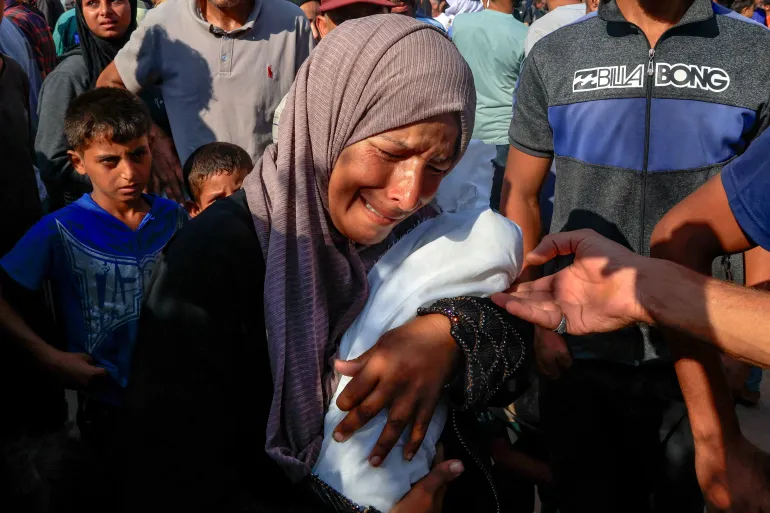
In a grim update that underscores the humanitarian catastrophe unfolding in Gaza, the head of the territory’s largest hospital revealed that 21 children have died from malnutrition and starvation over the past three days.
This latest tragedy adds to the toll of a relentless Israeli military offensive that has left more than two million residents of Gaza grappling with extreme shortages of food, medicine, and other essentials.
Mohammed Abu Salmiya, director of Al-Shifa Medical Complex in Gaza, disclosed during a press briefing that the deaths were confirmed at multiple hospitals in various parts of the strip during a 72-hour window. “Twenty-one children have died due to malnutrition and starvation in various areas across the Gaza Strip,” he said, highlighting the increasingly dire consequences of the months-long conflict.
The announcement coincided with reports from Gaza’s civil defence service that an Israeli airstrike on Al-Shati refugee camp, located to the west of Gaza City, killed at least 13 individuals and injured over 50 others. Mahmud Bassal, spokesperson for the agency, confirmed the figures to AFP.
The World Health Organization also weighed in, accusing Israeli forces of attacking its medical facilities as part of a broader escalation of ground operations. WHO Director-General Tedros Adhanom Ghebreyesus condemned what he described as deeply troubling actions by Israeli troops.
He claimed they stormed the agency’s staff residence in Gaza, forced women and children out, and subjected male staff members to handcuffing, stripping, and armed interrogation.
Gaza’s health ministry, run by Hamas, reported that over 59,000 people have died since the war began 21 months ago. The majority of the dead, according to authorities, are civilians. These figures have been met with skepticism by some outside observers, but independent assessments have consistently pointed to extremely high civilian casualties in the densely populated enclave.
The Al-Shati refugee camp, which sits along the Mediterranean coast, is now home to thousands of internally displaced persons, many of whom had already fled violence in northern Gaza. Makeshift shelters and tents form a fragile barrier between families and the intensifying military assault.
Raed Bakr, a 30-year-old father of three, recounted the horror of surviving a nighttime explosion that tore through the camp. His wife had been killed earlier in the conflict. “I felt like I was in a nightmare. Fire, dust, smoke and body parts flying through the air, dirt everywhere. The children were screaming,” he said.
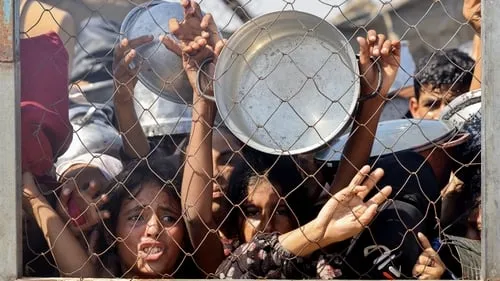
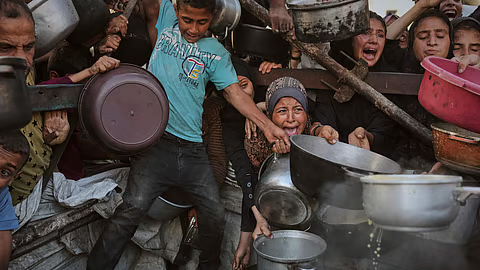
In Jerusalem, Latin Patriarch Pierbattista Pizzaballa, the top Roman Catholic authority in the Holy Land, decried the desperate humanitarian conditions he witnessed during a visit to Gaza. “We have seen men holding out in the sun for hours in the hope of a simple meal,” he said, calling the situation “morally unacceptable.”
His remarks followed an Israeli strike on the only Catholic church in Gaza last week that killed three people. Pope Leo XIV reacted strongly, condemning the war’s “barbarity” and the indiscriminate “use of force.”
The United Nations Secretary-General Antonio Guterres added his voice to the growing chorus of concern, warning that “the last lifelines keeping people alive are collapsing” across the strip. He noted a rise in cases of malnutrition among both children and adults as access to aid continues to dwindle.
Meanwhile, the Israeli military has expanded its ground presence in Deir el-Balah, a central area of Gaza that until recently had been seen as relatively safe. Residents had previously received warnings to evacuate ahead of military action. Civil defence officials confirmed that two people were killed in the area, which is now under active Israeli assault.
In a statement, the Israeli Defense Forces acknowledged they had responded with fire to “shots being fired toward them in the Deir al-Balah area,” and reiterated that they would not hesitate to act “in areas where terrorist activity threatens the security of the State of Israel.”
The UN Office for the Coordination of Humanitarian Affairs (OCHA) estimated that between 50,000 and 80,000 people are currently in Deir el-Balah, including some 30,000 living in displacement camps. Video footage from the area captured a thick column of smoke rising over the city as drones loomed overhead.
According to OCHA, nearly 88 percent of Gaza is now under either formal evacuation orders or military control by Israel, leaving Gaza’s 2.4 million residents in increasingly cramped and perilous conditions.
The war began after a deadly attack by Hamas in 2023 that killed 1,219 people in Israel, mostly civilians, according to an AFP tally based on official Israeli figures. Since then, Israel’s military campaign has been relentless, with Palestinian officials saying over 59,106 people have lost their lives — the vast majority civilians, including a growing number of children succumbing not just to bombs, but to hunger.
What you should know
Dr. Mohammed Abu Salmiya is the medical director of Al-Shifa Hospital in Gaza, the largest medical facility in the territory. Known for being on the frontlines of Gaza’s health crisis, he has consistently spoken out about the humanitarian consequences of the conflict.
His latest update about 21 children dying from starvation underscores the grave impact of the ongoing siege and assault on civilian health infrastructure in Gaza.