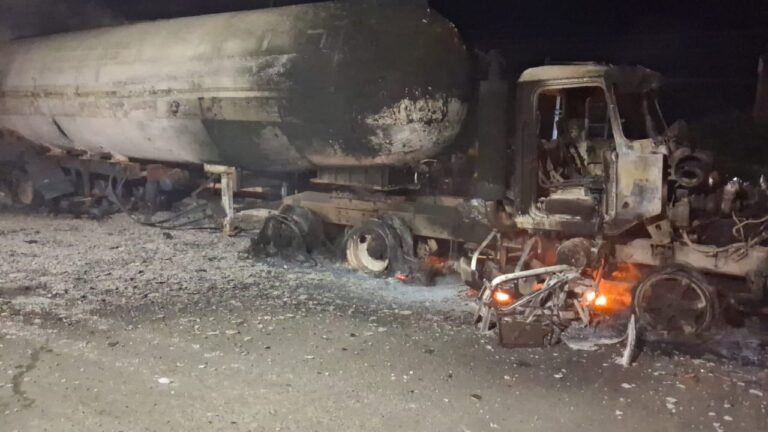
A devastating early-morning collision on Lagos’ busy Lekki-Epe Expressway has claimed two lives, left a trail of destruction, and highlighted once again the persistent dangers posed by heavy-duty vehicles on the city’s highways.
The incident unfolded in the pre-dawn darkness of Saturday, March 21, 2026, around 2:36 a.m. at the Tera Ahmed (also referred to as Tera Annex) bus stop in the Sangotedo area, a rapidly developing stretch along the Lekki corridor known for its mix of residential estates, commercial activity, and heavy traffic flow toward Epe.
According to an official statement from the Lagos State Fire and Rescue Service, a 30-tonne gas tanker—fully loaded and stationary on the highway—failed to pull over to the shoulder or a safer position. An oncoming 20-tonne tipper truck, heavily laden with sand and traveling at high speed from the Epe direction, slammed into the rear of the stationary tanker.
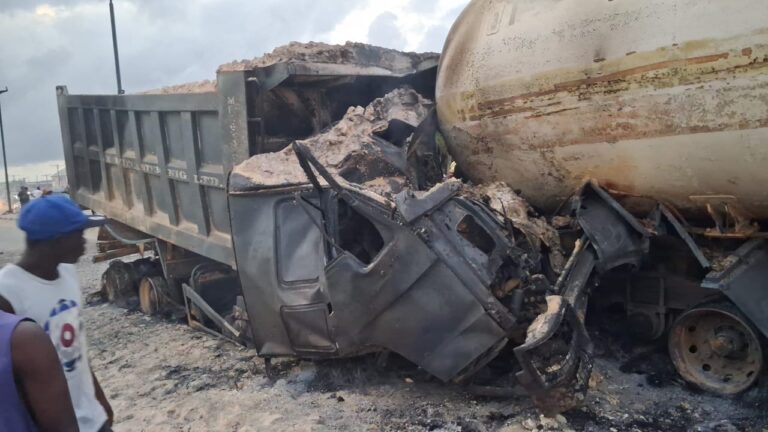
The violent impact ruptured the gas tanker’s integrity, igniting an immediate and ferocious blaze fueled by the highly flammable liquefied petroleum gas (LPG). Flames erupted explosively, spreading rapidly beyond the roadway and engulfing adjacent structures.
The fire raced through three adjoining warehouses and razed no fewer than 10 roadside shops and small businesses, including a gym and a generator repair house. Charred remains of vehicles—three Sienna buses, one Toyota Corolla, and a forklift—were later recovered from the affected properties, testifying to the intensity of the inferno.
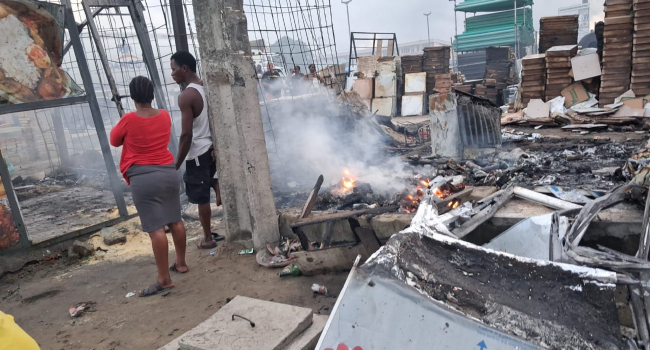
Eyewitness accounts and images from the scene show twisted metal wreckage scattered across the expressway, blackened shop fronts reduced to skeletons, and smoldering debris under the first light of day as crowds gathered in stunned disbelief.
Tragically, the tipper truck’s driver and his assistant, both adult males, perished in the flames, their bodies burnt beyond recognition. The driver of the gas tanker managed to escape unharmed, a narrow reprieve amid the chaos.
Responding swiftly, fire crews from the Lekki Phase II, Oniru, and Epe II stations of the Lagos State Fire and Rescue Service arrived promptly after the alert. Through coordinated and aggressive firefighting, they brought the blaze under control, preventing what could have been a far greater catastrophe.
Notably, the flames were stopped short of reaching a nearby Total petrol filling station and its fully loaded 33,000-liter Premium Motor Spirit (PMS) tanker—an averted disaster that could have triggered secondary explosions and multiplied the loss of life and property.
Controller General Margaret Adeseye of the Lagos State Fire and Rescue Service commended her team’s efforts in containing the incident and confirmed that normalcy has since returned to the axis, with ongoing operations to clear the wreckage of both trucks from the roadway.
This latest tragedy adds to a grim pattern of road accidents involving articulated vehicles and tankers in Lagos, where poor vehicle maintenance, reckless driving, overloading, and inadequate roadside breakdown protocols continue to claim lives and livelihoods.
Authorities have repeatedly urged stricter enforcement of traffic regulations, including mandatory pull-over procedures for breakdowns and enhanced driver training for heavy goods operators.
As recovery efforts continue and families mourn the deceased, the incident serves as a stark reminder of the urgent need for improved highway safety measures along this vital but accident-prone corridor.
Investigations into the precise cause—including possible contributing factors such as speed, mechanical failure, or fatigue—are expected to follow.
WHAT YOU SHOULD KNOW
A high-speed collision between a speeding, sand-laden tipper truck and a stationary gas tanker on the Lekki-Epe Expressway in the early hours of Saturday claimed two lives (the tipper driver and his assistant), razed 10 roadside shops and three warehouses, and destroyed several vehicles.
The stationary gas tanker failed to pull over off the highway, leaving it vulnerable in the path of fast-moving traffic—a preventable breach of basic road safety that turned a breakdown into a deadly incident.