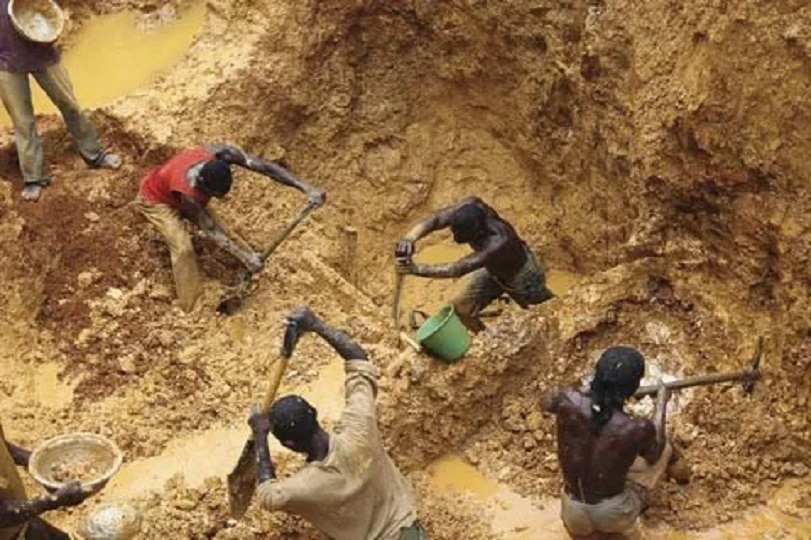
Nigeria’s mining and quarrying sector delivered a robust performance in tax remittances last year, contributing a total of ₦686.96 billion in Value Added Tax (VAT) in 2025, according to fresh data from the National Bureau of Statistics (NBS).
The figure marks a significant 23.5 percent jump from the N556.19 billion recorded in 2024, signaling improved tax compliance, better revenue mobilization efforts, and perhaps a modest uptick in formal activity within an industry long plagued by underperformance.
Seasoned observers see this as a bright spot in Nigeria’s perennial struggle to diversify its revenue base away from oil, even as the sector’s broader economic footprint remains disappointingly narrow.
The NBS data reveals a relatively stable quarterly trend throughout 2025, defying some of the macroeconomic headwinds that buffeted other parts of the economy.
- Q1 led with the strongest showing at ₦187.59 billion—likely reflecting post-year-end settlements and renewed activity after the festive period.
- Collections eased to ₦164.70 billion in Q2.
- They rebounded slightly to ₦166.77 billion in Q3.
- The year closed with ₦167.90 billion in Q4.
This consistency in the second half of the year points to resilient, if not spectacular, revenue inflows even amid inflationary pressures, foreign exchange volatility, and lingering infrastructure deficits.
For decades, Nigeria’s mining sector has been the classic tale of untapped promise. The country boasts abundant deposits of gold, lithium, tin, coltan, zinc, coal, and dozens of other solid minerals across virtually every geopolitical zone.
Yet, its contribution to Gross Domestic Product (GDP) has historically hovered well below its potential—often cited as under 5 percent in recent years, with some official updates suggesting it has climbed toward the 4-5 percent range through targeted reforms.
Illegal mining operations, popularly known as “artisanal” but frequently operating on an industrial scale with little oversight, have siphoned off billions in potential government revenue while causing environmental degradation and community conflicts.
Weak regulatory incentives, dilapidated roads and power infrastructure in mining corridors, and persistent policy inconsistencies have deterred the large-scale, responsible investments needed to professionalize the industry.
The result: a sector that punches far below its weight in job creation, export earnings, and overall economic transformation, despite employing hundreds of thousands, many in precarious, unregulated conditions.
The notable VAT improvement in 2025 appears to be linked, at least in part, to broader fiscal reforms implemented by the administration of President Bola Ahmed Tinubu. In June 2025, the president signed four landmark tax reform bills into law: the Nigeria Tax Bill, the Nigeria Tax Administration Bill, the Nigeria Revenue Service (Establishment) Bill, and the Joint Revenue Board (Establishment) Bill.
These laws aim to simplify Nigeria’s notoriously complex and multiplicity of taxes, reduce leakages, and create a more transparent, technology-driven revenue architecture.
A pivotal element for the mining sector was the decision to transfer the collection of mineral royalties from the Ministry of Solid Minerals Development to the newly empowered Nigeria Revenue Service (NRS)— a shift that took full effect from January 1, 2026, but whose groundwork clearly influenced compliance in 2025.
Early signs of tightening compliance were already visible. In the first quarter of 2025 alone, the federal government raked in N6.96 billion in various mining fees through the Mining Cadastral Office while registering 118 new private mineral buying centers—concrete evidence that more operators were formalizing their activities.
Analysts suggest these measures are beginning to curb some of the revenue leakages that have long characterized the sector, though the full benefits of the royalty handover are expected to materialize in 2026 and beyond.
While the ₦686.96 billion VAT haul is welcome news, it must be placed in context. Mining and quarrying still lag far behind manufacturing (which contributed over ₦1.17 trillion in VAT in the same period) and other more organized sectors.
Structural bottlenecks — from insecurity in mineral-rich areas to the absence of world-class processing facilities that would allow Nigeria to export finished or semi-processed minerals rather than raw ore — continue to cap the industry’s true potential.
Government officials have repeatedly expressed ambition to raise the sector’s GDP contribution significantly in the coming years through improved governance, infrastructure development, and attraction of responsible foreign direct investment.
Whether the tax reforms, coupled with ongoing efforts to sanitize licensing and combat illegal operations, can translate into sustained, transformative growth remains the central question.
For now, the 2025 VAT numbers offer a modest but encouraging data point: Nigeria’s mining sector is showing signs of life on the revenue front. Turning that fiscal pulse into broader economic vitality will require far more than improved tax collection — it will demand the political will to tackle the deep-rooted governance and infrastructure deficits that have held the industry back for generations.
WHAT YOU SHOULD KNOW
Nigeria’s mining and quarrying sector recorded a strong performance in 2025, remitting ₦686.96 billion in VAT—a 23.5% increase from ₦556.19 billion in 2024.
Recent tax reforms signed by President Tinubu in June 2025, particularly the transfer of mineral royalty collection to the Nigeria Revenue Service, are beginning to drive improved compliance and revenue mobilization in a historically underperforming sector.
While structural challenges persist, this upward trend signals modest progress toward realizing the sector’s fiscal potential.