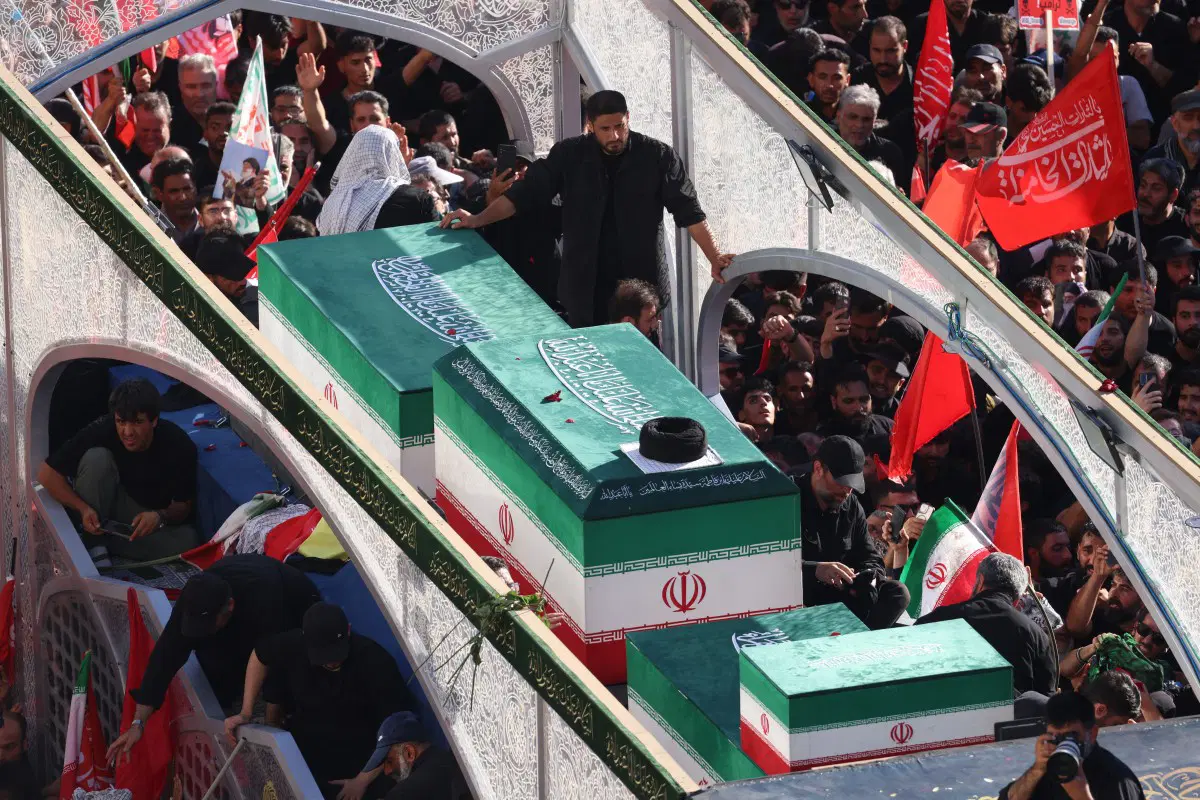
More than four months after an airstrike killed him, Iran laid its former supreme leader, Ali Khamenei, to rest on Thursday in the golden-domed shrine of Imam Reza, closing out a six-day funeral marathon even as fresh military exchanges with Washington threatened to unravel a ceasefire that has already frayed badly.
Khamenei was killed on February 28, at the outset of the war between Iran, the United States, and Israel, in a strike on his compound in central Tehran that also killed several members of his immediate family.
The coffins of the four family members killed alongside him in the strike that began the war were carried through the streets alongside his own in the funeral processions.
The burial followed a week of public mourning and processions that drew crowds totaling more than 15 million people by state estimates, with some Iranian figures putting the true number at more than double that.
The route had taken the coffin through cities in both Iran and Iraq, including farewell ceremonies in Tehran on July 3 through 5, processions in Tehran and Qom on July 6 and 7, and a crossing into Iraq on July 8 for rites in Najaf and Karbala before the body returned to Iran for the final burial in Mashhad. Iraqi authorities recorded roughly seven million mourners during the Karbala leg alone, according to Al Mayadeen.
The mood among mourners was one of open fury directed at Washington. Black-clad crowds pressed close behind the cortege, waving Iranian flags and photographs of Khamenei, chanting vows of vengeance against President Trump for his role in the killing, some shouting “I swear by the blood of the supreme leader, Trump, we will kill you,” while women held placards reading “Kill Trump.”
Questions continued to swirl around the whereabouts of Khamenei’s son and appointed successor, Mojtaba Khamenei. Mojtaba was named supreme leader by the Assembly of Experts on March 8, but foreign outlets have repeatedly noted his absence from public memorial events, with some reports citing possible health complications.
Since his appointment, he has communicated only through written statements, and is believed to have been wounded in the February strike that killed his father.
The burial itself came against a backdrop of renewed violence that undercut months of fragile diplomacy. The US and Iran had signed a preliminary truce on June 17 meant to halt the fighting while negotiators worked toward a lasting deal, but the ceasefire only partially held, with both sides trading strikes on several occasions since.
After Iran struck three tankers in the Strait of Hormuz, US forces hit targets inside Iran on two consecutive nights, prompting Trump to declare at a NATO summit in Ankara that the ceasefire was effectively over.
Hours before the burial, explosions were again reported near sensitive Iranian sites. Multiple blasts were heard around Bushehr, home to one of Iran’s nuclear plants and the nearby city of Choghadak, with three further explosions reported in the southern city of Konarak, according to Mehr News Agency.
US Central Command, however, denied carrying out any strikes inside Iran in the preceding hours, a familiar pattern of contested and murky claims from a conflict now well into its fifth month.
Adding another layer of alarm, security officials have flagged intelligence suggesting a live threat against the American president. Israeli intelligence reportedly told Washington that a new Iranian plot to kill Trump had been detected, according to a Wall Street Journal report citing anonymous sources, a claim consistent with the vengeance-focused rhetoric heard throughout the funeral processions.
The organizers’ apparent caution around crowd control was itself telling: Iranian authorities were mindful of the deadly 2020 crush at Qasem Soleimani’s funeral, and the extraordinary size of the crowds turning out for Khamenei, particularly in Karbala, reportedly forced delays in moving his body between stages of the procession.
With the ceasefire now effectively declared dead by Washington and both sides continuing to trade fire across the Gulf, the burial of Khamenei closes one chapter of the war’s chaos even as the shape of what comes next under a successor who has yet to be seen in public remains deeply uncertain.
WHAT YOU SHOULD KNOW
Iran has finally buried Ali Khamenei more than four months after his death, but the funeral did not bring closure. It landed in the middle of active fighting: the June 17 ceasefire has collapsed, US and Iranian forces are trading strikes again, and Trump himself has declared the truce over.
Iran’s supreme leader transition remains dangerously unresolved; his successor, Mojtaba Khamenei, still hasn’t appeared in public while the war that killed Khamenei is reigniting rather than winding down. The burial was less an ending than a pause in an ongoing conflict.