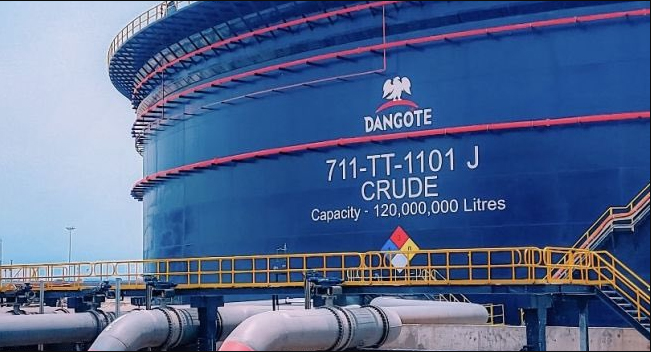
Nigeria’s Dangote Petroleum Refinery, has significantly ramped up exports of refined petroleum products and urea fertiliser to African countries reeling from supply disruptions caused by the Iran war.
The development marks a decisive moment for a facility that, just months ago, was still finding its footing in a turbulent domestic market.
Speaking on Monday during a rare high-level tour of the sprawling complex, Aliko Dangote, President of Dangote Industries, confirmed that the refinery is now operating at its full capacity of 650,000 barrels per day, positioning it as a critical stabiliser for both Nigeria and energy-deficit African economies.
“What I can do is assure Nigerians — and most of West Africa, Central Africa, and East Africa — we have the capacity to supply them,” Dangote declared, his words carrying the weight of a continent listening closely.
The refinery has already shipped around 17 cargoes of gasoline to other African countries, while exports of urea fertiliser are climbing fast as nations scramble to secure alternative supplies. Dangote noted a clear shift: more shipments are now heading to African markets — something the company was not prioritising before.
The fertiliser redirection is particularly striking. The plant can produce up to 3 million metric tonnes of urea annually, the bulk of which has traditionally been exported to the United States and South America. That calculus is now changing, rapidly and by necessity.
“In the last couple of days, we’ve been looking to mostly African countries, which we were not doing before,” Dangote said of the fertiliser shipments, without disclosing specific volume figures.
The trigger for this continental scramble lies thousands of kilometres away, in the increasingly volatile waters of the Persian Gulf. The Strait of Hormuz, which carries oil and petroleum products from Iraq, Saudi Arabia, Qatar, Kuwait, and the United Arab Emirates, remains largely closed due to Iranian attacks on shipping after the war began on February 28.
Oil prices extended gains on Tuesday as a U.S.-imposed deadline for Iran to open the Strait of Hormuz approached, with President Donald Trump threatening attacks on Iranian bridges and power plants if Tehran failed to comply with his deadline to reopen the waterway.
The market response has been swift and brutal. Brent crude futures rose to $111.51 a barrel, while U.S. West Texas Intermediate crude futures climbed to $115.86, reflecting deep anxiety about sustained supply losses. At their peak, crude prices had surged as high as $120 per barrel before partially easing.
The Middle East supply disruptions have led refiners to seek alternative sources for crude, particularly for physical cargoes in the U.S. and Britain’s North Sea, with spot premiums for West Texas Intermediate crude jumping to all-time highs on competition between Asian and European refiners.
African nations that have long been reliant on giant refineries in the Persian Gulf for fuel are in a bind as the Iran war chokes off supplies. The continent’s historically weak domestic refining capacity, long a structural weakness, has been ruthlessly exposed.
The pain is tangible and spreading. South African farmers are facing surging diesel costs ahead of the critical harvest season. In Nigeria, food prices have spiked in Lagos alongside a sharp increase in petrol prices recorded in March 2026.
Yet despite the refinery’s maximum output, fuel prices in oil-producing Nigeria have reached record-high levels, as Dangote’s maximum production has not fully offset the impact of elevated global crude costs. The billionaire industrialist acknowledged this paradox, pointing to structural bottlenecks in how crude is priced and traded.
Dangote said the refinery hoped to secure more crude cargoes priced in local currency to help curb fuel costs — a move that analysts say could fundamentally reshape Nigeria’s domestic energy pricing if realised.
Behind the scenes, Nigeria’s state machinery appears to be aligning with the refinery’s expanded mission. Two trade sources and a refinery official told Reuters that the Nigerian National Petroleum Company was allocating seven May crude cargoes to the Dangote refinery, up from five in previous months — a sign that the federal government recognises the strategic imperative of sustaining and expanding the facility’s output at this moment.
Energy economists say this moment could mark the beginning of a continental rebalancing. Africa has long imported the vast majority of its refined petroleum needs, leaving its economies exposed to external shocks and supply disruptions. Domestic refining capacity has historically lagged demand, making the Dangote refinery’s emergence both timely and strategically significant.
Less visible — but arguably more critical — is the surge in fertiliser exports. The shift is not just industrial; it carries profound implications for food systems across the continent. Fertiliser shortages typically translate into reduced crop yields, rising food prices, increased dependence on imports, and, in extreme cases, social instability.
Dangote himself positioned the refinery as a strategic asset for Africa’s long-term economic independence. “If we Africans don’t lead in the industrialisation of Africa, Africa will never industrialise,” he said, underscoring the urgency of homegrown investment in critical infrastructure.
His ambitions, it seems, are not confined to the present crisis. Dangote signalled plans to expand refining capacity and eventually list part of the business on the capital market, while also pointing to a $2.5 billion joint venture with Ethiopia to build a fertiliser plant of similar scale.
The broader geopolitical picture remains dangerously fluid. Iran rejected a 45-day ceasefire proposal, saying it wanted a permanent end to the war with guarantees against future attacks.
Tehran conveyed its response through Pakistan, a key mediator, even as a regional official involved in negotiations insisted that talks had not collapsed.
For now, the Strait of Hormuz remains a flashpoint, and the world watches. But on the sun-baked shores of Ibeju-Lekki, one man’s refinery has become something few predicted when its first drop of oil flowed: a continental anchor in a storm that shows no sign of abating.
“Nigeria would have been at a standstill now without the refinery,” Dangote said — a statement that, with each passing week of war and rising prices, rings more and more like prophecy.
WHAT YOU SHOULD KNOW
The Iran war has exposed just how vulnerable Africa remains to global energy shocks — but it has also revealed something equally important: the continent now has a credible buffer in its own backyard.
The Dangote Refinery, operating at full capacity and pivoting its exports toward African markets, is providing a lifeline at a moment of acute crisis. From petrol to fertiliser, it is filling gaps that distant suppliers can no longer reliably cover.
Africa’s energy security can no longer be an afterthought. For decades, the continent has outsourced its refining needs to the Middle East and beyond. One war, one blocked strait, and the entire system wobbles.
Dangote’s refinery is not just a business triumph — right now, it is a strategic necessity, and a compelling argument for why Africa must urgently invest in its own industrial capacity before the next crisis arrives.