
The Central Bank of Nigeria (CBN) has moved swiftly to douse a wave of public confusion over the legal status of the standard ₦100 banknote, issuing a firm statement on Wednesday to reassure Nigerians that the note remains fully valid for all transactions nationwide.
The clarification followed reports that some individuals and businesses had refused to accept the standard ₦100 note over uncertainty surrounding its legal tender status after the introduction of the commemorative ₦100 banknote.
According to the apex bank, the confusion had created unnecessary anxiety among members of the public, prompting it to reaffirm the legal status of all duly issued ₦100 banknotes currently in circulation.
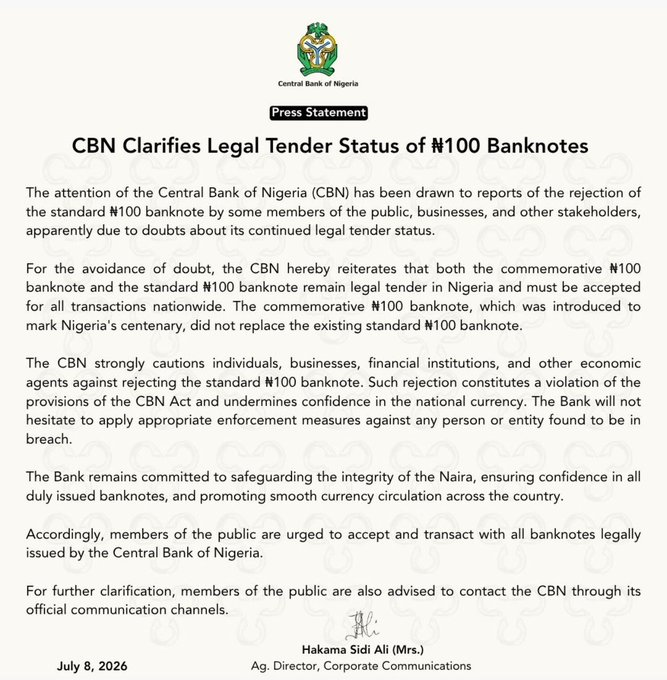
In a statement issued on July 8, 2026, and signed by the Acting Director of Corporate Communications, Hakama Sidi-Ali, the bank left no room for ambiguity. “For the avoidance of doubt, the CBN hereby reiterates that both the commemorative ₦100 banknote and the standard ₦100 banknote remain legal tender in Nigeria and must be accepted for all transactions nationwide,” the statement read.
At the heart of the public’s doubt appears to be the coexistence of two different ₦100 notes. The commemorative ₦100 banknote was introduced by the Central Bank of Nigeria in 2014 to mark Nigeria’s centenary, celebrating 100 years since the country’s amalgamation in 1914.
It was issued alongside, not as a replacement for, the existing standard ₦100 banknote, and both remain legal tender across the country.
Despite this, many traders and members of the public appear to have mistakenly concluded that one version had superseded the other, with the standard note bearing the brunt of the rejection.
The CBN’s tone was notably firm, framing the rejection not merely as a misunderstanding but as a legal infraction. “The CBN strongly cautions individuals, businesses, financial institutions, and other economic agents against rejecting the standard ₦100 banknote,” the statement said, adding that “such rejection constitutes a violation of the provisions of the CBN Act and undermines confidence in the national currency.”
The bank did not stop at a warning. It stated plainly that it “will not hesitate to apply appropriate enforcement measures against any person or entity found to be in breach.”
The CBN has previously reiterated that a Supreme Court ruling from November 2023 permits the concurrent circulation of all versions of the ₦1,000, ₦500, and ₦200 denominations indefinitely and has urged Nigerians to disregard claims that older note designs would cease to be legal tender. Wednesday’s statement on the ₦100 note echoes that same effort to stamp out currency-related misinformation before it disrupts everyday commerce.
The CBN has encouraged the public to report cases where businesses or individuals refuse to accept the standard ₦100 banknote and advised members of the public seeking further clarification to contact it through its official communication channels.
The bank says it remains committed to safeguarding the integrity of the naira, ensuring confidence in all duly issued banknotes, and promoting smooth currency circulation across the country.
For now, the message from Abuja is unambiguous: both the standard and commemorative ₦100 notes are legal tender, and refusing either carries real legal risk.
WHAT YOU SHOULD KNOW
Both the standard and commemorative ₦100 notes are legal tender in Nigeria; one did not replace the other. Refusing to accept either is a violation of the CBN Act, and the CBN has warned it will enforce sanctions against anyone who does.