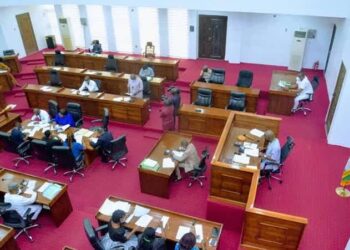
The Nigerian Senate has escalated pressure on the Tinubu administration to abandon its rehabilitation and reintegration policy for former Boko Haram fighters in a sweeping resolution adopted on Tuesday amid growing anger over a string of deadly attacks on both serving and retired military personnel.
The resolution grew out of a motion of urgent national importance sponsored by the chairman of the Senate Committee on Army, Senator Abdulaziz Yar’Adua, during plenary.
The motion centered on escalating attacks, abductions, and killings of serving and retired military personnel, particularly the recent killing of former Director of Defense Information, Maj. Gen. Abubakar Rabe, by bandits.
Yar’Adua told colleagues that retired officers remain attractive targets for terrorists and kidnappers because of their previous operational, intelligence, and command responsibilities, warning that persistent attacks on security personnel undermine troop morale and embolden criminal groups challenging the authority of the state.
The push to halt the rehabilitation policy came via an additional prayer from Senator Joseph Ikpea (APC, Edo Central), who argued the program had become a source of growing public concern, telling the chamber: “Mr. President, my additional prayer is that the issue of insecurity has become something Nigerians are deeply concerned about… My additional prayer is to stop the rehabilitation of Boko Haram.”
The proposal drew immediate and vocal backing. It was seconded by Senator Adams Oshiomhole, who said the policy of rehabilitating and reintegrating former insurgents defies logic at a time when victims of terrorism and families of fallen security personnel are still grappling with the consequences of insurgent attacks, adding pointedly, “It does not make even common sense to grant pardon, rehabilitate, and reintegrate criminals into society.”
Separately, a related motion sponsored by Senator Ali Ndume argued that former insurgents should face prosecution rather than reintegration, noting that many communities affected by the insurgency remain traumatized and continue to oppose the policy.
The Senate unanimously resolved to urge the Federal Government to suspend the rehabilitation and reintegration program for terrorists, intensify efforts to arrest and prosecute perpetrators of violent crimes, strengthen the nation’s security architecture through more effective oversight of security agencies, and engage directly with the Presidency on urgent measures to address the country’s deteriorating security situation.
Senators also resolved that a delegation led by Senate President Godswill Akpabio should meet with President Bola Tinubu to discuss the worsening security crisis.
Lawmakers further directed the Senate’s committees on defense, national security, and intelligence to intensify oversight of security agencies and hold the nation’s security chiefs accountable for addressing the worsening situation.
The chamber also paused for reflection: it resolved that Senate leadership would immediately constitute a delegation to visit the family of the late general, the Katsina State government, and the Nigerian Army to convey its condolences.
Opening the session, Senate President Godswill Akpabio remarked that insecurity remained one of Nigeria’s greatest challenges despite the National Assembly’s recess, saying that while democracy advanced, the country’s challenges did not go into recess; insecurity, he said, continues to cast long shadows, leaving many families “prisoners of fear.”
He also referenced ongoing abductions elsewhere in the country, telling colleagues: “For as long as one Nigerian remains in captivity, all Nigerians share in that captivity.”
The rehabilitation and reintegration program being targeted was initiated under Operation Safe Corridor (OSSC), the federal government’s response to insurgent activity in the northeast, run jointly by state governments, local leaders, and the armed forces to offer a pathway back to civilian life for former fighters, particularly those who voluntarily defect.
The program has faced mounting public criticism in recent months. In June, news that 720 “repentant” terrorists who had completed Borno State’s deradicalization and reintegration program would be resettled into communities drew sharp public criticism, partly because reintegration is seen by many residents as undermining justice for victims and because history has shown that pardoned fighters can return to crime.
Cost has also become a flashpoint: Borno State reportedly spent N2.6 billion on Boko Haram members’ rehabilitation over nine months, more than the state spent on primary healthcare, its Ministry of Environment, and its Ministry of Justice combined, with the rehabilitation scheme ranking as the seventh most expensive capital project in Borno’s 2025 budget.
The timing lends the Senate’s resolution added weight. The latest surrender of two senior terrorist commanders in Yobe has placed fresh scrutiny on how the federal government intends to handle them, coming just as the Senate has called for an end to rehabilitation and reintegration and demanded that captured terrorists be prosecuted rather than resettled.
Military authorities have consistently maintained that surrendered fighters in leadership positions carry significant intelligence value and are processed through debriefing before any decision on their disposition is taken, and the Army has not indicated whether the pair will eventually face prosecution or pass through the rehabilitation pipeline, saying only that debriefing is ongoing.
That gap between a legislature demanding prosecution and a military establishment still weighing the intelligence value of high-level defectors is likely to shape how, or whether, the Senate’s resolution translates into actual policy change from the Tinubu administration.
WHAT YOU SHOULD KNOW
The Nigerian Senate has unanimously called for the suspension of the Boko Haram rehabilitation and reintegration program, driven by rising attacks on military personnel, including the killing of Maj.-Gen. Abubakar Rabe and mounting public anger over resettling former insurgents while victims and security families still bear the scars of terrorism.
Lawmakers want prosecution to replace pardon, arguing that reintegrating ex-fighters undermines justice and public trust. But this creates a real tension with the military, which still values captured commanders for their intelligence, meaning the Senate’s demand, however forceful, may not immediately change government policy.