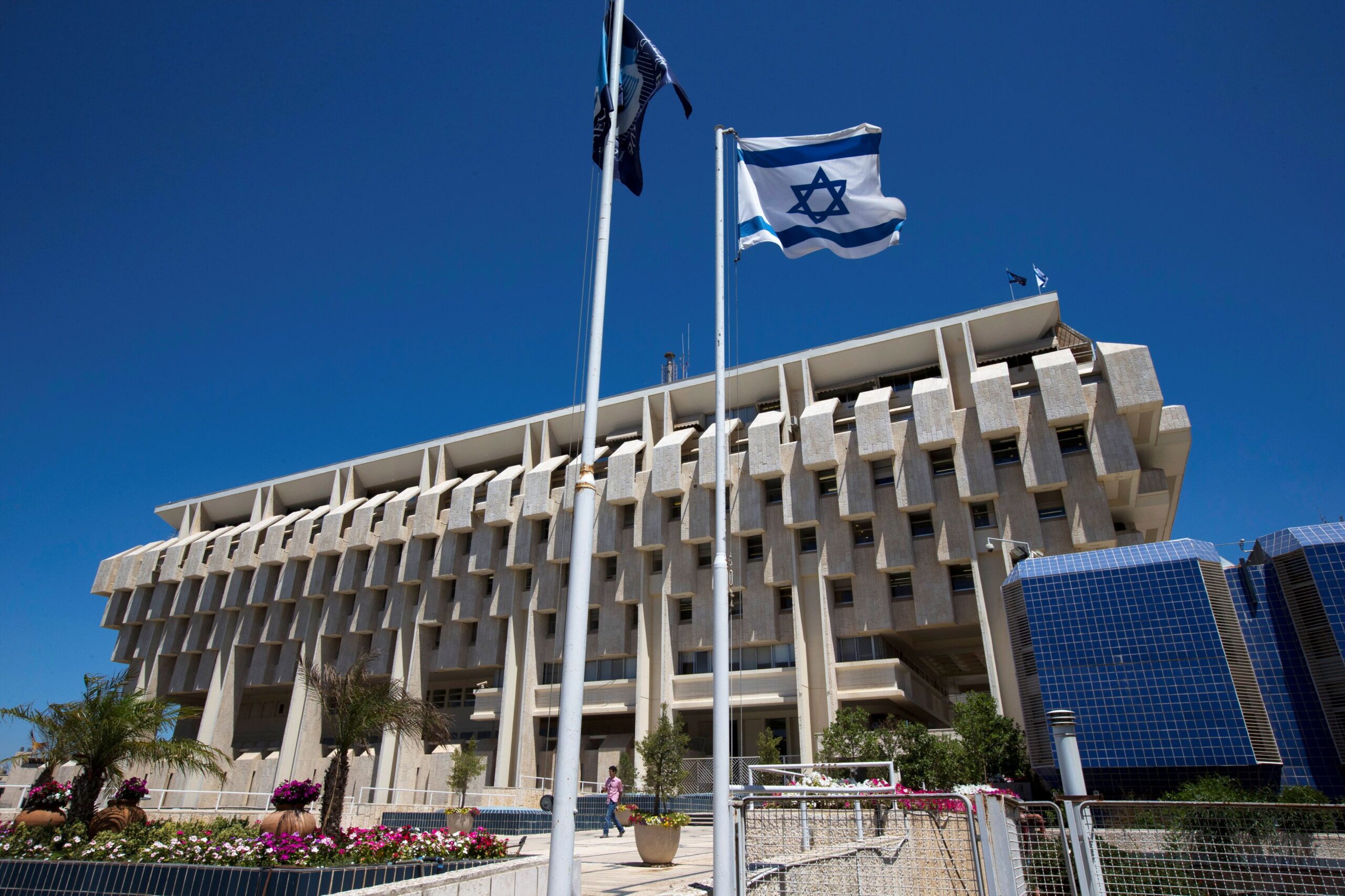
The Bank of Israel has delivered a sobering verdict on the cost of two years of unrelenting conflict: the bank said that Israel has lost roughly $57 billion, which is 177 billion shekels, equivalent to 8.6 percent of annual GDP.
The stark assessment appears in the central bank’s 2025 annual report, released on Monday, which chronicles the economic toll from the outbreak of war in October 2023 through the end of 2025.
The figure covers Israel’s prolonged ground and air campaign in Gaza triggered by Hamas’s deadly October 7 attack, as well as parallel military operations against Hezbollah in Lebanon. It does not, however, include the still-unfolding costs of the four-week-old confrontation with Iran that has drawn the United States into the fray.
In blunt language rarely heard from a central bank, Governor Amir Yaron warned that the fighting has fundamentally rewritten Israel’s fiscal future. “Before the current conflict, we assumed a 5.2 percent growth rate and a 3.9 percent deficit target this year,” Yaron said.
Those projections, he noted, were designed to keep the country’s debt burden stable. Instead, a higher deficit target and an almost certain downward revision to growth forecasts will now push the debt-to-GDP ratio higher—a shift that could haunt Israeli taxpayers and investors for years.
The report paints a picture of an economy that has absorbed blow after blow. Even the brief but intense 12-day exchange of fire with Iran in June sliced an additional 0.3 percent off GDP on its own. Meanwhile, the cabinet has already moved to plug the widening gap, approving a revised 2026 state budget that injects an extra $13 billion in emergency spending.
The damage is not confined to battlefield accounting. Researchers at the Bank of Israel documented a noticeable shift in trade patterns that they cautiously link to politics. Exports to eight European Union countries, viewed as more critical of Israel’s conduct in the war, dropped by $1 billion in 2024 and another $1.5 billion in 2025.
At the same time, sales to other trading partners rose. “This pattern may indicate that political positions are influencing export volumes to these countries,” the report stated—the closest the central bank has come to acknowledging a potential boycott effect.
The numbers underscore a broader truth: modern warfare exacts a price that extends far beyond munitions and troop deployments. Tourism, once a pillar of the Israeli economy, collapsed in the war’s early months.
High-tech investment, the engine of Israel’s “Start-Up Nation” miracle, slowed as global investors grew skittish. Reservists called up for extended duty left behind unfilled desks in offices and factories. And while the defense industry itself has seen a temporary boom, the overall drag on civilian growth has been unmistakable.
For ordinary Israelis, the abstract billions translate into higher taxes, slower wage growth, and a creeping sense that the country’s economic resilience—long taken for granted—is being tested like never before.
With the conflict against Iran still active and no clear end in sight to the fighting in Gaza, economists inside and outside the central bank are watching closely to see whether the fiscal guardrails that kept Israel’s credit rating strong for decades can hold.
The Bank of Israel’s report is more than a ledger of past losses. It is a cautionary forecast: unless growth rebounds quickly and the government reins in spending once the shooting stops, the war’s shadow could stretch across Israel’s balance sheet for the rest of the decade.
WHAT YOU SHOULD KNOW
Israel’s economy has suffered a staggering $57 billion loss—8.6% of its annual GDP—over two years of war in Gaza and Lebanon, according to the Bank of Israel’s 2025 annual report.
The conflict has fundamentally worsened the country’s fiscal outlook, driving higher deficits, slower growth, and a rising debt-to-GDP ratio, even before factoring in the ongoing war with Iran.
Political backlash has also begun hitting exports, with $2.5 billion lost to critical EU countries in 2024–2025. This is no longer just a military or humanitarian story—it is now a deep and lasting economic crisis that will burden Israelis for years to come.