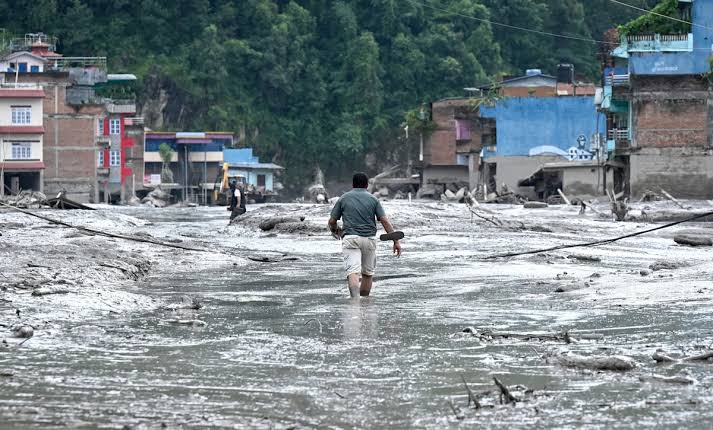
For a sixth straight day, exhausted rescue crews clawed through waterlogged debris and thick, ash-grey mud along the Nepal-China border on Monday, as the scale of last week’s glacial flood disaster came into fuller, grimmer focus.
Officials on both sides of the frontier now put the number of missing at nearly 4,800, a figure that has climbed sharply in recent days rather than fallen, confounding hopes that the crisis had already peaked.
The confirmed death toll has surged past 900, with Nepal’s disaster authorities reporting the vast majority of fatalities and Chinese officials in the Tibet Autonomous Region confirming a smaller but rising count on their side of the border.
Nepali police say more than 4,200 people remain unaccounted for domestically alone, a jump of roughly 1,700 in a single day, driven largely by a wave of new reports from families and employers only now able to reach affected districts.
The disaster began the previous Wednesday, when a section of glacier broke away high in the Himalayas and plunged into a river system near the Nepal-China border, unleashing a wall of water, ice, and rock that Nepali officials have described as unimaginable in scale.
The flood tore through the Trishuli and Bhotekoshi river valleys, flattening villages, sweeping away bridges, including a key crossing linking the two countries, and burying hydropower installations under tons of silt.
Search efforts have now shifted toward what authorities are calling their “highest priority”: the hydropower tunnels where more than 900 workers remain missing, potentially trapped in flooded and mud-choked passageways.
Military helicopters and international rescue teams have been working the site around the clock, though officials caution that conditions inside the tunnels make recovery slow and dangerous.
The mounting toll of unidentified dead has created a logistical crisis of its own. With mortuary capacity overwhelmed and refrigeration units running low, authorities have begun burying unidentified remains in mass graves, first collecting DNA samples in hopes of eventually matching them to missing-persons reports.
Among the missing are hundreds of foreign nationals, including pilgrims traveling to Mount Kailash in Tibet, hydropower workers from South Korea and other countries, and dozens of Americans complicating identification efforts further.
Chinese authorities have flagged several additional high-risk sites near the disaster zone for continued monitoring, warning that unstable debris and a barrier lake formed by the initial landslide could still trigger secondary flooding.
The United States has pledged several million dollars in emergency assistance, including food aid for tens of thousands of affected households, as the death toll continues its steady, punishing climb nearly a week after the flood first struck.
WHAT YOU SHOULD KNOW
Nearly a week after a Himalayan glacier collapse sent a wall of water and mud crashing across the Nepal-China border, the crisis is still getting worse, not better.
The missing toll has climbed to almost 4,800 even as confirmed deaths pass 900, with hundreds of workers feared trapped in flooded hydropower tunnels and unidentified bodies now being buried in mass graves after DNA sampling. This is an active, escalating disaster, not one already contained.