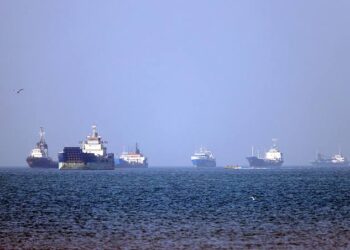
Oil prices pushed higher for a second straight session on Friday, as traders digested fresh signs that Tehran intends to keep the Strait of Hormuz on a tight leash rather than restore the free-flowing traffic the market had been quietly betting on just days earlier.
By mid-morning in London, Brent crude had added roughly 80 cents, or about 1%, to trade near $83.30 a barrel, while U.S. benchmark West Texas Intermediate was up around 0.7% at just under $78.
The move builds on Thursday’s sharp rally, when both contracts jumped more than $3 a barrel. Brent gained over 3.8% to settle above $82, and WTI rose more than 3% to finish near $77.71 after Iranian state media disclosed the contents of a draft plan governing shipping through the chokepoint.
The catalyst was a report from Tehran’s semi-official Fars news agency describing legislation now before a parliamentary committee.
According to that account, the draft would ban U.S. and Israeli vessels outright, while ships from any other nation Iran deems to have caused it harm would be barred until compensation is paid, with violators facing penalties equal to a fifth of the value of the cargo aboard.
Iranian officials say the arrangement is being worked out jointly with Oman, which sits across the waterway, but the fine print has done more to unsettle the market than reassure it.
Money is the sticking point. Iran is pushing for transit fees equivalent to 5-7% of a cargo’s value, Oman is proposing something closer to 3%, and Washington is holding out for no fee at all, a gap analysts say leaves the three sides far from a workable compromise.
Compounding that, industry sources have flagged that U.S. sanctions and the restrictive insurance clauses attached to tanker cargoes make any fee-based scheme difficult to actually implement, whatever the headline percentage ends up being.
That combination is why traders are treating this week’s news less as progress toward a deal and more as a warning about what any eventual deal will look like.
As one Rystad Energy analyst framed it, the market isn’t pricing in a bad agreement; it’s pricing in the likelihood that whatever does emerge will be a tightly managed, conditional corridor rather than a genuine return to pre-war shipping norms.
A separate voice in the market, from Vanda Insights, described the week’s swings as a sentiment rollercoaster, with participants still unclear on what precisely would need to happen for any agreement to be finalized.
The volatility follows a rough stretch for oil bulls. Prices had slid earlier in the week on optimism that a resolution was close, with Brent briefly dropping below $80 on Thursday, its first dip under that level since mid-July.
Even with Friday’s gains, both benchmarks remain on track for a weekly decline of roughly 8%, a reminder of just how sensitive this market has become to every twist in the diplomacy.
Adding to the tension, Yemen’s Houthi movement said Thursday it had launched missile and drone strikes on Saudi-aligned forces in Yemen’s Marib and Hadramout provinces, a fresh sign, analysts noted, that instability in the broader region hasn’t cooled even as attention centers on Hormuz.
For his part, President Trump told reporters Thursday he expects the conflict to wind down soon, though he offered no timeline, and traders showed little sign of taking the comment as a reason to look past the risks still on the table.
The roughly one-fifth of global oil and LNG flows that normally pass through the strait remain the reason every fragment of news out of Tehran, Muscat and Washington continues to move markets, and for now, seasoned observers say, that fragility looks set to persist until something more concrete than a draft bill lands on the table.
WHAT YOU SHOULD KNOW
Oil’s rally isn’t about optimism; it’s about uncertainty. Iran’s draft plan signals that any resolution on Hormuz will likely be a restricted, fee-based corridor rather than a return to normal shipping, and with Iran, Oman, and Washington still far apart on transit fees (and sanctions making even that framework hard to enforce), the market is bracing for prolonged instability rather than a swift fix. Until the terms of an actual deal are clear, expect continued volatility in crude prices.