A rare and public rift has opened up between the world’s two most powerful football institutions after UEFA flatly rejected proposals by FIFA to bring in outside investors on a new commercial entity built around the World Cup and FIFA’s other flagship competitions.
FIFA unveiled the plan on Tuesday, announcing its intention to create FIFA Forward Enterprise (FFE), a wholly-owned subsidiary that would consolidate the governing body’s commercial rights, broadcasting, sponsorship, ticketing, and licensing together with the operational running of its tournaments.
According to FIFA’s own figures, the new venture could raise $4.2 billion from external investors through the sale of minority, non-controlling stakes on a valuation of around $20 billion.
FIFA has been at pains to stress that the sport’s governance itself is not up for sale. The organization says it would retain sole control of the subsidiary and exclusive authority over football governance, competitions, the international match calendar, and all regulatory and sporting decisions.
Outside backers, FIFA insists, would have no operational say; they would simply be investing in a FIFA subsidiary rather than in FIFA itself.
The money, FIFA argues, is intended to flow back into the grassroots of the game. Under the proposal, regular FIFA Forward development funding for member associations would rise sharply from the currently budgeted $8 million per association to $20 million for the 2027–30 cycle, then $22 million and $24 million in the two cycles after that.
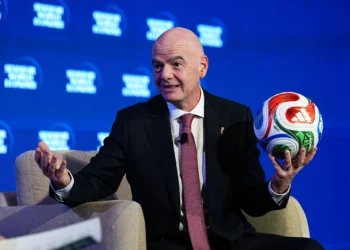
FIFA president Gianni Infantino framed the initiative as a matter of fairness across the sport’s 211 member federations, describing it as an effort toward the democratization of football worldwide.
But UEFA, which represents 55 national associations and runs Europe’s leading club competitions, was having none of it. In a strongly worded statement, European football’s governing body said the plan amounted to overreach into territory that should remain untouchable, warning that “this crosses a line that football’s governing institutions should never cross.”
UEFA went further, insisting that the sport’s identity is not a commodity: “The soul and governance of football are not assets to trade, especially with zero transparency as to who gains financially. None of us are the owners of football. It is not FIFA’s to sell.”
UEFA also called on the rest of the football family leagues, clubs, players, supporters, and governments to treat the matter with equal urgency and reportedly summoned European associations to meet this week to coordinate a joint response, with some reports suggesting a boycott is being discussed.
The identity of FIFA’s prospective investors has added an extra layer of scrutiny to the proposal.
Sources say Thrive Eternal, a permanent-capital investment vehicle launched earlier this year by venture capitalist Joshua Kushner, is expected to lead the group of backers, with former Disney chief executive Bob Iger acting as an adviser and former Liberty Media boss Greg Maffei involved in structuring the deal.
FIFA is reportedly working with JPMorgan on the transaction. Notably, several outlets have pointed out that Joshua Kushner’s brother, Jared Kushner, is married to Ivanka Trump, a family connection that has fueled further debate, even as sources maintain Jared Kushner himself is not a potential investor.
For now, the proposal remains just that: a proposal. FIFA has said the plan will be put before its 211 member associations and requires the backing of the 37-member FIFA Council before it can proceed.
Whether Infantino can win over a bloc as influential as UEFA, though, may determine whether football’s first experiment in selling a piece of itself to private capital ever gets off the ground.
WHAT YOU SHOULD KNOW
At its core, this dispute is about whether football’s governing bodies should invite private capital into the business side of the sport.
FIFA says the money up to $4.2 billion would flow straight into development funding for its member associations, tripling their support in some cases.
UEFA sees it differently: it views any sale of stakes tied to the World Cup as crossing a line into commercializing the sport’s governance and identity itself, regardless of the safeguards FIFA has promised.
The real story to watch isn’t the money; it’s whether FIFA can get its own member associations, and UEFA in particular, to agree that private investors can hold a stake in football’s commercial machinery without ever touching how the game itself is run.