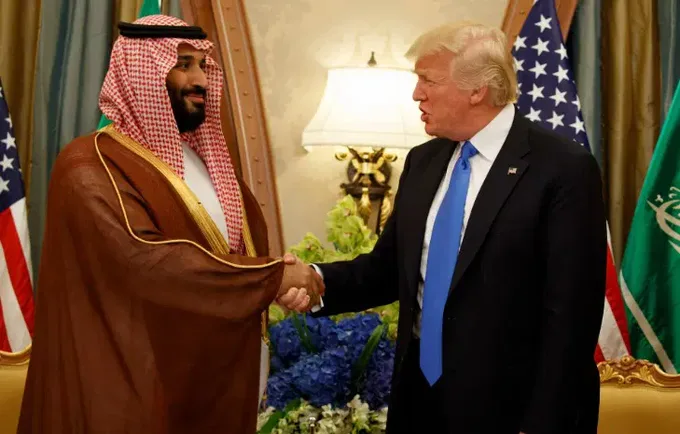
The Trump administration is set to finalize what officials call a historic nuclear cooperation deal with Saudi Arabia, years in the making and arriving as the U.S. remains at war with Iran over the same underlying issue: nuclear weapons.
According to multiple U.S. officials cited by American news outlets, President Trump has personally signed off on the pact, clearing the way for it to be announced as early as Wednesday. U.S. officials told the media that the deal was designed to solidify ties between Washington and the Middle Eastern nation amid the Iran war, while also providing billions of dollars for the U.S. nuclear industry.
The 30-year pact is formally known as a “123 Agreement,” a reference to the section of the U.S. Atomic Energy Act that governs civilian nuclear cooperation deals, and it was first reported by the Wall Street Journal.
It is expected to be signed jointly by U.S. and Saudi officials, with Energy Secretary Chris Wright reportedly set to sign alongside his Saudi counterpart, Prince Abdulaziz bin Salman. The two had talked during an overseas trip last year.
At the heart of the agreement is a provision that has alarmed nonproliferation advocates on both sides of the aisle: the possibility that Saudi Arabia could eventually enrich its own nuclear fuel for civilian reactors without adopting the so-called “gold standard” of international oversight long sought by Washington in past nuclear-cooperation deals.
The sticking point in years of negotiations has been the scope of international monitoring. Saudi officials had long resisted the IAEA’s Additional Protocol over fears it could theoretically grant inspectors access to the holy city of Mecca or royal palaces.
To bridge that gap, the deal instead includes a bilateral safeguards agreement that mirrors much of the model protocol but omits the elements Riyadh objected to, an arrangement that will still require ratification by the IAEA’s Board of Governors.
As previously reported, lawmakers will not have final say. Congress will be required to vote on the agreement but would need a veto-proof majority to actually block it, a procedural quirk of the 123 Agreement framework that has historically made these nuclear deals difficult for legislators to derail once a president commits to them.
That hasn’t stopped bipartisan unease. Critics warn the arrangement could pave the way for the kingdom to pursue its own uranium enrichment and stoke broader fears of nuclear proliferation in a region already on edge.
The timing is impossible to separate from the war raging next door. Iran, Saudi Arabia’s main regional rival, has continued to hold onto a stockpile of enriched uranium and has vowed to preserve its nuclear program despite months of American bombardment, insisting the effort is strictly civilian.
Riyadh has made clear it isn’t willing to be left behind: Crown Prince Mohammed bin Salman has previously warned the kingdom would seek its own nuclear weapon if Iran ever obtained one.
That posture is reinforced by the kingdom’s other alliances. Saudi Arabia signed a mutual defense pact with Pakistan, the only Muslim-majority nuclear power, last September, and Pakistan’s defense minister said afterward that Islamabad’s nuclear program would “be made available” to Riyadh if needed.
Secretary of State Marco Rubio, pressed on the matter Wednesday while attending a Southeast Asian foreign ministers’ summit, would not confirm details of the emerging deal but pushed back firmly on proliferation concerns, insisting Washington would not sign any agreement that raises that risk.
The caution reflects longstanding Israeli anxiety over any Gulf state gaining enrichment capability. Israel, widely believed to already possess undeclared nuclear weapons of its own, has for years been wary of Saudi Arabia gaining access to nuclear technology.
Notably, the White House appears to have abandoned an earlier strategy of bundling the nuclear deal with a broader diplomatic package. The Biden administration had linked a Saudi nuclear agreement to the normalization of ties between Riyadh and Israel, a track that stalled after the October 7 Hamas attacks.
The Journal reports Trump has since delinked the two issues, pursuing the nuclear deal separately from the push to bring Saudi Arabia into the Abraham Accords.
The Saudi deal is not occurring in isolation. Washington has been expanding civilian nuclear diplomacy across the region: it recently signed a memorandum of understanding with Bahrain, a small island nation just off the Saudi coast, opening negotiations toward a 123 Agreement of its own, following a similar pact with Malaysia.
Rubio has framed the push as open-ended, telling reporters the U.S. is ready to partner with any nation pursuing a civilian program that isn’t aimed at weapons development or regional intimidation.
The announcement lands against the backdrop of an increasingly volatile Gulf. Iran’s Yemeni allies, the Houthi rebels, have threatened to blockade Saudi ports, a move that could imperil the flow of millions of barrels of crude to world markets, and Saudi forces and the Houthis have already traded fire in the past week, straining a fragile 2022 truce.
Whether the nuclear pact will further inflame that volatility or serve as a stabilizing show of U.S. commitment to a longtime Gulf partner is likely to be the subject of fierce debate in Washington in the days ahead, starting the moment the ink dries.
WHAT YOU SHOULD KNOW
The U.S. is set to help Saudi Arabia build a nuclear program that could eventually enrich its own uranium without the full international inspection standards Washington has demanded of other countries, and this is happening in the middle of a live war with Iran over that same concern.
Washington is fighting to stop Iran from getting anywhere near weapons-grade nuclear capability while simultaneously clearing a path for its Gulf rival to acquire similar enrichment technology in a deal Congress can’t meaningfully block.
Add in Saudi Arabia’s own leadership stating they’ll pursue a bomb if Iran ever gets one, and a region already destabilized by war, port blockade threats, and cross-border strikes, and this deal isn’t just an energy agreement.
It’s a bet that arming an ally with dual-use nuclear capability will deter proliferation rather than accelerate it.