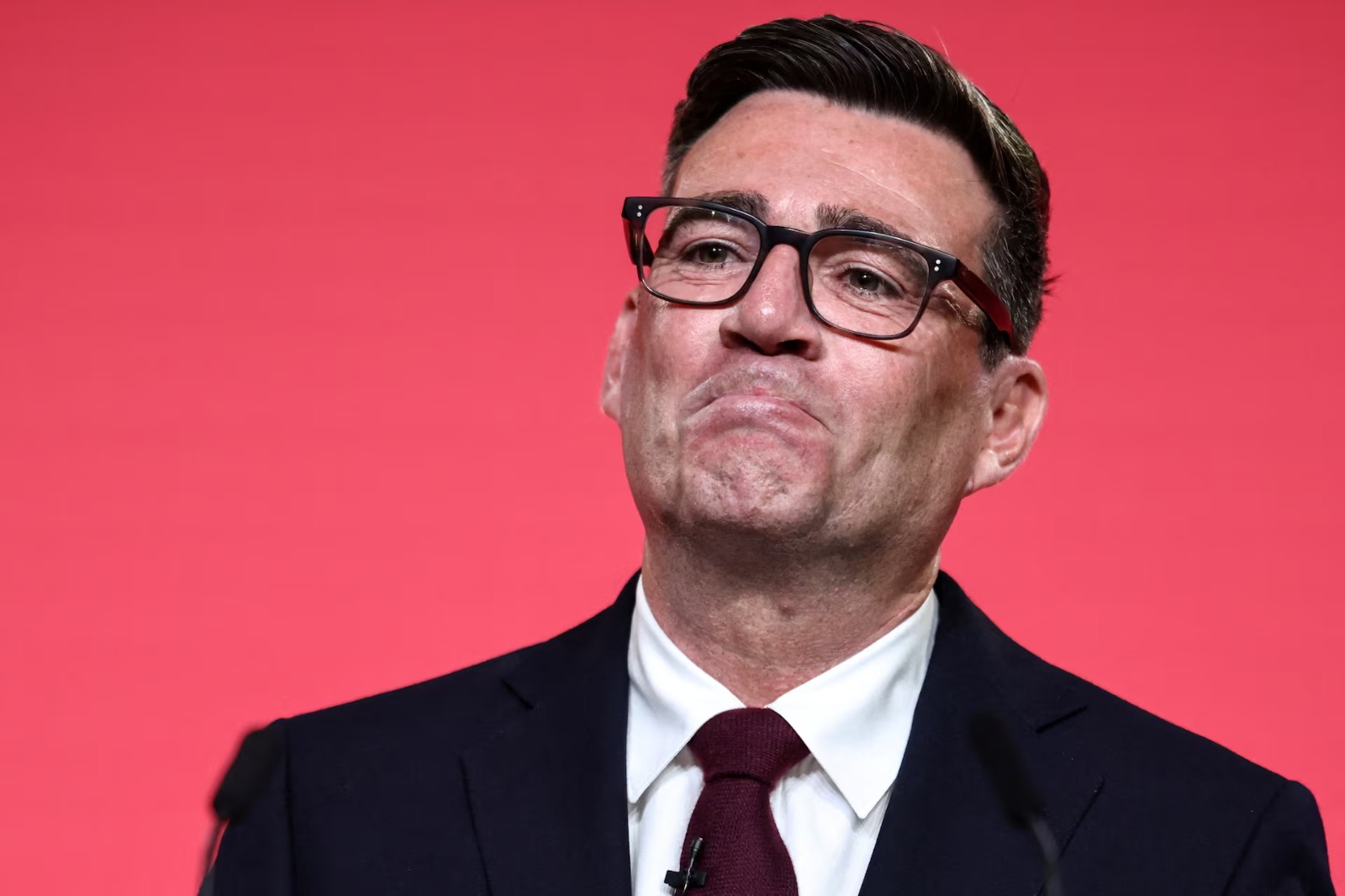
Andy Burnham has officially been confirmed as the new leader of Britain’s governing Labour Party, clearing the final hurdle before he takes over as prime minister on Monday, succeeding Keir Starmer.
The Greater Manchester mayor-turned-national leader was confirmed at a special leadership conference and will become the country’s seventh prime minister in a decade of significant political instability once he formally succeeds Starmer.
In his acceptance speech, Burnham promised to restore public hope and pledged to challenge a political and economic system he argued fails ordinary people.
Burnham’s ascent, while dramatic, had been building for weeks. Although Friday’s confirmation was the official capstone, he had effectively been leader-in-waiting since winning a critical by-election last month that returned him to Parliament and positioned him to challenge Starmer directly.
That contest came after a seat was vacated in Makerfield, deep in Labour’s traditional northern strongholds, an area now being contested by the hard-right populist Reform UK, allowing Burnham to stand and win.
The backdrop to the leadership change was Labour’s rocky standing in the polls. Poor local election results in May had fuelled fears within the party about the consequences of Starmer remaining in charge going into the next general election, given his persistent unpopularity despite Labour’s landslide victory two years prior. Starmer announced his intention to resign shortly after Burnham’s by-election win.
Once the contest opened, it was effectively a formality. Burnham, nicknamed the “King of the North” for his fierce advocacy of Greater Manchester’s interests during his time as mayor, was elected leader after securing overwhelming backing from Labour MPs. Support among the party’s 403 MPs was described as unassailable, turning what might have been a contest into something closer to a coronation.
Much of the momentum behind Burnham’s rise stems from Labour’s anxiety over Nigel Farage’s Reform UK, which has been leading national opinion polls for months.
Burnham has pitched himself as Labour’s best chance to blunt that populist surge, framing his platform around what he calls the biggest rebalancing of power from London to Britain’s regions, a plan he argues will ease the inequality and resentment driving voters in “left-behind” areas toward Reform. That message is widely seen as what won over nervous Labour lawmakers worried about losing their own seats to Farage’s party.
Burnham’s career has spanned national and local government for two decades. He served as UK Culture Secretary under Gordon Brown before spending nine years as mayor of Greater Manchester and has consistently woven arts and grassroots culture into his broader policy agenda.
Notably, during his 2008-2009 tenure as Culture Secretary, he championed “A Night Less Ordinary,” a roughly £2.5 million Arts Council England scheme that distributed 618,000 free theatre tickets to people under 26, and originated the “UK City of Culture” concept, inspired by Liverpool’s 2008 stint as European Capital of Culture.
His path to the top job wasn’t a straight line he had previously tried and failed twice to win the Labour leadership as an MP, finishing fourth behind Ed Miliband in 2010 and a distant second to Jeremy Corbyn in 2015.
Burnham is expected to enter Downing Street on Monday, at which point attention will turn quickly to his choice of Cabinet and the direction of his government.
Given the scale of Reform’s polling lead and Labour’s uneasy footing, his early weeks in office are likely to be closely watched both by his own party and by a public increasingly skeptical of Westminster’s revolving door at the top.
WHAT YOU SHOULD KNOW
Andy Burnham’s rise to Prime Minister was driven by one key factor: Labour’s fear of Reform UK. Facing a surging Farage-led populist threat and eroding support in its traditional heartlands, the party turned to Burnham the “King of the North,” betting that his regional, anti-establishment appeal could do what Starmer’s leadership couldn’t. His coronation-like path to Downing Street reflects less a personal triumph than a party moving to protect itself ahead of the next election.