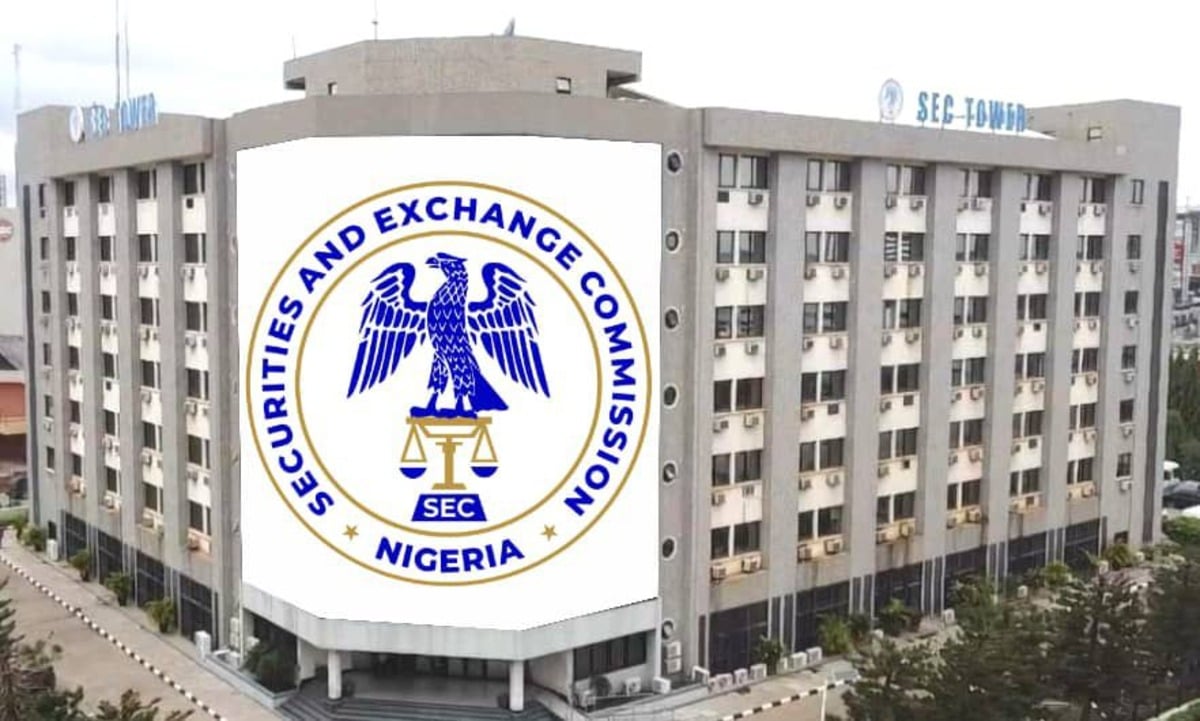
Nigeria’s push to regulate its booming digital asset market took another step forward on Friday, as the SEC admitted seven new firms into its Accelerated Regulatory Incubation Programme (ARIP), nearly doubling the number of crypto and blockchain companies under its oversight.
The newly admitted firms Bitbarter Technologies Limited, Luno Fintech Nigeria Limited, GetEquity Limited, Koinkoin Global Network Limited, Wrapped CBDC Ltd., Trovotech Ltd., and Blockvault Custodian Ltd. will each receive an Approval-in-Principle (AIP), granting them the right to operate within the defined perimeters of the sandbox program, subject to ongoing regulatory and supervisory conditions.
It is worth noting that three of the seven, Wrapped CBDC, Trovotech, and Blockvault Custodian, are not entirely new to the SEC’s radar. All three were originally admitted into the Commission’s parallel Regulatory Incubation (RI) Program back in August 2024, where they were permitted to test their business models and technology on a provisional basis.
Friday’s announcement effectively graduates them from that testing phase into the more formal AIP status under ARIP, alongside four genuinely new entrants.
The SEC was careful to frame the approval as a milestone, not a finish line. “An approval-in-principle confirms that an entity has satisfied the commission’s admission requirements for the program.
Please note that it is not a final license and remains conditional on the entity’s continued compliance with all applicable regulatory, operational, and supervisory obligations,” the Commission said in its statement.
That distinction matters. Under the ARIP framework introduced in June 2024 as a stopgap measure pending the finalization of comprehensive Digital Asset Rules, an AIP is explicitly a precursor to full registration, not a substitute for it.
Firms admitted must continue to file periodic returns, submit to onsite and offsite inspections, maintain risk management frameworks aligned with anti-money laundering and counter-terrorism financing requirements, and operate strictly within the terms of the operational plans they submitted to the Commission.
Non-compliance carries real teeth: the ARIP framework provides for financial penalties running into the millions of naira, and the SEC retains the power to terminate a firm’s participation outright if it breaches conditions or is deemed unfit to continue.
Friday’s cohort builds directly on groundwork laid in August 2024, when the SEC granted the first-ever AIPs under ARIP to two crypto exchanges, Quidax and Busha, making them Nigeria’s first legally recognized crypto trading platforms.
At the same time, the Commission admitted several other firms, including Trovotech and Wrapped CBDC, into the separate RI Program for real-time testing of their models.
That earlier move was itself a response to years of regulatory ambiguity. The Central Bank of Nigeria had restricted banks from servicing crypto exchanges in 2021, and the SEC’s 2022 Rules on Virtual Asset Service Providers struggled to gain traction with firms that had launched before those rules existed.
ARIP was designed to bridge that gap, offering a faster, sandbox-style route to legitimacy for VASPs and other digital investment service providers already doing business in or targeting Nigerian consumers.
Among Friday’s newly admitted firms, Luno’s approval carries particular symbolic weight given its decade-long history in the market. The exchange, which entered Nigeria in 2015, said in a separate statement that the AIP followed an extensive engagement process with the SEC and represents a further step in its regulatory journey in the country.
Luno Nigeria’s Chief Executive Officer, Ayotunde Alabi, called the development “an important milestone” that validates the company’s approach to building responsibly in the market.
The company said the added regulatory clarity would help deepen its relationships with retail customers and institutional partners alike and would support its push into business-to-business services, an area it flagged as increasingly important as banks, fintechs, payment providers, and asset managers explore digital asset offerings of their own.
Luno indicated plans to broaden its institutional suite to include digital asset infrastructure, stablecoin applications, treasury solutions, and crypto-as-a-service products.
The Commission noted that additional applications remain under review and that further AIPs will be issued on a case-by-case basis as applicants satisfy the program’s requirements, among them incorporation in Nigeria, a Nigeria-resident chief executive, evidence of capital and a fidelity bond, and clearance from any other sectoral regulator under which the firm already operates.
The SEC reiterated that only firms holding valid approvals under either ARIP or the RI Program are legally authorized to offer crypto trading or related digital asset services in Nigeria, a reminder aimed squarely at the many platforms still operating outside the regulatory perimeter.
Taken together, Friday’s expansion signals that Nigeria’s SEC intends to keep widening its sandbox rather than rushing toward a blanket licensing regime, a calculated, incremental approach the Commission says balances its twin goals of encouraging innovation in one of Africa’s most active digital asset markets while shoring up investor protection and market integrity.
WHAT YOU SHOULD KNOW
Nigeria’s SEC has admitted seven more firms, including Luno, into its ARIP sandbox, granting them approval-in-principle status. The key thing to understand: this is not a full operating license.
It’s a conditional, provisional stamp that firms must keep earning through continued regulatory compliance, and it signals Nigeria’s steady, incremental push to bring crypto firms under formal oversight rather than granting outright legitimacy overnight.