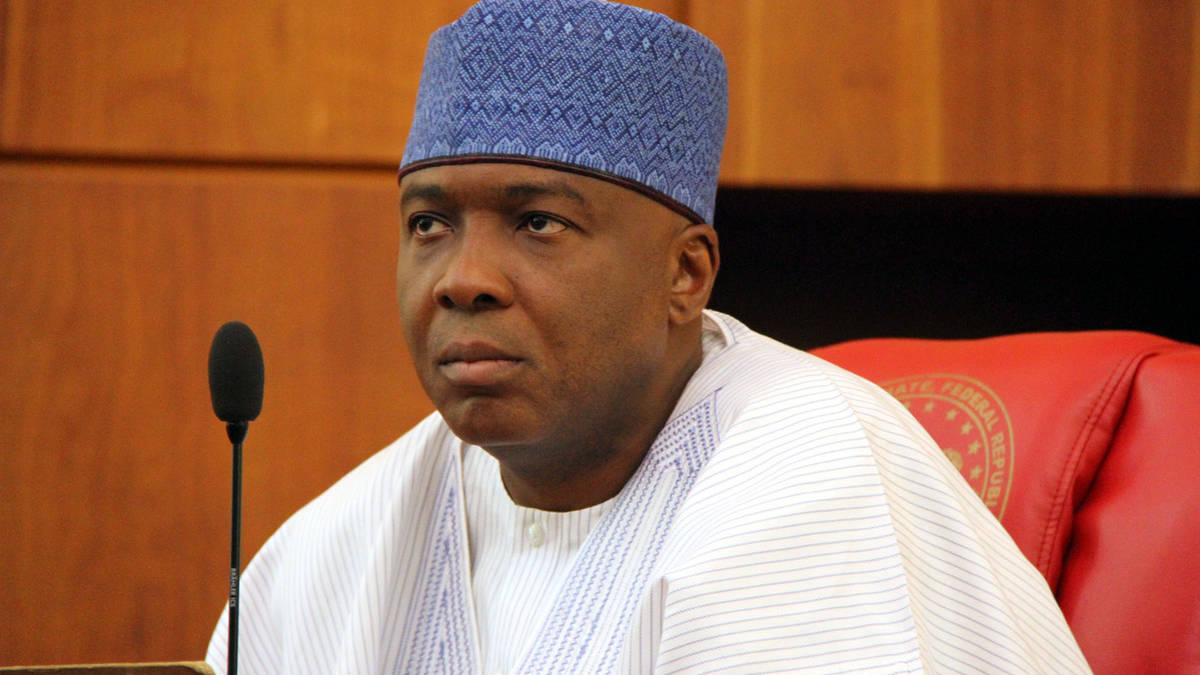
A State High Court in Ilorin dismissed every objection raised by former Senate President Bukola Saraki’s legal team and cleared the way for his criminal arraignment on July 22.
The ruling, delivered by Justice M.O. Folorunsho, represents a significant setback for Saraki, who had sought to have the entire case thrown out at a preliminary stage rather than face trial on its merits.
At the heart of the matter is a single-count charge accusing Saraki of criminal defamation under Section 399 of the Penal Code, Cap: P4, Laws of Kwara State, 2006.
Prosecutors allege that on or around April 17, 2026, Saraki published statements via his verified social media platforms, later amplified by national newspapers, claiming that Governor AbdulRahman AbdulRazaq lacked an education beyond the secondary school level.
Prosecutors say the claim touched on a constitutional qualification for contesting governorship elections, adding a layer of political weight to what might otherwise read as a personal insult.
The state’s position, as reflected in the charge sheet, is unambiguous: Saraki knew, or ought reasonably to have known, the claim was false and that he published it deliberately to provoke and humiliate the governor and, by extension, the Kwara State Government; conduct the prosecution argues was capable of inciting a breach of public peace.
Rather than contest the substance of the allegation at this stage, Saraki’s defence, led by Senior Advocate Jimoh Mumeen, appearing in court through counsel T.A. Ahmed, mounted a procedural challenge.
The defence’s motion on notice raised seven distinct grounds, spanning claims of improper service of court processes, an alleged abuse of court process, and, most centrally, an argument that the Kwara State High Court simply lacked jurisdiction to try the matter at all. Ahmed urged the court to decline jurisdiction outright and dismiss the charge without proceeding further.
Prosecuting counsel Rafiu Balogun pushed back forcefully, telling the court the state had already filed a counter-affidavit on June 11 rebutting the defence’s claims and characterizing the jurisdictional challenge as “frivolous and incongruous.”
Justice Folorunsho sided decisively with the prosecution, resolving all seven reliefs against Saraki. In language that leaves little room for further procedural wrangling on this point, the judge declared the court “blessed with territorial jurisdiction to hear this case” and held that the criminal defamation allegation stands validly against the former Senate President.
Notably, the defence’s broader implication that the prosecution was a politically engineered attack rather than a genuine legal grievance was also addressed and rejected by the bench.
Reviewing the charge sheet and accompanying proof of evidence, Justice Folorunsho found nothing to suggest political motivation, calling the defence’s objection “without any iota” of merit.
That finding matters beyond the courtroom. Saraki and Governor AbdulRazaq have a fraught political history in Kwara, and any suggestion that the state machinery was being weaponized against a political rival would have fed directly into a familiar narrative in Nigerian politics. The judge’s explicit rejection of that framing removes, at least for now, one avenue of public sympathy the defence might have leaned on.
Saraki was not physically present for the ruling. The court addressed this directly, invoking Section 227(b), which permits a court to dispense with a defendant’s physical presence for interlocutory applications, the kind of preliminary jurisdictional wrangling that occupied Thursday’s proceedings. That leeway, however, will not extend to the arraignment itself, where a formal plea is expected to be taken.
Notably, other reports of the same proceedings indicate the prosecution had also sought a bench warrant over Saraki’s absence, which the judge declined to grant, a sign the court is, for now, allowing the process to unfold through ordinary scheduling rather than compulsion.
In a statement issued after the ruling, Saraki’s media office said Mumeen was unable to attend in person because he was indisposed and confirmed that the former Senate President has instructed his lawyers to appeal the jurisdictional ruling before the next adjourned date, meaning the fight over whether this case belongs in the Kwara State High Court at all may not be fully settled, even as the arraignment date stands.
Saraki’s camp also struck a conciliatory public tone, with the former governor voicing confidence in the judiciary and calling on his supporters to remain peaceful.
With arraignment now fixed for July 22, the next hearing will determine how Saraki formally responds to the one-count charge and whether his legal team’s promised appeal on the jurisdiction question complicates or delays that process.
Given Saraki’s national profile and his history with Governor AbdulRazaq, the case is likely to draw continued attention well beyond Kwara State’s borders as it moves toward trial.
WHAT YOU SHOULD KNOW
The Kwara State High Court has dismissed all seven objections raised by Bukola Saraki’s legal team, ruling that it has full jurisdiction to try him on a criminal defamation charge and finding no evidence the case is politically motivated.
Saraki is now set to be formally arraigned on July 22 over allegedly false claims that Governor AbdulRahman AbdulRazaq lacks a secondary school education, a case that will proceed to trial even as Saraki’s camp signals plans to appeal the jurisdiction ruling.