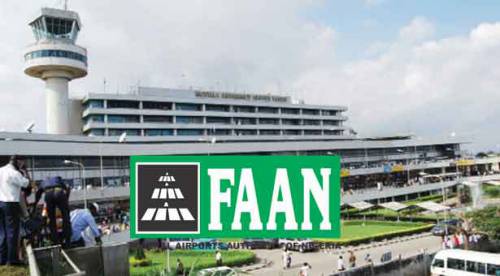
Flight operations have returned to normal at the temporary international terminal of the Murtala Muhammed International Airport (MMIA) in Lagos, following a flooding incident on Sunday that briefly disrupted activities at the facility and forced the relocation of several international carriers.
The Federal Airports Authority of Nigeria (FAAN) confirmed the development on Monday, attributing the flooding to drainage complications stemming from ongoing construction work at the airport, rather than any structural failure of the terminal itself.
Speaking to journalists, Henry Agbebire, FAAN’s Director of Public Affairs and Consumer Protection, explained that torrential rainfall on Sunday had overwhelmed parts of Lagos, leading to widespread traffic disruptions across the city and, more critically, allowing water to seep into sections of the temporary international terminal.
“It was enough to disturb operations, and water flowed into the terminal. That was why the airlines affected were moved to Terminal Two while our technical team and the contractor mitigated the issue,” Mr. Agbebire said, painting a picture of an airport authority scrambling to contain an unexpected breach even as the city around it grappled with the downpour.
The affected carriers, Air France-KLM, Ethiopian Airlines, and Fly Gabon, were swiftly redirected to Terminal Two as engineers and contractors moved in to address the drainage fault.
According to Mr. Agbebire, the relocation was a precautionary and operational necessity rather than a sign of a wider crisis, insisting that the disruption was contained quickly and did not result in any flight cancellations.
“The flooding was localized and linked to ongoing construction activities affecting drainage,” he said, adding that “the situation was promptly managed through established operational contingency measures. No flights were cancelled, and passenger safety was never compromised.”
By the time normalcy returned, the three relocated airlines had been moved back to the temporary international terminal, signalling that engineers had successfully resolved the immediate drainage issue. FAAN has not disclosed how long the relocation lasted, nor the extent of damage, if any, caused by the floodwaters within the terminal.
The incident has, however, drawn renewed attention to the vulnerability of Nigeria’s busiest airport to seasonal flooding, particularly given that construction work currently underway at MMIA appears to have compromised existing drainage channels.
Lagos, a coastal megacity prone to flash floods during the rainy season, has in recent years seen its drainage infrastructure repeatedly tested by intense rainfall, with airports, highways, and residential neighborhoods all bearing the brunt of poor water management systems.
In response, Mr Agbebire said FAAN has already begun implementing corrective measures aimed at reinforcing the airport’s drainage network to forestall a repeat occurrence, particularly as Nigeria moves deeper into its rainy season, typically running from April through October.
“We have commenced corrective measures to strengthen drainage and prevent a recurrence. We will continue to monitor developments, and it is something we will give priority to during this rainy season,” he stated.
The episode raises fresh questions about the adequacy of contingency planning at one of West Africa’s busiest aviation hubs, especially as construction projects continue at the airport.
While FAAN has sought to reassure travelers that passenger safety was never at risk, the incident underscores the broader infrastructural challenges facing Lagos as climate-driven extreme weather events become more frequent and intense, placing added pressure on aging or under-construction public facilities to withstand the stress of heavy seasonal rainfall.
For now, flight operations at MMIA’s temporary international terminal continue as normal, with FAAN pledging closer monitoring of the airport’s drainage systems in the weeks ahead.
WHAT YOU SHOULD KNOW
Sunday’s heavy rains exposed a critical drainage flaw linked to ongoing construction at MMIA’s temporary international terminal, briefly disrupting flights and forcing three airlines to relocate.
While FAAN insists the disruption was swift and contained and safety was never compromised, the real takeaway is that Lagos’s premier airport remains vulnerable to seasonal flooding as long as construction work continues to interfere with its drainage infrastructure.
FAAN’s promise to prioritize drainage reinforcement this rainy season will be the true test of whether Sunday’s incident was a one-off or a sign of recurring risk for travelers passing through MMIA in the months ahead.