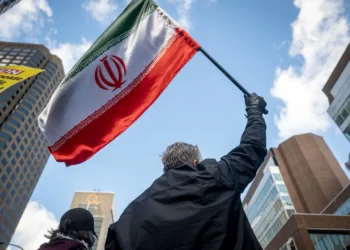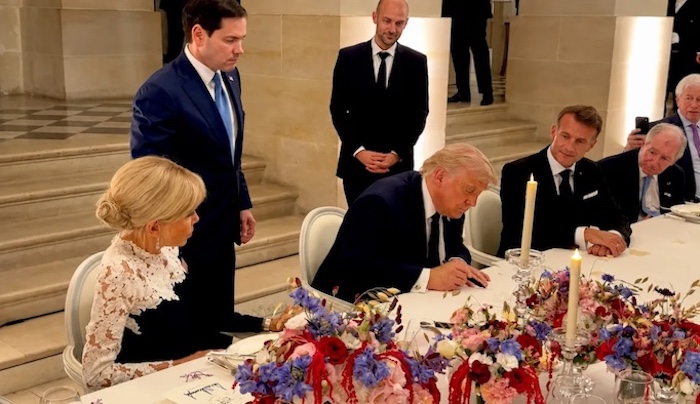
On Wednesday night, the United States and Iran formalized a preliminary peace accord over dinner at the Palace of Versailles, a historic setting for an even more historic moment.
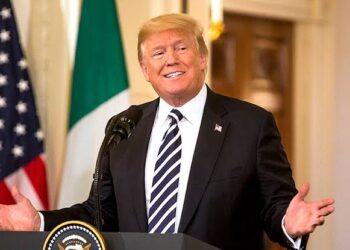
President Donald Trump, seated across from Iranian officials in one of history’s most opulent royal residences at the invitation of French President Emmanuel Macron, put pen to paper on a memorandum of understanding that commits both nations to ending a conflict that has rattled global energy markets, displaced civilians across the Middle East, and placed the world economy on a knife’s edge since hostilities broke out on February 28.
“It’s signed,” Trump declared as he departed the palace, the breezy confidence of a man who had just pulled off what his administration is already billing as a defining diplomatic achievement. “Signed it in Versailles; I just signed it.”
The agreement, extending the current U.S.-Iran ceasefire for 60 days, is sweeping in its ambition but careful in what it actually resolves. It commits both sides to negotiate a permanent end to the war, while the fate of Iran’s nuclear program, the main reason Trump cited for launching the war in February, remains unresolved for now.
The Strait of Hormuz, closed by Iran during the conflict in a move that sent oil prices soaring and threatened shipping lanes vital to global trade, will be reopened to international shipping.
The United States, in turn, will move to lift the sanctions that have long strangled the Iranian economy. A proposed $300 billion reconstruction program for Iran is also outlined as part of post-war recovery, a figure that signals the scale of destruction wrought by the three-month conflict.
Iran, for its part, has reaffirmed its commitment not to acquire or develop nuclear weapons, a condition that Washington has consistently described as non-negotiable.
Trump had announced the two sides struck an agreement on Sunday, but the specifics of the plan had not been made public until Wednesday, causing considerable speculation and confusion about what is and isn’t outlined in the framework. Senior administration officials finally briefed reporters on the full contents at a press conference capping off the G7 summit in Evian.
Speaking to reporters after the signing, Trump was characteristically direct about his motivations. “I didn’t want to see economic catastrophe,” he said. “If this conflict had continued, the consequences for the global economy could have been severe.”
He compared the agreement favorably to the 2015 nuclear deal brokered under President Barack Obama, calling it a far stronger arrangement, though critics have noted that both agreements rest on fundamentally similar architecture: sanctions relief in exchange for nuclear concessions from Tehran.
The president was equally frank about the alternative. He warned that the United States would respond with force if negotiations over the coming 60 days fail to produce a final settlement, leaving little doubt that the diplomatic window he has opened comes with a hard deadline and harder consequences.
G7 leaders welcomed the announcement and called for continued diplomatic efforts to build on the deal, describing it as “an historic opportunity to prevent Iran from acquiring any nuclear weapon.”
Iranian officials welcomed the accord, but their language was measured and at times pointed. Iran’s parliamentary speaker and chief negotiator, Mohammad Bagher Ghalibaf, made clear that the goodwill extended to Washington should not be mistaken for trust.
“If the enemy does not understand the language of logic, we will enter again with the language of power,” Ghalibaf said in remarks carried by state media, a warning dressed in the language of diplomacy but carrying the unmistakable edge of a nation that has not forgotten who fired first.
The memorandum was officially finalized after being signed in both English and Farsi, upon Iran’s insistence, for transparency, a small but telling detail about the depth of suspicion that still pervades the relationship between these two countries.
Several Democratic senators criticized the agreement, saying it is a better deal for Iran than for the United States, while Republican reaction has also been mixed. Former Vice President Mike Pence urged Trump to seek more explicit and verifiable language around Iran’s nuclear program. “Trust but verify,” he said, before suggesting the order should in fact be reversed: “Verify, then trust.”
To understand the weight of this agreement, it is necessary to revisit what ignited it. On February 28, U.S. and Israeli forces launched military operations against Iran, triggering one of the most consequential regional conflicts in decades.
Iran’s response, including the effective closure of the Strait of Hormuz, sent shockwaves through global energy markets almost immediately.
The Strait of Hormuz is not merely a body of water. It is the jugular vein of global energy supply, a narrow channel through which roughly one-fifth of all global oil and liquefied natural gas shipments normally pass. Its closure, even partial and temporary, was enough to raise inflation fears across multiple continents and push oil prices to levels not seen in years.
Brent crude fell approximately one percent in early Asian trading following news of the signing, as investors began pricing in a reduced risk to energy supply chains. The relief, however modest, was real, though prices remained well above pre-conflict levels, a reminder that the scars of the past three months will take time to heal.
The choice of venue was not lost on observers. That one of the most consequential diplomatic milestones of the Trump presidency was reached not in Washington or Mar-a-Lago but in the Hall of Mirrors corridor of a French royal palace, at the hospitality of Emmanuel Macron, carries its own symbolism.
Macron had framed the G7 discussions around the long-term reopening of the Strait of Hormuz and the wider diplomatic opportunity created by the agreement. Wednesday night, he delivered.
Qatar and Pakistan, which helped mediate the deal, were praised by Qatari Prime Minister Sheikh Mohammed bin Abdulrahman Al Thani, who urged “positive and constructive” negotiations ahead. The role of those two nations in bringing Washington and Tehran to the table has been one of the less-heralded but arguably most consequential elements of the entire diplomatic effort.
The 60-day countdown to a final agreement is now underway. Both sides may extend the timeline by mutual consent if negotiations require it, though the history of U.S.-Iran diplomacy offers little comfort to those hoping for a smooth path forward.
The nuclear question of enrichment levels, verification mechanisms, and the fate of existing stockpiles remains the hardest knot to untangle.
In an interview with The New York Times, Trump said Iran would be permitted low-level nuclear enrichment, a notable shift from his earlier, repeated calls for the complete dismantling of Iran’s nuclear program. That concession, if it holds, may prove to be the quiet centerpiece of a deal that is being sold as an American victory.
For now, the guns are quiet, the Strait is set to reopen, and two old adversaries have, for the first time in years, found themselves in the same room, signing the same document.
Whether that document becomes the foundation of a lasting peace or merely a pause before the next confrontation will be determined in the 60 days ahead. The world will be watching.
WHAT YOU SHOULD KNOW
The United States and Iran have signed a preliminary peace agreement at the Palace of Versailles, marking the first formal step toward ending a conflict that began in February 2026.
While the deal reopens the Strait of Hormuz, initiates sanctions relief, and outlines a $300 billion reconstruction program for Iran, the central issue, Iran’s nuclear program, remains unresolved. Both sides have 60 days to reach a final settlement.
The agreement has steadied global markets and eased fears of an economic catastrophe, but deep mutual distrust persists.
Iran’s negotiators have made clear that goodwill has its limits, while critics on both sides of the American political divide question whether the terms are strong enough to hold.