Nigeria and Cameroon have signed a landmark defence MoU in Yaoundé, pledging shared regional security even as an alleged Cameroonian military incursion into Nigerian territory threatens to overshadow the deal.
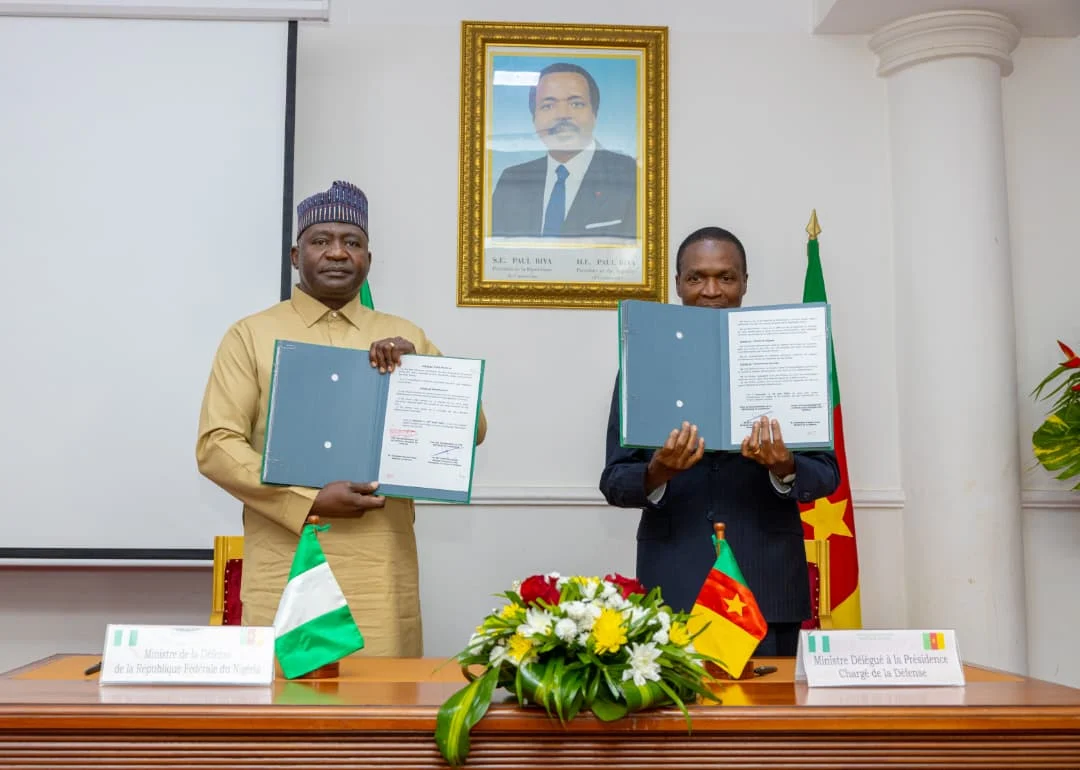
The MoU was inked on Wednesday by Nigeria’s minister of defence, retired General Christopher Musa, and Cameroon’s minister delegate at the presidency in charge of Defence, Mr. Joseph Assomo, at a ceremony that concluded two days of intensive behind-closed-doors deliberations between defence and security experts from both countries.
At its core, the agreement is a modernized architecture for cross-border security cooperation, one designed to address a shared southern border that has long been plagued by smuggling, armed non-state actors, and periodic flare-ups of tension that have tested bilateral relations going back decades.
The MoU establishes a structured framework spanning both terrestrial and maritime domains, encompassing intelligence sharing, operational coordination, logistics support, joint military training, and personnel exchange programs.
Critically, it also provides for collective response mechanisms to emerging security threats, language that suggests both nations are preparing for a rapidly evolving threat landscape, rather than the static challenges of the past.
Speaking at the signing ceremony, General Musa made clear that the agreement was not merely symbolic. “It would henceforth provide a structured framework for military cooperation and operations between both countries,” he said, “and further institutionalize collaboration in addressing common security concerns.”
Those are carefully chosen words from a soldier-turned-minister who understands, perhaps better than most, the difference between a diplomatic declaration and an operational commitment.
Beyond the land border, both sides turned their attention to the Gulf of Guinea, one of the world’s most strategically significant and persistently dangerous bodies of water. The two nations discussed the operationalization of the Combined Maritime Joint Task Force, described by officials as a strategic platform for enhancing maritime security and safeguarding the economic interests of both countries in the Gulf.
The Gulf of Guinea has for years been ranked among the most piracy-prone maritime zones on the planet, with criminal networks targeting oil tankers, fishing vessels, and commercial shipping with a sophistication and brazenness that has alarmed both regional governments and the international shipping community.
For Nigeria, with the world’s largest oil industry in sub-Saharan Africa largely dependent on safe maritime passage, the economic dimension of Gulf security is existential. For Cameroon, whose own offshore energy interests are growing, the calculus is much the same.
The formalization of a joint maritime task force framework, if fully operationalized, would represent one of the most significant bilateral security arrangements in the Gulf region in recent memory.
The most forward-looking element of Wednesday’s discussions was the conversation around defence industry cooperation, a subject that General Musa appeared to approach with particular conviction.
“One of the enduring challenges confronting African defence capability development has been limited indigenous production of military hardware,” the minister observed, stressing the need for stronger regional industrial partnerships across the continent.
It is a diagnosis that resonates widely across African military establishments, many of which remain deeply reliant on imported weapons systems from Europe, Russia, the United States, and increasingly China, a dependency that critics argue compromises both operational autonomy and long-term strategic sovereignty.
Musa used the occasion to highlight opportunities under Nigeria’s Defence Industries Corporation framework, reaffirming Abuja’s openness to collaboration in defence manufacturing, technology transfer, research, and innovation.
His Cameroonian counterpart, Assomo, responded with what officials described as genuine interest, confirming that a formal proposal framework is currently being finalized to concretize bilateral arrangements in defence technology.
If those arrangements materialize, they could mark the beginning of a modest but meaningful West and Central African push toward reducing external dependency in military procurement, a goal that has been discussed in various African Union forums for years without substantial progress.
Days before the ministers sat down to sign their names to a document pledging mutual respect and security cooperation, reports emerged that armed Cameroonian soldiers allegedly invaded the Danare community in the Boki Local Government Area of Cross River State, causing widespread panic among residents.
Cross River State sits precisely within the geographic zone that the new MoU is designed to stabilize, a fact that lends the alleged incursion an uncomfortable irony, and that will undoubtedly sharpen scrutiny of whether the agreement translates from parchment to practice.
Nigeria and Cameroon share a border stretching nearly 1,700 kilometers, a frontier that traverses dense forest, riverine terrain, and communities whose ethnic and cultural ties predate the colonial boundaries that now divide them. It is a border that has historically been difficult to police and relatively easy to exploit.
The Lake Chad Basin to the north has long been destabilized by Boko Haram and its offshoots, forcing both countries into an existing multilateral security arrangement under the Multinational Joint Task Force. Wednesday’s agreement extends that spirit of cooperation southward, filling what security analysts have described as a critical gap in the bilateral relationship.
For the broader Economic Community of West African States region and for the Central African Economic Community, to which Cameroon also belongs, the Nigeria–Cameroon pact sends a signal, however fragile, that bilateral security cooperation between neighbors can be pursued through formal institutional channels, even amid unresolved tensions on the ground.
Both governments have described the signing as a “pivotal milestone.” History will judge it by the crises it prevents or fails to.
WHAT YOU SHOULD KNOW
Nigeria and Cameroon have signed a landmark defence MoU committing both nations to joint border security, intelligence sharing, maritime cooperation in the Gulf of Guinea, and defence industry collaboration.
The agreement signals genuine political will toward regional stability; its true test lies not in the ceremony in Yaoundé but in events on the ground, most pointedly, the alleged armed incursion by Cameroonian soldiers into Nigerian territory just days before the ink dried.