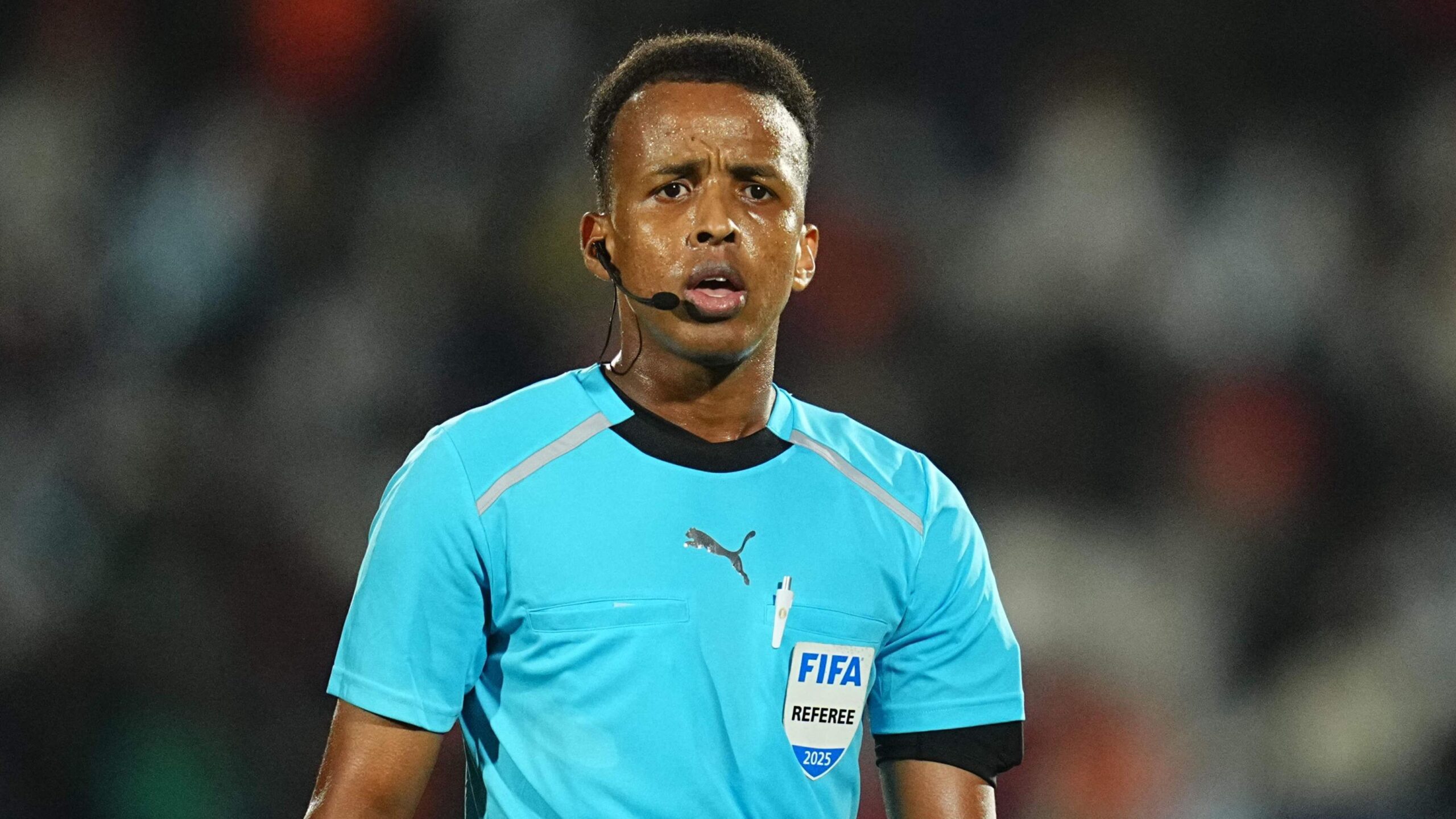
UEFA has moved swiftly and decisively to restore the honour of Somali referee Omar Artan, appointing him to officiate the 2026 UEFA Super Cup on August 12 in Salzburg, Austria, just hours before the FIFA World Cup.
The announcement, made Thursday by European football’s governing body, sent an unmistakable message to the global football community: that whatever verdict Washington had delivered at Miami International Airport last Saturday, the football world was not done with Omar Artan.
The Super Cup fixture, a marquee clash between UEFA Champions League winners Paris Saint-Germain and Europa League holders Aston Villa, is no consolation prize. It is one of European football’s most watched annual showpieces, and handing Artan its whistle is as pointed a statement of solidarity as the sport’s corridors of power could have made.
UEFA President Aleksander Ceferin was unambiguous in his praise, releasing a statement that read more like a rebuttal of the US government’s position than a routine administrative announcement.
“Omar Artan is an excellent young but already experienced referee who has proven himself at the highest competition level of the Confederation of African Football,” Ceferin said. “Football is made to connect people, and UEFA wants to show its respect to Omar and his outstanding officiating skills, which have earned him such a prestigious nomination.”
The timing of that statement, released mere hours before FIFA’s World Cup was scheduled to begin, was no accident. European football’s most powerful administrator was, in effect, drawing a sharp contrast between the values his institution wished to project and the circumstances that saw a celebrated African referee turned back at America’s door.
Artan’s expulsion from the United States on Saturday had sent shockwaves through the global football community. He had arrived at Miami International Airport as part of the 52-strong roster of referees assembled for the World Cup finals being spread across Canada, Mexico, and the United States, only to find himself denied entry.
His appointment to that roster had been a watershed moment for Somali football, a rare and deeply cherished milestone for a nation whose relationship with the beautiful game has long outpaced its international recognition. For his compatriots, it was not simply one man’s achievement; it was Somalia’s arrival on the grandest stage the sport has to offer.
The US State Department, however, saw things differently. A spokesperson told AFP that Artan had been deemed “associated with suspected members of terrorist organizations,” rendering him, in the department’s language, “ineligible for admission to the United States.” FIFA subsequently confirmed that Artan would play no further part in the tournament.
No further details were provided. No formal charges were leveled. And critically, no evidence was made public, leaving football administrators, human rights observers, and Artan’s supporters to question the basis on which a man who had risen to the pinnacle of African officiating was turned away at the border of the country hosting the world’s biggest sporting event.
If the United States expected the episode to pass quietly, what followed suggested otherwise. Artan returned to Mogadishu on Wednesday to scenes that underscored just how much his World Cup appointment had meant to ordinary Somalis. The welcome was not of a man returning in disgrace, it was of a national figure returning in defiance.
Artan himself struck a tone that was composed, dignified, and forward-looking. He vowed to press on toward the 2030 World Cup, signaling that neither his ambitions nor his resolve had been diminished by his treatment in Miami.
CAF President Patrice Motsepe, speaking in the wake of the Super Cup announcement, gave voice to the pride that Artan’s journey had stirred across the continent.
“His receipt of the CAF Men’s Referee of the Year Award 2025 and his appointment as a referee of the FIFA World Cup 2026 are a recognition of his world-class refereeing ability and the international respect that he enjoys,” Motsepe said.
Motsepe further described the Super Cup appointment as “a great honour for Omar Artan and for African referees” and framed it as “an excellent example of football, bringing together and uniting people from Africa and Europe and worldwide.”
For a tournament marketed on themes of global unity and inclusion, the image of a decorated African referee being turned away at an American airport based on unverified and unspecified security concerns has proved deeply uncomfortable viewing for FIFA and its partners.
The body has faced pointed questions about its due diligence in selecting host nations and about its capacity to guarantee equal and dignified access for all participants, regardless of nationality or background.
UEFA’s move, framed formally within an existing cooperation framework between UEFA and CAF, carries weight beyond the procedural. The joint statement affirmed that the two confederations are “united by a shared commitment to developing football at all levels and promoting the core values of unity, equality, and non-discrimination.” In the context of Artan’s treatment, those are not empty words; they are a rebuke rendered in the language of institutional solidarity.
The story of Omar Artan is, at its heart, a story about who gets to belong in global football and who gets to decide. A man who earned his place among the world’s elite referees through years of dedication, who was formally nominated to the sport’s most prestigious stage, found that nomination rendered meaningless by a security designation his own sport never saw coming and has never fully understood.
That UEFA moved as quickly and publicly as it did to restore his standing speaks to a broader anxiety within football’s governing structures about how the sport is perceived in an increasingly fractured geopolitical landscape.
For Artan, the Super Cup in Salzburg on August 12 will be more than a football assignment. It will be a statement delivered not with words, but with a whistle.
WHAT YOU SHOULD KNOW
Somali referee Omar Artan, denied entry to the United States for the 2026 FIFA World Cup on unverified security grounds, has been handed a powerful platform by UEFA, which appointed him to officiate the prestigious Super Cup in Salzburg this August.
The move, backed by both UEFA President Ceferin and CAF President Motsepe, is a clear and deliberate act of solidarity, sending an unmistakable message that merit and dignity cannot be cancelled by a border decision. Simply put: the United States shut the door on Artan, and European football opened a bigger one.