The federal government has unveiled plans to extend Lagos’ growing rail network directly to the terminals of the Murtala Muhammed Airport, a long-overdue intervention that transport experts and commuters alike have called a game-changer.
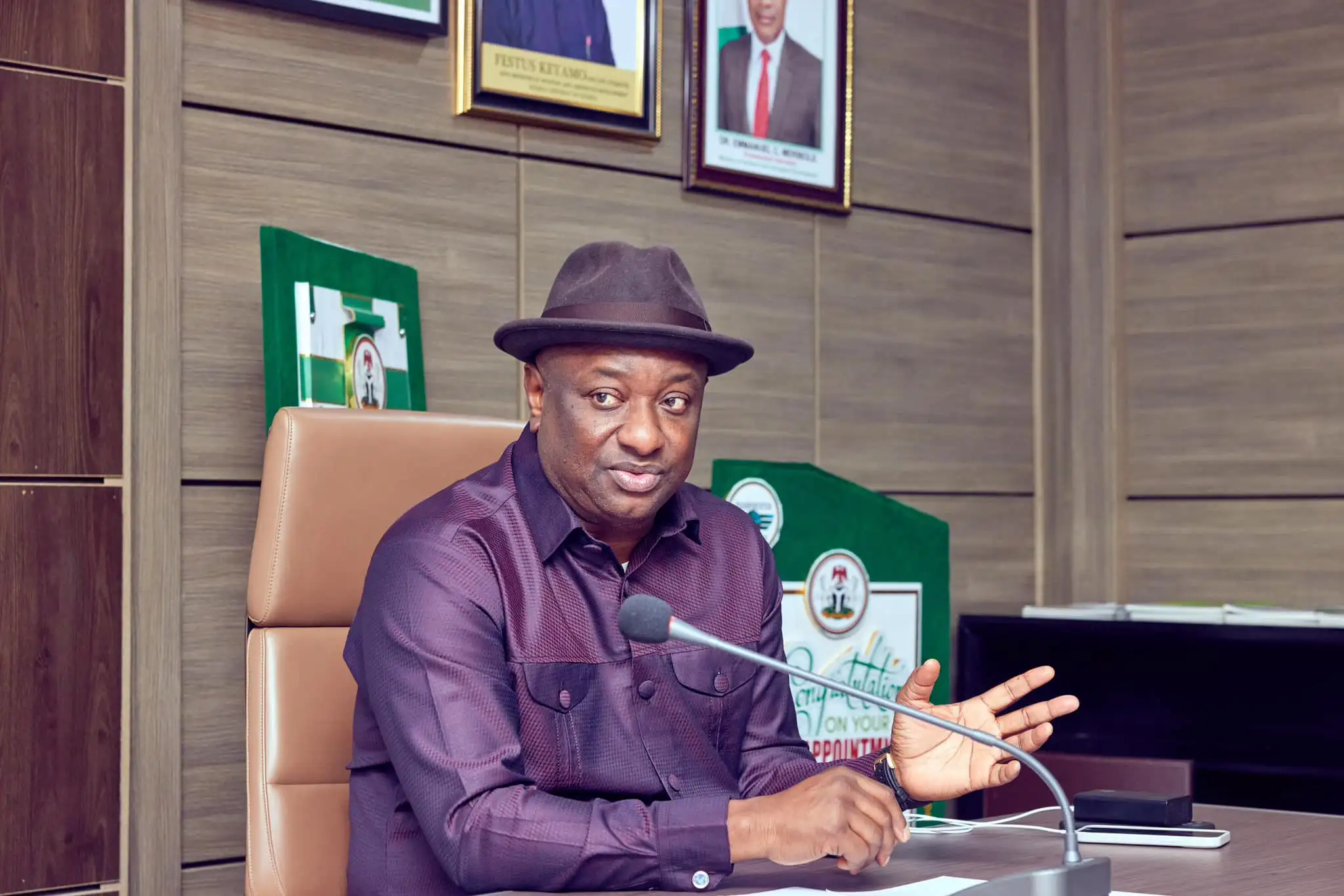
The announcement was made on Monday by the minister of aviation and aerospace development, Festus Keyamo, at the opening of Invest Lagos 3.0, an investment forum convened by the Lagos State Government.
Speaking before an audience of local and foreign investors, Mr. Keyamo confirmed that active discussions are already underway between his ministry and the Lagos State Government to extend the Red Line rail, which currently terminates at Ikeja Bus Stop, all the way through the airport’s terminal complex.
“That rail line is about to start,” the minister declared with visible confidence. “Lagos is just ready for the next big step in terms of its aviation activities.”
The proposed extension, if executed as described, would not simply add a few kilometers of track. It would stitch together several critical nodes in Nigeria’s aviation infrastructure into a single, seamless transit corridor.
The extension would connect from Ikeja Bus Stop through the General Aviation Terminal (GAT), continue to the Murtala Muhammed Airport Terminal Two (MMA2) operated by Bi-Courtney Aviation Services Limited (BASL), and terminate at the international wing of the airport.
For the millions of Lagosians who have long endured the city’s infamous traffic locally dubbed “go-slow” on the way to catch a flight, the promise of a direct rail link to the airport represents something close to salvation.
The Red Line rail has already begun fundamentally changing travel patterns for savvy commuters, with the Ikeja Train Station emerging as the primary hub for airport-bound passengers, though currently, travelers must still take a five-minute airport shuttle or a short taxi from the arrivals hall to complete the journey to the terminals.
The airport rail announcement comes as Lagos is in the midst of what can only be described as a mass transit renaissance. The Red Line’s Phase 1 commercial services were launched on October 15, 2024, stretching from Oyingbo to Agbado, with key stations including Ikeja, Oshodi, Mushin, and Yaba.
Meanwhile, the Blue Line, Nigeria’s first functional intra-city electric rail, transported approximately 3.5 million passengers in 2025, with daily ridership climbing to 15,000 commuters, while daily trips on the corridor rose to 90 in 2025, reflecting growing public acceptance of the rail system.
Construction is also progressing on Phase 2 of the Blue Line, which will extend the rail a further 14 kilometers from Mile 2 to Okokomaiko, adding six new stations and a 400,000-square-meter depot.
Taken together, these developments paint the picture of a city in serious pursuit of a modern, integrated transport backbone, and the airport rail link, analysts say, is the missing piece that could make it truly transformational.
Mr. Keyamo made a broader, more strategic case for the project, framing it as essential to Lagos’ ambitions as a continental aviation hub. He noted that Lagos accounts for approximately 67 per cent of all international passenger traffic entering Nigeria by air, underscoring the state’s outsized importance to the country’s aviation industry.
He then pointed to geography as Lagos’ trump card, arguing that no other city on the continent enjoys the same central positioning. “In just six hours across the Atlantic, you will get to South America from the Lagos airport,” he said. “Six hours down, you will get to Southern Africa. Six hours to the Middle East, you will get to Dubai or Qatar.
Six hours up, you will get to Europe.” The minister described this as the “equidistant advantage” that Lagos holds as a potential hub for the whole of Africa, noting that Nigeria would soon catch up with established hubs like Addis Ababa and Lomé.
It is a compelling vision and one that pits Lagos squarely against Ethiopian Airlines’ Addis Ababa hub and the rapidly growing aviation sectors in Rwanda and Togo, all of which are competing aggressively for Africa’s air transit crown.
The minister’s airport ambitions go well beyond a rail link. He disclosed that approximately $500 million has been committed under the Tinubu administration to reconstructing and modernizing the aging international terminal at Lagos airport, a facility that, it is worth noting, was inaugurated 47 years ago in March 1979 and has long strained under the weight of passenger volumes it was never designed to accommodate.
Mr. Keyamo also pointed to the resolution of the long-running contractual dispute between the federal government and Bi-Courtney Aviation Services Limited as evidence of the administration’s appetite for private sector collaboration, a significant signal to the investor community gathered at the forum.
He further announced the expansion of Nigeria’s international airport network, with the designation of Victor Attah International Airport in Uyo and Maiduguri International Airport, bringing the total number of international airports in Nigeria to seven.
The country has a complicated history with large-scale transport projects; timelines slip, funding gaps emerge, and political transitions can abruptly reorder priorities.
The minister’s repeated assurance that the rail extension is “about to start” will need to be followed swiftly by groundbreaking ceremonies, procurement processes, and visible construction activity to maintain credibility.
What is undeniable, however, is that the conditions for this project have never been more favorable. Lagos has proven, with both the Blue and Red lines, that it can build and operate functional urban rail at scale.
The federal government has a political incentive to deliver visible infrastructure wins ahead of the next electoral cycle. And the traveling public, tired of watching their flights depart from behind a wall of traffic, is ready and waiting.
If the airport rail becomes reality, it won’t just be an infrastructure project. It will be a statement to investors, to rival hubs across Africa, and to the millions of Lagosians who have learned, through hard experience, that Nigeria’s commercial capital is finally ready to move at the speed it has always deserved.
WHAT YOU SHOULD KNOW
Nigeria’s federal government plans to extend Lagos’ Red Line rail directly to Murtala Muhammed Airport, a project that, if delivered, would be the single most transformative upgrade to the city’s transport infrastructure in decades.
With Lagos handling 67% of Nigeria’s air passenger traffic, a direct rail link to the airport is not a luxury; it is a logical necessity. Backed by a $500 million terminal modernization program and a rapidly maturing urban rail network, Lagos is making a credible, coordinated push to become Africa’s premier aviation hub.