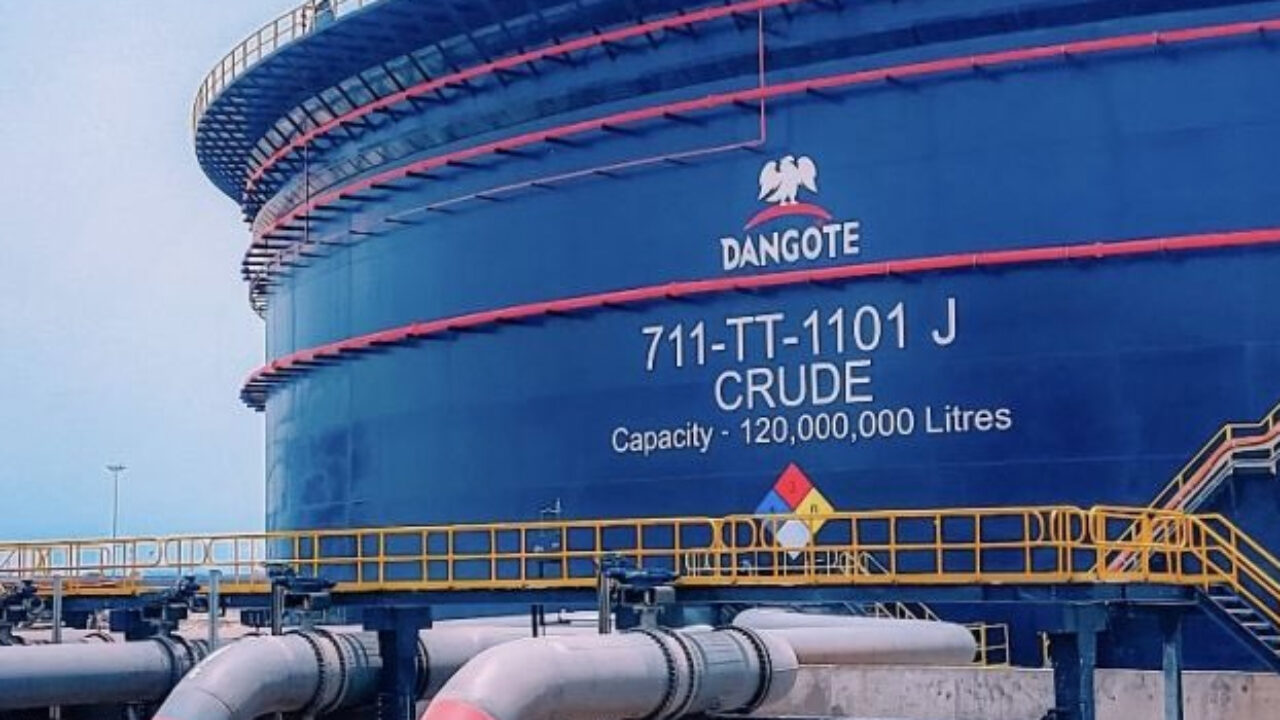
The Dangote Petroleum Refinery has announced fresh reductions in the ex-depot prices of petrol (PMS) and diesel (AGO), offering renewed relief to Nigerian consumers and businesses.
Under the latest adjustment, the refinery cut the ex-depot price of petrol to ₦1,250 per litre, down from ₦ 1,275, while diesel was reduced to ₦ 1,700 per litre from ₦ 1,800.
While the reductions may appear modest on paper, a ₦25 cut on petrol and a ₦100 cut on diesel, energy analysts say the cumulative impact of such moves, when multiplied across millions of daily transactions nationwide, is anything but marginal.
Anthony Chijiena, spokesperson for the Dangote Group, confirmed the development, stating, “We have reduced our PMS price from ₦1,275 to ₦1,250 per liter and AGO from ₦1,800 to ₦1,700 per liter.”
The announcement, made Saturday, is expected to cascade down to retail prices at filling stations across the country. Pump prices for petrol had been hovering between ₦1,350 and ₦ 1,370, while diesel had remained well above ₦ 2,000 per liter in many parts of the country.
This latest cut is not an isolated event. It is part of a broader, sustained strategy by the $20 billion mega-facility to reshape Nigeria’s downstream petroleum sector from the ground up.
Refinery Chairman Aliko Dangote has repeatedly reaffirmed his commitment to keeping domestic fuel prices “reasonable and competitive,” even in the face of global market volatility. His position has been unambiguous: the refinery intends to compete aggressively, including against imported fuel.
“Prices are going down. The reason why prices have to go down is that we have to also compete with imports,” Dangote has said, adding that petroleum products “will continue to be sold in the market at a very reasonable price.”
The downward price movement comes against a backdrop of declining global crude oil prices, which have softened to around $91 per barrel for Brent crude and $87 for West Texas Intermediate.
The refinery has consistently passed those savings on to the domestic market, a departure from the historical practice of Nigerian consumers bearing the full brunt of international price swings.
The Dangote refinery’s pricing strategy is reshaping competitive dynamics in the downstream sector in ways that were unimaginable just a few years ago. “The margins are shrinking by the day,” one Lagos-based fuel distributor told this publication. “Dangote has access to better economies of scale and a more efficient refining process. We simply can’t match their prices without incurring significant losses.”
Nigeria’s central bank data shows the country spent $1.26 billion on petroleum imports in the first quarter of 2025 alone, even as Dangote’s domestic output continued to increase, a clear sign that the transition away from import dependency, while underway, remains a work in progress.
Cross-border smuggling, driven by Nigeria’s significantly lower fuel prices relative to neighboring countries, remains an ongoing challenge. Dangote himself has noted that Nigerian prices are now approximately 55 percent lower than those of neighboring nations, creating persistent arbitrage temptations along the country’s porous borders.
For the average Nigerian, the commuter, the small business owner, and the generator-dependent household, each price reduction sends a signal that the era of crippling fuel costs may, slowly but measurably, be drawing to a close.
Transporters, manufacturers, and logistics companies that have long factored punishing diesel costs into their pricing will likely find some breathing room in the latest adjustment.
The refinery has previously noted that at full operational capacity, it produces some 57 million liters of petrol daily, far exceeding Nigeria’s local consumption of approximately 46 million liters, meaning the facility has not only the ambition but the physical capacity to transform domestic supply.
The direction of travel is clear. Whether the relief reaches the consumer at the pump and how quickly will depend on the response of marketers and retailers up and down the distribution chain.
WHAT YOU SHOULD KNOW
The Dangote Petroleum Refinery has again reduced its ex-depot prices for petrol (₦1,250/liter) and diesel (₦1,700/liter), continuing a pattern of deliberate, consumer-focused price cuts driven by the refinery’s growing domestic output and declining global crude oil prices.
The bigger story here is not just the numbers; it is the structural shift taking place in Nigeria’s energy sector. For the first time, a locally owned, large-scale refinery is producing more fuel than the country consumes, actively competing with imports, and consistently passing savings down the chain.
If marketers and retailers follow suit, ordinary Nigerians, from commuters to small business owners, stand to gain the most. The era of Nigeria importing its own crude oil as refined fuel, at great cost to its economy, may finally be coming to an end.