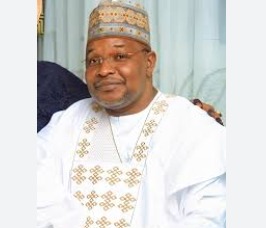
Alhaji Muhammad Bello Dalhat has emerged as the Peoples Democratic Party’s governorship candidate for Kano State, inflicting a crushing defeat on a challenger carrying one of the most recognizable and controversial surnames in Nigerian political history.
Dalhat polled a commanding 2,233 votes to see off Alhaji Muhammad Sani Abacha, son of the late military head of state General Sani Abacha, who could only muster 749 votes in the primary election. The margin of nearly three to one, leaving little room for ambiguity about where the party faithful in Kano had placed their confidence.
The result was announced by Hon. Umar Danjani Hadejia, chairman of the election committee constituted by the PDP‘s national leadership to oversee the exercise, lending the process an air of institutional credibility that the party will be keen to project ahead of what promises to be a fiercely competitive election cycle.
“With the total votes recorded, Alhaji Muhammad Bello Dalhat scored the highest number of votes and is hereby declared the winner and the PDP governorship candidate for Kano State,” Hadejia declared in a formal statement that closed the chapter on what many had anticipated would be a tighter race.
For Muhammad Sani Abacha, the result represents a sobering lesson in the limits of political lineage. His father, General Sani Abacha, ruled Nigeria with an iron fist from 1993 until his sudden death in 1998, a tenure remembered as much for its sweeping human rights abuses and staggering allegations of looted state wealth as for any developmental achievements.
The Abacha name, long a fixture in northern Nigerian political circles, carries enormous weight. Still, in Kano’s delegate halls on this occasion, it was not enough currency to purchase the party’s ticket.
The younger Abacha had clearly banked on name recognition and family networks in a state where his father still commands a complex legacy. That calculation, it appears, fell short against Dalhat’s apparent grassroots organization and the persuasive arithmetic of delegate politics.
The significance of this primary extends well beyond internal party mechanics. Kano State is not just any constituency; it is Nigeria’s most populous state, a commercial and cultural heartbeat of the north, and a perennial political bellwether whose governorship contest invariably draws national attention.
Whoever flies the PDP flag into the 2027 general election will be stepping into an arena already crowded with formidable political interests.
The ruling All Progressives Congress (APC) in the state, alongside other parties jostling for relevance in Kano’s notoriously fluid political landscape, will be watching Dalhat’s emergence with calculated interest as they assess the opposition threat he now represents.
Sunday’s primary is emblematic of a broader national mood. Across Nigeria’s 36 states and the Federal Capital Territory, political parties are accelerating their internal processes, with the 2027 general elections still roughly 18 months away, already dominating backroom conversations, boardroom negotiations, and grassroots mobilizations.
The PDP, which lost the presidency in 2023 and has been engaged in an often turbulent process of internal rebuilding and realignment, will view the Kano primary as an opportunity to project unity and organizational discipline.
A clean, credible primary with an undisputed winner and a functioning committee is precisely the sort of image the opposition giant needs to restore confidence among voters who have, in recent cycles, drifted toward other platforms.
For Alhaji Muhammad Bello Dalhat, the hard work has only just begun. A primary victory, however convincing, is merely a mandate from the faithful.
Converting it into a general election triumph in a state as dynamic and unpredictable as Kano will demand a far broader coalition, one that reaches well beyond the walls of PDP delegates’ halls.
WHAT YOU SHOULD KNOW
Alhaji Muhammad Bello Dalhat has won the PDP governorship primary in Kano State, defeating Muhammad Sani Abacha, son of former military ruler Sani Abacha, by a landslide margin of 2,233 votes to 749.
The result is a clear demonstration that in Nigerian democracy, political pedigree and a famous surname are no substitute for grassroots organization and genuine popular support.
As 2027 approaches, Dalhat now carries the opposition’s flag into Nigeria’s most populous and politically consequential state, a battle that will test far more than his primary victory suggests.