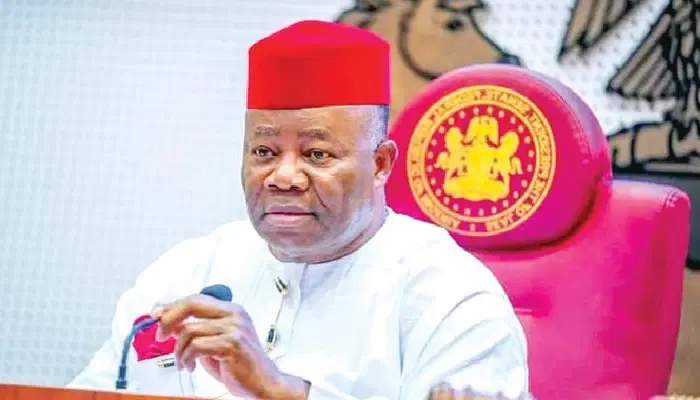
Senate President Godswill Akpabio has once again found himself at the centre of public debate, not necessarily for the words he spoke, but for what those words now signify in a country growing increasingly restless with the speech of those in power.
Akpabio’s recent statement that he is praying for insurgency in Nigeria to end in 2026 has reignited a long-standing conversation about the delicate balance between faith and governance, as well as the gap between political language and practical responsibility.
This is not the first instance in which Godswill Akpabio’s comments on national security have generated criticism. Just days earlier, he had suggested that the persistence of violence across the country was politically motivated, allegedly driven by elements opposed to President Bola Tinubu ahead of the 2027 elections. That assertion, made at a time when insecurity continues to claim lives, was widely interpreted as an attempt to frame a national tragedy through a political lens.
His latest remarks, which shift from a political explanation to a spiritual appeal, have intensified scrutiny over the consistency, clarity, and credibility of leadership communication in Nigeria.
It is important to acknowledge that Nigeria remains a deeply religious society, where faith is woven into both private and public life. Invoking divine intervention is not unusual for leaders, particularly during periods of crisis. Historically, appeals to God have accompanied moments of national difficulty, from conflict to economic instability. However, a distinction must be made between drawing strength from faith and presenting it as an alternative to concrete policy.
That distinction lies at the heart of the current controversy surrounding Godswill Akpabio.
His statement “that God should end insurgency… and that we should defeat insurgency” might ordinarily be viewed as an expression of optimism. Yet, when placed against the ongoing reality of attacks by insurgents, bandits, and criminal groups across various regions, it has been received by many not as reassurance, but as a reflection of growing frustration.
Across the country, communities continue to endure violence, with recent incidents in parts of the North Central further underscoring the scale of the challenge. In such an environment, citizens increasingly expect leaders to communicate with clarity of purpose and demonstrate a firm grasp of actionable solutions.
The reaction to the Senate President’s remarks, therefore, extends beyond religion. It speaks to expectations. Nigerians expect their leaders to articulate strategies, maintain consistency in messaging, and reinforce confidence in the government’s ability to fulfil its core duty of protecting lives and property.
Compounding the issue is Godswill Akpabio’s recent communication history. His earlier comment about “sending prayers to senators’ email boxes,” widely interpreted as a reference to allowances, remains fresh in public consciousness and has contributed to perceptions of disconnect between leadership and everyday realities. In that context, renewed references to prayer risk being viewed less as sincerity and more as a recurring pattern.
Nevertheless, dismissing the role of faith entirely would ignore its significance in Nigerian society. Faith continues to provide emotional resilience and moral grounding for many citizens. The concern, however, is not about whether leaders should pray, but whether such expressions are being framed as substitutes for decisive action.
Nigeria’s security challenges are complex and deeply rooted, involving factors such as intelligence gaps, porous borders, socio-economic inequalities, proliferation of arms, and unresolved local grievances. Addressing these issues demands a comprehensive approach that includes military coordination, police reform, community engagement, economic inclusion, and strong legislative oversight.
These are responsibilities that cannot be deferred to divine intervention alone.
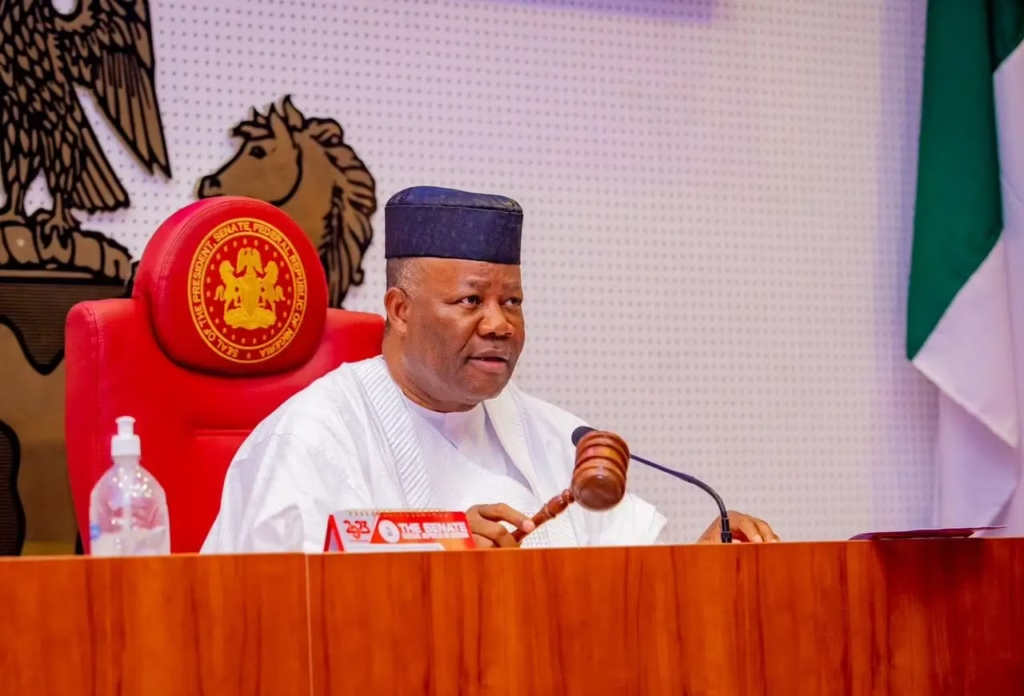
As Senate President, Godswill Akpabio occupies a position that carries significant institutional authority. His statements influence public perception, shape national discourse, and signal the direction of government thinking. Suggesting, even indirectly, that the resolution of insurgency is tied to a divine timeline risks creating uncertainty about the role of state institutions in addressing the crisis.
It also raises a critical question about accountability: if outcomes are framed within a spiritual timeline, how does that align with the urgency required of governance?
The political context further complicates the situation. With the 2027 elections approaching, statements from key figures are increasingly interpreted through a political lens. Godswill Akpabio’s earlier remarks linking insecurity to political opposition had already set that tone. His latest comments, though grounded in faith, have done little to shift that perception.
At a time like this, leadership requires a higher level of discipline in communication.
Nigeria possesses both the institutional framework and the human capacity to address its security challenges. What remains critical is clear, consistent messaging that assures citizens of a defined plan and demonstrates that such a plan is being executed with urgency and accountability.
Public reactions to the Senate President’s remarks should not be seen as a rejection of faith, but rather as a call for focus. Nigerians are not asking their leaders to abandon spiritual expressions; they are asking for a stronger emphasis on action, clarity, and measurable progress.
Ultimately, while Godswill Akpabio’s statement may have been intended to inspire hope, hope without a visible framework for action risks losing its impact. In a country grappling with persistent insecurity, leadership communication must go beyond belief and reflect determination.
Faith may provide comfort in uncertain times, but it is effective governance that must deliver lasting security.
What You Should Know
The controversy surrounding Akpabio’s remarks reflects broader concerns about leadership communication in Nigeria, especially on critical issues like insecurity.
While faith remains an important part of public life, citizens increasingly expect clear strategies and decisive action from those in power.
The backlash is less about religion and more about accountability, consistency, and results. With security challenges persisting, public confidence depends heavily on how leaders communicate and act.
As political activities ahead of 2027 intensify, statements by top officials are likely to face deeper scrutiny and interpretation within both governance and political contexts.