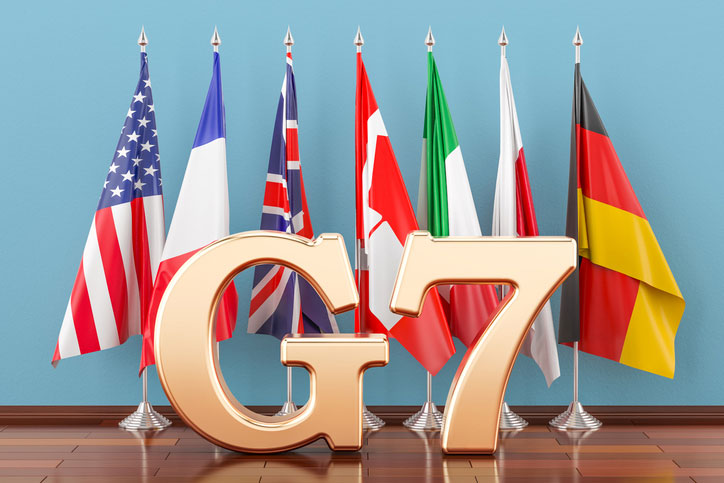
G7 finance ministers are holding an emergency meeting today to discuss a coordinated release of strategic oil reserves via the IEA, aiming to stabilize surging global energy markets amid the escalating U.S.-Israeli war with Iran.
According to reports from the Financial Times, the virtual meeting is set for Monday and involves a call with IEA Executive Director Fatih Birol at 8:30 a.m. New York time—comes as the week-old conflict has triggered severe disruptions to oil flows through the Strait of Hormuz, sending crude prices surging more than 25% in recent sessions to levels not seen since mid-2022.
At the heart of the crisis is the Strait of Hormuz, the narrow chokepoint between Iran and Oman that handles roughly one-fifth of the world’s seaborne oil trade and a substantial share of liquefied natural gas.
Iranian retaliatory actions, including attacks on vessels and warnings against passage, have brought tanker traffic to a near standstill, with satellite data showing drops of up to 90% in movements through the strait. This has created massive bottlenecks, forcing producers to curtail output due to overflowing storage and halted exports.
A stark example is Iraq, one of OPEC’s largest producers. Industry sources and officials report that output from the country’s key southern oilfields—including major sites like Rumaila, West Qurna, and Maysan—has plummeted by about 70%, falling from roughly 4.3 million barrels per day (bpd) to around 1.3 million bpd. With exports via the Gulf blocked and domestic refineries unable to absorb the surplus, storage tanks have filled rapidly, compelling sharp production cuts. Similar pressures are affecting other Gulf producers, amplifying the supply shock.
The conflict, which erupted with U.S. and Israeli strikes on Iranian targets and has since drawn in wider regional attacks on energy infrastructure and shipping, has fueled fears of prolonged disruptions. Brent crude futures have climbed dramatically—briefly exceeding $110 per barrel in some sessions—while West Texas Intermediate has followed suit, marking one of the sharpest weekly gains in decades.
Analysts warn that sustained closure or severe restrictions in the strait could remove millions of barrels from global markets daily, risking stagflationary pressures worldwide as higher fuel costs ripple through economies.
The G7—comprising the United States, Canada, France, Germany, Italy, Japan, and the United Kingdom—coordinates on major economic and security issues. The IEA’s emergency response mechanism allows member countries (which hold collective strategic petroleum reserves) to release oil in a coordinated fashion during supply crises, a tool last deployed significantly during events like the 2022 Russia-Ukraine conflict.
Sources indicate that at least three G7 nations, including the U.S., have voiced support for such a move. Discussions reportedly center on a substantial release—potentially 300-400 million barrels—to temporarily flood the market and cap price spikes.
While the exact scale and timing remain under negotiation, the proposal reflects growing alarm among major economies over the war’s spillover into energy security and inflation.
A successful coordinated release could provide short-term relief by boosting the available supply. However, experts caution it would not address underlying geopolitical risks or replace lost production if the conflict drags on.
As ministers and Birol convene, markets are watching closely: any signal of decisive action could temper the rally in oil prices, while delays or divisions might exacerbate volatility. With the Middle East conflict showing no immediate signs of de-escalation, the coming hours could prove pivotal in determining whether global consumers face weeks—or months—of elevated energy costs.
WHAT YOU SHOULD KNOW
G7 finance ministers are meeting to discuss a large, coordinated release of emergency oil stocks through the IEA to cap the price surge and prevent a deeper energy crisis—a move that could provide short-term relief but won’t solve the underlying geopolitical risk if the Middle East conflict continues.
The escalating war has severely disrupted global oil supply by choking traffic through the Strait of Hormuz—the critical chokepoint for ~20% of world oil trade. Iraq’s southern fields alone have already slashed output by ~70% (from 4.3 mb/d to 1.3 mb/d) due to export blockages and full storage tanks, driving oil prices up more than 25% in days.