CBN announces major progress in bank recapitalization, revealing that 30 of 33 Nigerian banks now meet the new minimum capital requirements as of March 6, 2026, just weeks ahead of the March 31 deadline.
In a statement released on Friday, Acting Director of Corporate Communications Hakama Sidi-Ali confirmed the milestone, highlighting that the recapitalization effort—launched in March 2024—is advancing steadily across the industry. “As of March 6, 2026, the recapitalization exercise is progressing steadily.
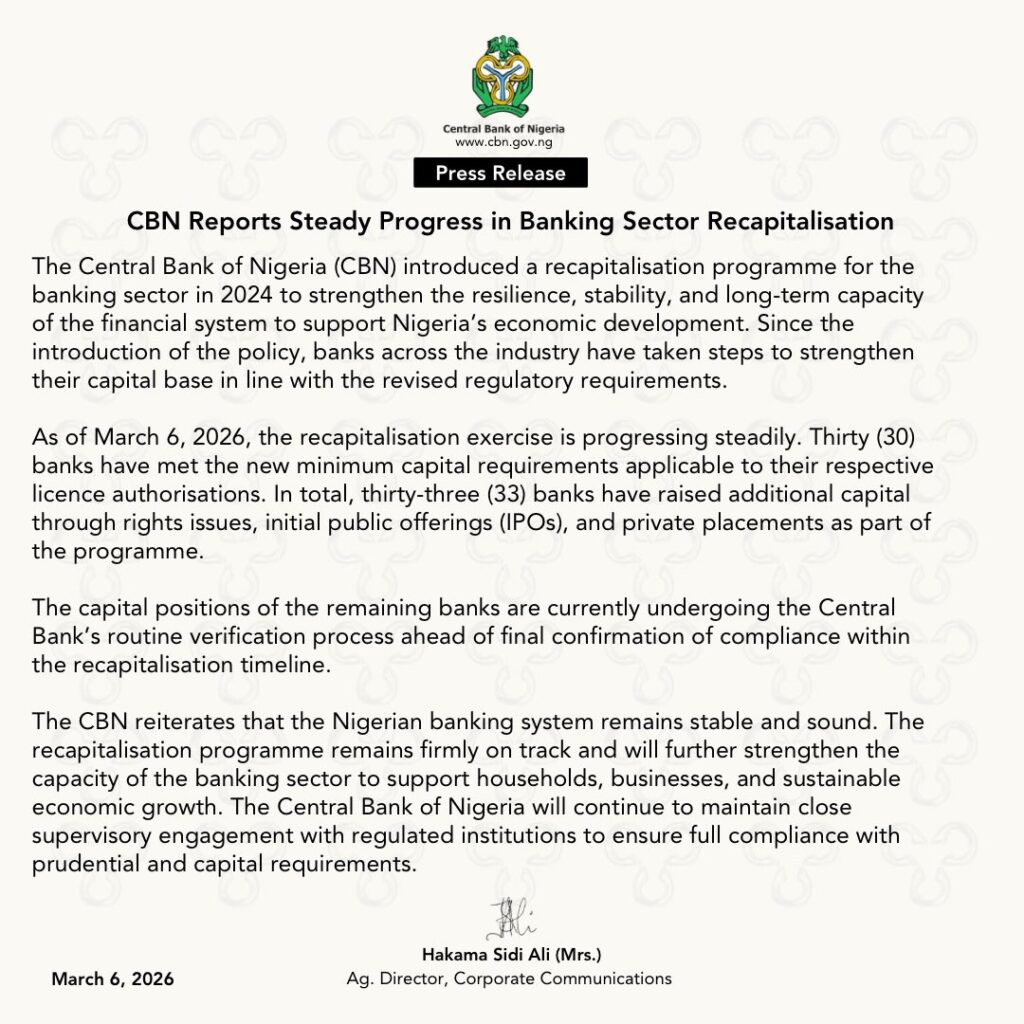
Thirty (30) banks have met the new minimum capital requirements applicable to their respective license authorizations,” the statement read. “In total, thirty-three (33) banks have raised additional capital through rights issues, initial public offerings (IPOs), and private placements as part of the program.”
The policy, introduced under Governor Olayemi Cardoso’s leadership, marked a sharp upward revision of minimum paid-up capital thresholds to bolster the sector’s resilience amid economic volatility, inflation pressures, and the need for greater lending capacity to drive growth. The requirements vary by license category:
- International commercial banks: ₦500 billion
- National commercial banks: ₦200 billion
- Regional commercial and merchant banks: ₦50 billion
- National non-interest banks: ₦20 billion
- Regional non-interest banks: ₦10 billion
These thresholds, focused strictly on paid-up share capital and share premium (excluding reserves or retained earnings), represent a substantial increase from previous levels, aimed at ensuring banks can better absorb shocks, expand credit to households and businesses, and support sustainable economic development.
The rapid compliance trajectory is notable. As recently as late February 2026, during the Monetary Policy Committee meeting, the CBN reported that 20 banks had met the thresholds, with a collective verified capital raise of approximately ₦4.05 trillion.
The jump to 30 compliant institutions in a matter of weeks reflects intensified fundraising efforts through the capital markets and other channels, including strong participation from domestic investors.
While 30 banks have now cleared the bar, the remaining three are subject to the CBN’s routine supervisory verification process. This step ensures that funds raised meet prudential standards, are properly accounted for, and comply fully with regulatory guidelines.
“The capital positions of the remaining banks are currently undergoing the Central Bank’s routine verification process ahead of final confirmation of compliance within the recapitalization timeline,” Sidi-Ali noted.
The CBN reiterated its confidence in the sector’s overall health, emphasizing that Nigeria’s banking system remains stable and sound despite the ongoing adjustments. “The recapitalization program remains firmly on track and will further strengthen the capacity of the banking sector to support households, businesses, and sustainable economic growth,” the statement affirmed.
The regulator pledged continued close oversight throughout the process to safeguard depositors and maintain financial system integrity.
Analysts view the development as a positive signal for investor confidence and the broader economy. With most banks already compliant or nearing confirmation, the program appears poised to conclude successfully by the March 31, 2026, deadline—positioning Nigeria’s financial institutions for stronger performance in an increasingly competitive and risk-prone operating environment. The apex bank has assured stakeholders that any final verifications will be handled expeditiously to avoid disruptions.
WHAT YOU SHOULD KNOW
Nigeria’s banking recapitalization program is on a strong track for success. As of March 6, 2026, 30 out of 33 banks have already fully met the new, significantly higher minimum capital requirements set by the Central Bank of Nigeria. The remaining three are in the final verification stage, with the entire exercise firmly on course to conclude by the March 31 deadline.