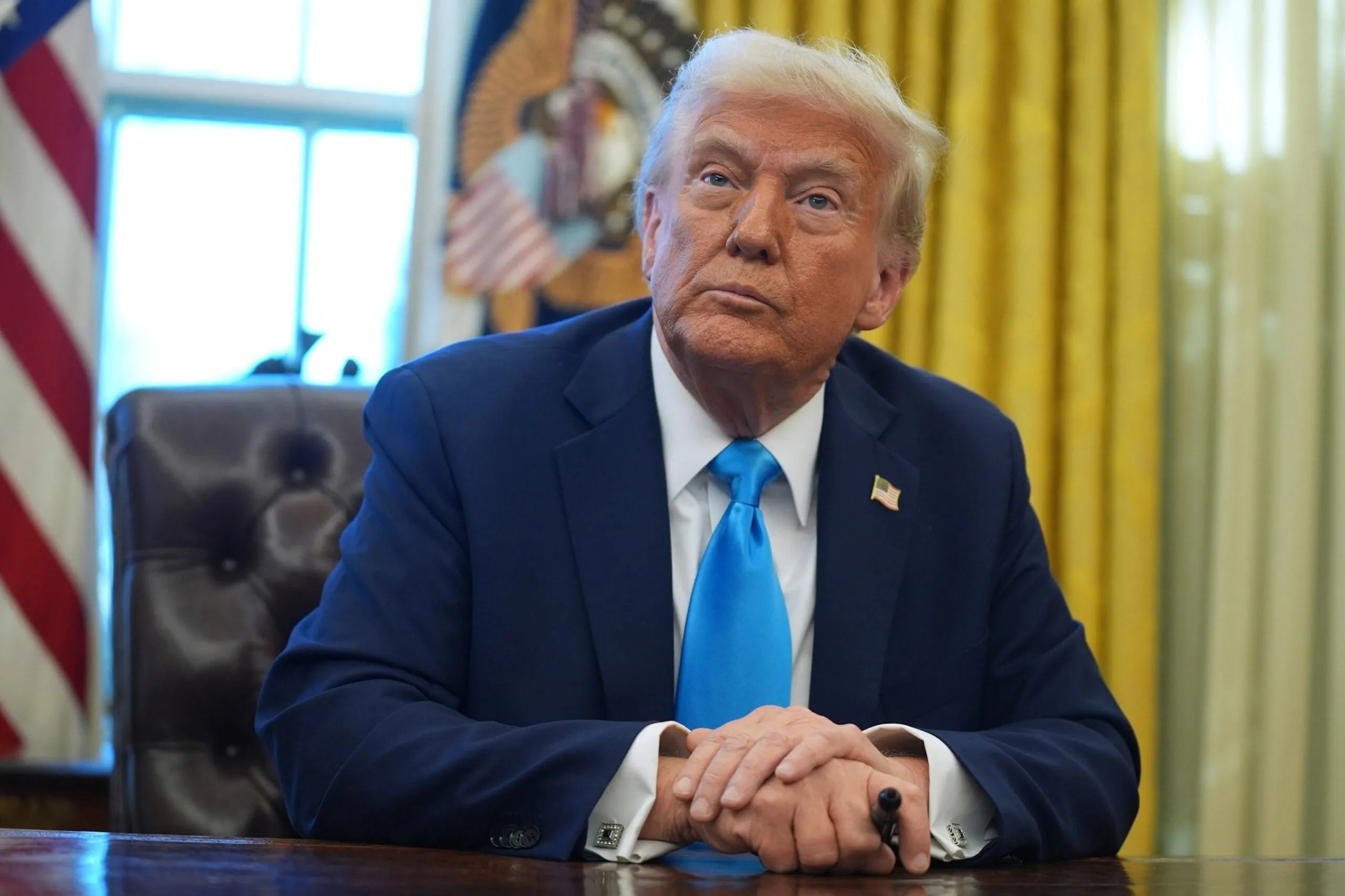
US President Donald Trump on Tuesday declared that a ceasefire agreement between Iran and Israel had taken effect, calling on both parties to adhere strictly to the arrangement as the hostilities between the long-time adversaries stretched into their twelfth day.
Trump made the announcement via his Truth Social account, urging, “THE CEASEFIRE IS NOW IN EFFECT. PLEASE DO NOT VIOLATE IT!”
Earlier, Trump had detailed the conditions of the truce, stating that it would roll out in two phases within a 24-hour period. According to him, Iran was expected to first cease all military operations starting around 4:00 a.m. GMT, with Israel expected to reciprocate by halting its activities 12 hours later. Despite the announcement, neither Iran nor Israel officially confirmed any such agreement.
Reports of ongoing hostilities persisted even as the ceasefire window approached. Iranian state outlets reported waves of missile launches towards Israeli territory, while Israeli rescue agencies confirmed fatalities.
Four individuals were reportedly killed in Beersheba following one of the Iranian missile strikes. The Magen David Adom rescue service stated that three were declared dead at the scene, and a fourth fatality was later added to the toll.
While explosions thundered across parts of northern Israel, journalists in Tehran reported overnight blasts that were among the most intense since the conflict began. The Iranian capital’s north and central areas were rocked by what residents described as some of the strongest detonations so far.
Despite the volatile conditions on the ground, Trump remained insistent that both nations were ready to halt aggression. Just hours before his updated declaration, Iranian Foreign Minister Abbas Araghchi had dismissed claims of any formal agreement to end military actions.
However, he did hint that Tehran might suspend its retaliatory attacks if Israeli forces ceased operations by 4:00 a.m. Tehran time.
“Provided that the Israeli regime stops its illegal aggression against the Iranian people no later than 4 a.m., we have no intention to continue our response afterwards,” Araghchi wrote on social media.
Trump’s call for calm came shortly after Iran launched a significant strike on Al Udeid Air Base in Qatar — the largest American military facility in the Middle East — an act the U.S. president downplayed as a measured response. According to Trump, Tehran had provided early notification of the missile barrage, ensuring no casualties occurred.
The Iranian National Security Council stated that the strike was in retaliation for the United States’ recent bombing of its nuclear sites. It emphasized that the volume of missiles fired matched the number of American bombs used against Iran, suggesting a calculated, proportional response rather than an escalation.
“This was calibrated and telegraphed in a way that would not result in any American casualties, so that there is an off-ramp for both sides,” said Ali Vaez, senior advisor at the International Crisis Group.
The attack followed a U.S.-led offensive launched in support of Israel, during which massive bunker-busting bombs were deployed against an underground uranium enrichment center and two other nuclear installations in Iran between Saturday and Sunday.
As tensions continued to rise, French President Emmanuel Macron urged for an end to the “spiral of chaos,” while Chinese officials warned of potential ripple effects on the global economy due to the ongoing conflict.
Meanwhile, Iran asserted that its missile launches were directed solely at U.S. military targets and not at Qatar itself. Nonetheless, Qatari authorities decried the missile strikes as a “blatant aggression,” warning that they reserve the right to respond in kind.
The missiles were aimed at Al Udeid Air Base, which had been evacuated before impact. Iran’s state-affiliated media quoted the Islamic Revolutionary Guard Corps confirming the strike.
A U.S. defense source described the attack as involving both short-range and medium-range ballistic missiles. Explosions were reported across Doha and Lusail on Monday evening, with witnesses observing rockets soaring through the skies.
Celebratory gatherings erupted in central Tehran, where large crowds, waving Iranian flags and chanting slogans including “Death to America,” filled the streets in what was broadcast live by state television.
In anticipation of further instability, Qatar announced a temporary closure of its airspace. Several foreign embassies, including that of the United States, advised citizens to remain indoors.
Iran’s health ministry revealed that over 400 people have died as a result of Israeli airstrikes since the conflict began, while Israel reports 24 casualties from Iran’s retaliatory attacks.
What you should know
President Donald Trump has declared a ceasefire between Iran and Israel despite ongoing missile exchanges and rising casualties. While Iran and Israel have yet to officially acknowledge any truce, Trump claims both sides have signaled a willingness to de-escalate.
The conflict began with Israeli strikes on Iran’s nuclear sites, followed by Iranian and U.S. retaliations. A U.S. base in Qatar was struck, though no casualties were reported.