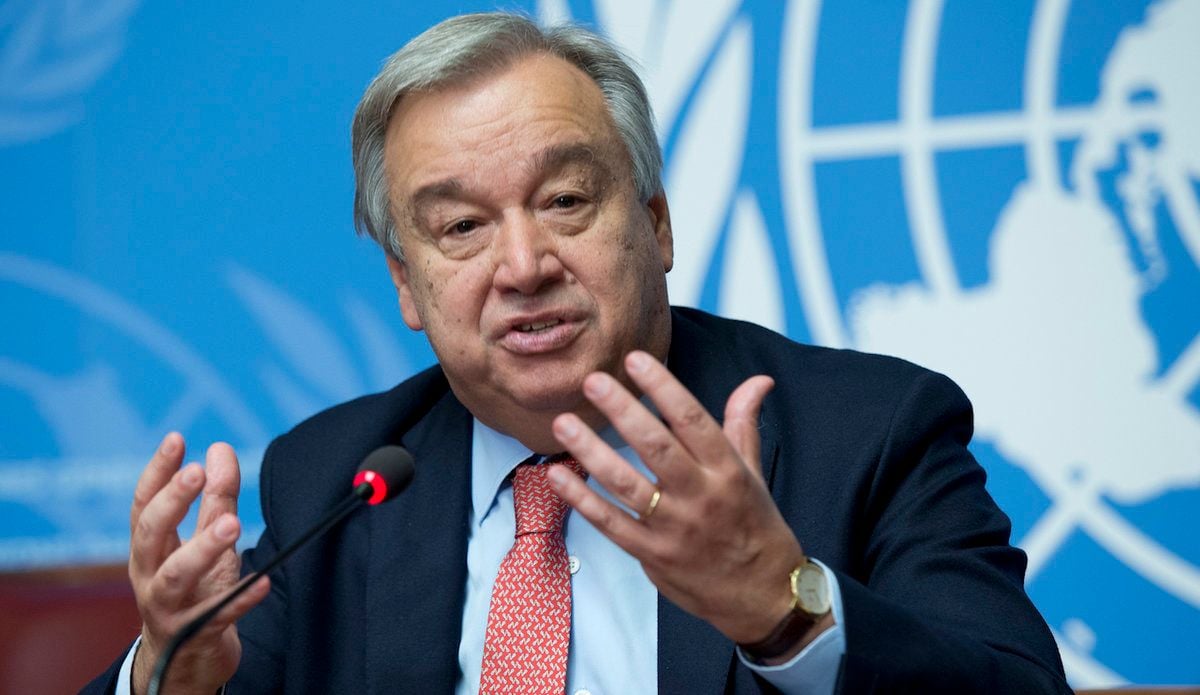
UN Secretary-General António Guterres has urgently called on nations to ditch fossil fuels and embrace homegrown renewable energy, describing the shift as both technologically and geopolitically overdue.
Guterres made his position unequivocally clear in a late Monday post on his verified X account, where the 77-year-old former Portuguese prime minister and longtime climate advocate framed the current oil market turmoil not merely as an economic setback but as a defining moment of strategic choice for the world’s governments.
The Secretary-General’s remarks arrive as global oil prices continue to reel from the fallout of the United States-Israeli military campaign against Iran, a conflict whose ripple effects have disrupted supply chains, inflated fuel costs, and reignited fears of sustained energy instability across importing nations.
Yet rather than focusing on the immediate pain, Guterres directed his message toward an exit one he says is more accessible today than at any point in human history.
“For decades, dependence on fossil fuels has meant dependence on volatility,” the UN chief wrote, in what read as a stinging indictment of the international community’s chronic failure to wean itself off carbon-intensive energy despite decades of warnings. “This is unsustainable.”
Drawing a deliberate contrast with previous energy shocks—including the Arab oil embargo of 1973 and the Gulf War-era price surges of the early 1990s—Guterres acknowledged that past generations of policymakers were largely at the mercy of global commodity markets and had little structural recourse when the taps were tightened.
That era, he suggested, is over.
“In past oil shocks, countries had little choice but to absorb the pain,” he wrote. “Now they have an exit ramp: homegrown renewable energy has never been cheaper, more accessible, or more scalable.”
Central to Guterres’ argument is a geopolitical one that cuts across party lines and ideological borders: energy derived from the sun and wind cannot be seized, sanctioned, or withheld by adversaries.
In some of his sharpest language to date, the UN chief underscored the inherent security advantage of renewable energy over fossil fuel dependence with vivid clarity.
“The resources of the clean energy era cannot be blockaded or weaponized,” he declared. “There are no price spikes for sunlight and no embargoes on the wind.”
It was a message crafted as much for Washington and Brussels as it was for Nairobi, Lagos, and New Delhi—a reminder that in a world increasingly defined by great-power competition and resource-driven conflict, energy independence rooted in domestic renewables represents not just an environmental choice, but a national security imperative.
Guterres concluded by urging governments to treat clean energy acceleration as a triple priority: “The fastest path to energy security, economic security, and national security is to speed up a just transition away from fossil fuels and toward renewable energy.”
Guterres’ remarks take on an especially poignant dimension when viewed through the lens of Africa, a continent endowed with some of the planet’s most abundant renewable energy potential, yet paradoxically among the most energy-deprived regions on Earth.
With vast reserves of solar irradiation, powerful wind corridors, and some of the world’s largest untapped hydroelectric resources, Africa is sitting on a clean energy goldmine. Experts and development economists have long argued that if harnessed effectively, Africa’s natural endowments could power not only the continent itself but also contribute significantly to global decarbonization targets.
Those arguments received a sharp, data-driven reinforcement last year, when the European Union publicly highlighted what has become one of the most glaring mismatches in global energy finance: while Africa holds an estimated 60% of the world’s best solar resources, it attracts a mere 2% of global energy investment, a disparity so stark it borders on the unconscionable, according to energy justice advocates.
The EU’s figures, previously reported by Nairametrics, lay bare a structural dysfunction in the way capital flows to emerging markets. Despite Africa’s solar wealth, the continent continues to grapple with a confluence of barriers that have made renewable energy deployment chronically slow: high capital costs driven by risk premiums levied by international lenders, limited domestic investment capacity, geographic barriers that complicate grid connectivity across vast territories, and persistent supply chain constraints that delay procurement and installation of critical infrastructure.
The result is a continent where energy poverty remains a daily reality for hundreds of millions of people. According to the EU’s data, 600 million people across Africa currently lack access to electricity, a figure that represents roughly half the continent’s total population and one that underscores the scope of the challenge facing policymakers, investors, and development institutions alike.
The urgency of Africa’s energy challenge is set to intensify dramatically in the decades ahead. With Africa’s population projected to double by 2050, reaching an estimated 2.5 billion people, the demand for affordable, reliable, and sustainable power will surge to levels that existing infrastructure is wholly unprepared to meet.
For development economists, this demographic reality cuts both ways. On one hand, it poses an existential risk to economic growth and social stability if energy access fails to keep pace with population growth.
On the other, it presents a historic opportunity: with much of Africa’s energy infrastructure still in its infancy, the continent has the unique advantage of being able to build clean from the ground up—leapfrogging the legacy fossil fuel systems that have locked wealthier nations into expensive and politically fraught energy transitions.
The question is whether the international community—including the multilateral institutions, private investors, and wealthy-nation governments whose capital could unlock Africa’s renewable potential—will rise to meet that opportunity before it passes.
For now, the Secretary-General of the United Nations has offered his answer in plain terms. The technology exists. The resources are there. What is lacking, his words implied, is the political will and the financial commitment to close the gap between potential and reality.
In a world shaken once again by the consequences of fossil fuel dependence, perhaps that message will finally find the audience it deserves.
WHAT YOU SHOULD KNOW
The world’s repeated oil crises—now inflamed by military conflict in the Middle East have exposed a vulnerability that nations can no longer afford to ignore: fossil fuel dependence is a security liability. UN Secretary-General Guterres is right that the exit ramp exists and is cheaper than ever.
The real scandal, however, is Africa. A continent holding 60% of the world’s best solar resources attracts just 2% of global energy investment, leaving 600 million people without electricity.
As Africa’s population heads toward doubling by 2050, the window to build clean energy infrastructure from the ground up—bypassing the fossil fuel trap entirely—is open now, but it won’t stay open forever. The technology is ready. The resources are there. What the world owes Africa is the capital and political will to match them.