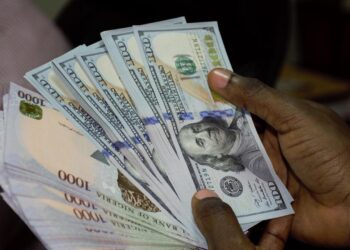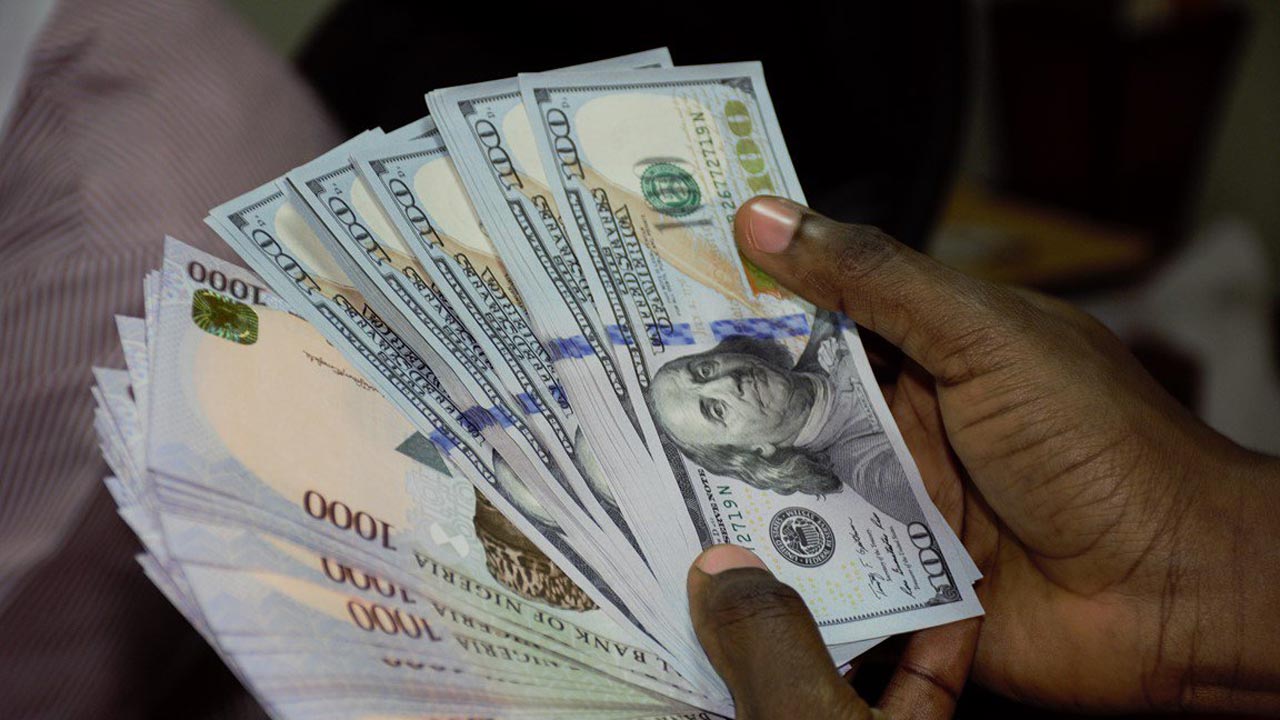
The naira extended its losing streak on Thursday, sliding to ₦1,355 per dollar as domestic pressures and global tensions continued to batter the local currency.
Data released by the Central Bank of Nigeria (CBN) confirmed the depreciation from ₦1,348.1 to the dollar recorded just a day earlier on Wednesday, a move that, while modest in isolation, forms part of a troubling pattern that has analysts watching the trajectory of Africa’s largest economy with growing unease.
The naira’s slide on Thursday was not merely a one-day event. Intraday trading data painted a picture of a currency struggling to find its footing, fluctuating between ₦1,350 and ₦1,355.8 per dollar across 46 interbank deals, a relatively thin deal count that speaks to the limited liquidity defining Nigeria’s foreign exchange market in recent sessions. The simple average rate for the day settled at ₦1,354.19 to the dollar.
Cast that against the rate recorded just one week earlier, ₦1,341.01 to the dollar on April 17, and the pattern becomes impossible to ignore. In the space of five trading sessions, the naira has shed roughly ₦14 in value, a consistent downward drift that has market watchers speaking carefully but pointedly about the direction of travel.
“The data is telling a very clear story,” one Lagos-based currency analyst said. “You have persistent demand pressure, limited supply, and a CBN that has less room to intervene than it did even a month ago. That is a difficult combination.”
Compounding the pressure on the naira is a quiet but consequential erosion in Nigeria’s external reserves. According to the latest figures, gross reserves fell to $48.48 billion, down from $48.54 billion recorded at the start of the week on April 20. While the drop of roughly $60 million may appear marginal in absolute terms, its significance lies in what it signals: a reduced buffer for the CBN to deploy in defense of the currency.
Nigeria’s foreign reserves have long served as the central bank’s primary tool for smoothing out volatility in the foreign exchange market, allowing it to inject dollar liquidity when demand spikes and the naira comes under pressure. A declining reserve position, even a gradual one, narrows the window for intervention, and markets are acutely aware of it.
The steady drawdown, taken together with the naira’s slide, suggests that supply-side constraints are deepening. Dollars are not flowing into the market at the pace needed to meet demand, and the gap, for now, is being filled by depreciation.
If domestic factors are providing the kindling, global dynamics are adding the flame. Across international markets on Thursday, the U.S. dollar strengthened on the back of safe-haven demand as investors and traders reacted to a deteriorating geopolitical picture centered on the Middle East.
Stalled peace negotiations between the United States and Iran have reignited fears of a broader conflict in one of the world’s most strategically sensitive waterways. Mounting tensions around the Strait of Hormuz have raised the specter of potential supply disruptions, a scenario that historically sends investors rushing toward the dollar as a store of safety.
The dollar index, a measure of the greenback’s strength against a basket of major currencies, hovered around 98.82 on Thursday and remained firmly on course for a weekly gain of 0.58 percent, a notable move in a market where fractions of a percentage point carry enormous consequences.
The dollar’s advance was felt well beyond Abuja and Lagos. The euro, British pound, and Japanese yen all recorded weakness against the greenback. Emerging market currencies fared no better: the Philippine peso, Malaysian ringgit, and Indian rupee each posted losses, a reminder that Nigeria’s naira is not alone in bearing the weight of a stronger dollar—but also that the country’s specific domestic vulnerabilities make its exposure sharper than most.
For Nigeria, the intersection of domestic FX illiquidity, declining reserves, and a globally resurgent dollar presents a challenging outlook in the near term. The CBN has, in recent months, taken a series of steps to reform the country’s foreign exchange framework, including moves toward a more unified, market-reflective exchange rate, but those reforms are yet to unlock the sustained foreign inflows that would provide meaningful relief.
Business owners dependent on dollar-denominated imports, manufacturers sourcing raw materials from abroad, and consumers at the end of a long chain of FX-sensitive prices are all, in different ways, absorbing the consequences of a naira that has now weakened by over N14 in a single week.
Unless the CBN signals a more aggressive intervention posture, or global risk sentiment shifts in a direction that cools dollar demand, analysts say the path of least resistance for the naira in the sessions ahead remains downward.
WHAT YOU SHOULD KNOW
Nigeria’s naira continued its downward spiral this week, touching ₦1,355 to the dollar on Thursday, its weakest level in recent sessions as thinning foreign reserves and surging global demand for the U.S. dollar tighten the squeeze on Africa’s largest economy.
With external reserves slipping to $48.48 billion and interbank dollar supply remaining constrained, the CBN has shrinking room to defend the currency.
Meanwhile, geopolitical tensions in the Middle East are driving investors toward the dollar, hitting emerging market currencies hard, and Nigeria, with its import-dependent economy, is feeling that pain more acutely than most. Until foreign inflows improve or global risk appetite softens, the naira’s outlook remains firmly under pressure.