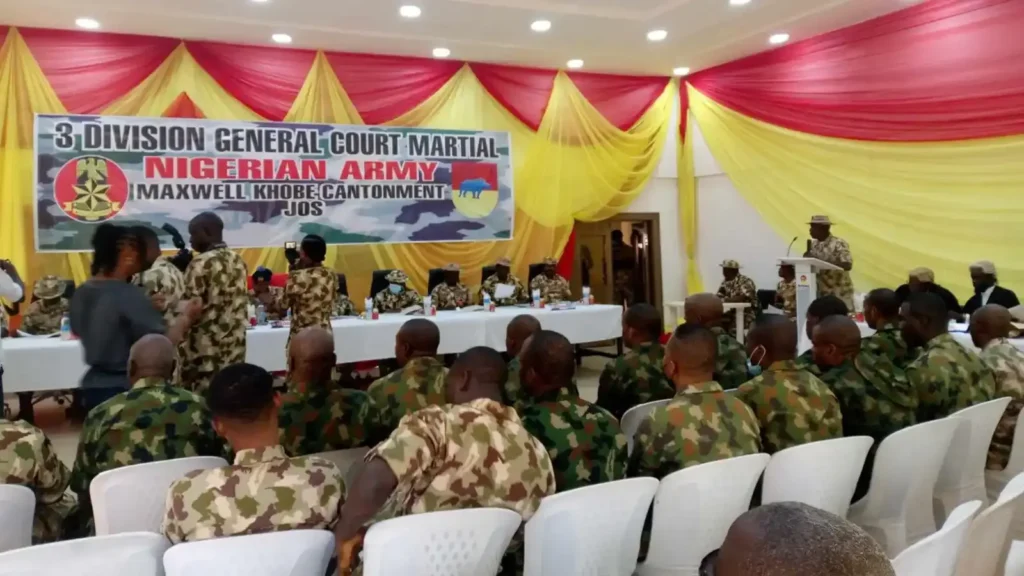
The Nigerian military has inaugurated a general court-martial to prosecute 36 personnel accused of participating in an alleged plan to overthrow the administration of Bola Ahmed Tinubu, marking a significant development in the unfolding security case.
The court-martial, established by the Defence Headquarters, was formally inaugurated on Friday at the Scorpion Mess in Asokoro, Abuja, under tight security arrangements. Despite the seriousness and public interest surrounding the matter, proceedings were conducted behind closed doors.
Journalists, including defence correspondents who had earlier been invited, were denied entry into the venue. Security operatives also prohibited the use of mobile phones to capture the arrival of the accused personnel, who were conveyed to the location in an Army Headquarters Garrison bus around 8:53 a.m.
The military trial is running concurrently with separate criminal proceedings initiated by the Federal Government at the Federal High Court in Abuja, creating a dual-track legal process that has drawn scrutiny.
On April 22, the Attorney-General of the Federation, Lateef Fagbemi, arraigned another set of suspects allegedly connected to the same plot before Justice Joyce Abdulmalik. The defendants in that case, comprising retired military officers, a serving police officer, and civilians, pleaded not guilty to a 13-count charge involving treason, terrorism, and money laundering.
According to the prosecution, the accused individuals conspired in 2025 to undermine the Nigerian government and failed to disclose the alleged plot to relevant authorities. The court subsequently ordered their remand in the custody of the Department of State Services, with an expedited hearing fixed for April 27.
The parallel prosecution of suspects in both civilian and military courts has sparked a growing legal controversy. Prominent human rights lawyer, Femi Falana, has called on the Attorney-General to invoke Section 174 of the Constitution to halt the court-martial and consolidate all related cases before the Federal High Court.
Falana argued that offences such as treason and terrorism fall strictly within the jurisdiction of the Federal High Court under Section 251 of the Constitution. He questioned the legal rationale behind trying some suspects in civilian courts while subjecting others to a military tribunal for the same alleged offences.
“Courts-martial lack the jurisdiction to handle such grave constitutional offences,” Falana stated, adding that even during previous military regimes, coup-related matters were often handled by special tribunals rather than conventional courts-martial.
The military had earlier disclosed that the alleged coup attempt was uncovered through internal intelligence operations, which led to the arrest of the suspects now facing trial.
Meanwhile, families of the accused, alongside activist Omoyele Sowore, have demanded transparency in the judicial process. They have urged authorities to ensure that all proceedings are conducted within a civilian legal framework to safeguard the fundamental rights of the defendants.
The case continues to generate national attention, with legal experts and civil society groups closely monitoring how the government navigates the intersection of military justice and constitutional law in one of the most sensitive trials in recent times.
What you should know
The trial of 36 military personnel over an alleged coup plot has raised serious legal and constitutional questions in Nigeria. While the military has opted for a court-martial, parallel proceedings in a civilian court have sparked debate over jurisdiction and due process.
Legal experts argue that offences like treason and terrorism should be handled exclusively by the Federal High Court. The situation highlights tensions between military justice and constitutional law, as well as concerns about transparency and fair trial rights.
The outcome could set a major precedent for how similar cases are handled in Nigeria’s democratic system.