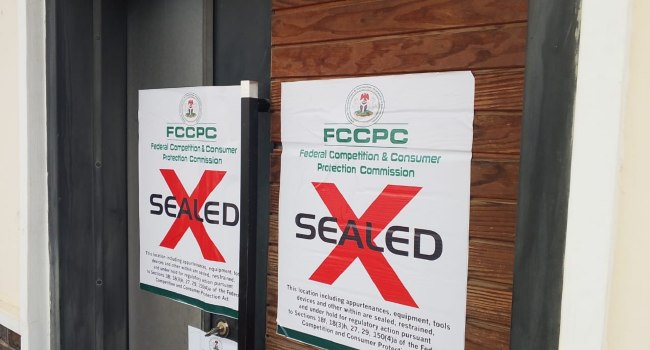
Nigeria’s Federal Competition and Consumer Protection Commission (FCCPC) has sealed off Paradise Estate, located in the Life Camp Extension area of the Federal Capital Territory.
The Commission describes its action as a result of a sustained pattern of consumer rights violations that left an untold number of homebuyers out of pocket and without the properties they paid for.
The sealing, which marks one of the more visible regulatory interventions in Nigeria’s notoriously murky real estate market in recent memory, came after a prolonged period of non-compliance by the estate’s management, a sequence of events that regulators say left them with no viable alternative but to act.
At the heart of the matter is a story that has become painfully familiar to thousands of Nigerians chasing the dream of homeownership: buyers who handed over full payment for housing units, only to watch deadlines come and go with no keys, no structures, and, in many cases, no meaningful explanation from the developer.
According to the FCCPC, multiple formal complaints had been lodged against Paradise Estate by aggrieved buyers who alleged they had made complete payments for residential units that were never delivered. The Commission says it engaged the estate’s management through the appropriate regulatory channels, issuing directives that were, time and again, reportedly ignored.
“The developer was given a seven-day window to respond to an official summons,” said Marvin Nadah, the FCCPC’s Deputy Director of Surveillance, speaking to reporters at the scene. “They failed to comply. That non-compliance triggered our visitation and the eventual sealing of the premises.”
Nadah’s words were measured, but the weight of what they represented was unmistakable: a government agency publicly drawing a line in the sand against a real estate operator accused of leaving ordinary Nigerians financially stranded.
Paradise Homes did not accept the Commission’s action without protest. Aloysius Ezenwa, the company’s head of legal, arrived on the scene and mounted a robust defence, arguing that all transactions between the developer and its buyers are governed by an existing “Contract of Sale,” a legal instrument he maintained shields the company from the kind of regulatory enforcement the FCCPC was pursuing.
Ezenwa described the sealing as heavy-handed and inappropriate, insisting that the underlying dispute is fundamentally a contractual matter that ought to be resolved before a designated tribunal rather than through the blunt instrument of a regulatory shutdown.
“This is a contractual matter,” Ezenwa argued, his frustration evident. “It should be settled before a tribunal.”
It is a line of argument that will be familiar to legal observers, the invocation of the sanctity of private contracts as a firewall against regulatory intervention. Whether it will prove persuasive in this instance remains to be seen.
The Commission, for its part, was unequivocal. Officials maintained that their actions were entirely lawful and that, as of the time of the sealing, no court order or appeal had been served on them to halt the process. In the absence of such a legal instrument, they said, there was no basis to stand down.
Beyond the specifics of the Paradise Estate case, the FCCPC’s intervention carries a broader message, and the Commission appears keenly aware of that fact.
In its public statements, the agency reiterated its commitment to prioritizing the rights of Nigerian consumers and ensuring that real estate developers are held to account for the obligations they undertake when they accept payments from members of the public.
The warning to the wider industry was pointed: adhere strictly to your contractual obligations and to the provisions of consumer protection law, or face consequences.
The sealing of Paradise Estate shines an uncomfortable spotlight on Nigeria’s real estate sector, a market that has long been a breeding ground for disputes between developers and buyers, disputes that often leave the buyer in the weakest possible position, having parted with life savings, pension funds, or loan proceeds, with little immediate recourse.
Consumer protection advocates have for years called on regulators to take a more muscular approach to unscrupulous developers, arguing that the law already provides sufficient grounds for enforcement but that political will has historically been in short supply.
The FCCPC’s latest move suggests that calculus may be shifting, though for the buyers of Paradise Estate, many of whom may have been waiting years for homes they have already fully paid for, the real measure of success will be whether the sealing translates into actual accountability, and ultimately, into the homes or refunds they were promised.
As legal arguments continue to take shape and the Commission stands by its enforcement action, one thing remains clear: the residents of Abuja’s real estate market, buyers and developers alike, are watching closely.
The outcome of this case could set a significant precedent for how consumer rights violations in the housing sector are handled for years to come.
WHAT YOU SHOULD KNOW
The FCCPC’s sealing of Paradise Estate in Abuja sends a clear and timely message: collecting payment without delivering on contractual promises is not just a business dispute; it is a consumer rights violation with real regulatory consequences.
At the core of this story are ordinary Nigerians who paid in full for homes they never received and a developer who repeatedly ignored official directives until enforcement came knocking at its door.
Whatever legal arguments Paradise Homes chooses to pursue, the Commission has made its position plain: consumer protection law stands above contractual convenience.