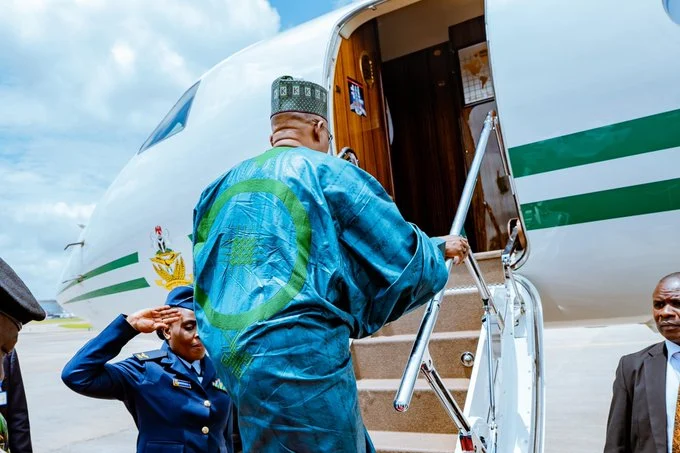
Vice President Kashim Shettima departed Abuja for Luanda, Angola, on Saturday to represent President Bola Tinubu at the African Union’s 21st Extraordinary Summit, a gathering seen as one of the continent’s most significant peace and security meetings in recent times.
The Vice President’s departure was confirmed in a statement issued on Saturday by Stanley Nkwocha, Senior Special Assistant to the President on Media and Communications in the Office of the Vice President.
According to Nkwocha, the extraordinary session has been convened specifically to interrogate strategies for conflict resolution and to chart a path toward lasting peace and stability across a continent still grappling with entrenched crises from the eastern Democratic Republic of Congo to the Sahel and the Horn of Africa.
Shettima is not travelling to Luanda alone. He is being accompanied by a delegation of senior defence and security officials, a composition that signals the weight Abuja is placing on the security dimensions of the summit rather than treating it as a purely ceremonial or diplomatic outing.
The choice of Angola’s capital as host is itself notable. Luanda has, in recent years, positioned itself as a hub for African-led mediation efforts, and the Angolan presidency has repeatedly framed its stewardship of continental affairs around dialogue-first approaches to crises such as the conflict in the eastern DRC.
Against that backdrop, the 21st Extraordinary Session brings together heads of state, government leaders, and other key stakeholders from across the continent to thrash out what the statement described as “practical solutions to regional security challenges.”
At the heart of the deliberations will be efforts to strengthen the African Union’s continental mechanisms, the architecture through which the bloc attempts to anticipate, prevent, mediate, and ultimately resolve disputes before they metastasize into full-blown conflicts.
It is a conversation that has taken on fresh urgency as security challenges continue to test the AU’s institutional capacity across multiple fronts simultaneously.
For Nigeria, the summit offers another platform to reassert a role it has long claimed: that of a continental heavyweight in peacekeeping and conflict resolution.
Abuja’s statement was explicit on this point, noting that the country “has continued to play a strategic role in peacebuilding and conflict resolution across Africa and beyond,” a reference that echoes Nigeria’s decades-long history of troop and diplomatic contributions to regional interventions, from ECOWAS peacekeeping missions to its long-standing engagement with AU security frameworks.
Nkwocha’s statement made clear that Nigeria’s presence in Luanda is intended to go beyond attendance.
The delegation is expected to actively shape deliberations on reinforcing the mechanisms through which the AU prevents conflicts, resolves disputes, and sustains peace once agreements are reached in three distinct but interlocking phases of the peace-and-security cycle that have often proven the AU’s weakest links in practice.
“Senator Shettima will join African leaders and other key stakeholders converging on the Angolan capital to discuss practical solutions to regional security challenges and strengthen collective efforts towards conflict prevention and resolution,” the statement read, underscoring that Nigeria’s participation is meant to reaffirm, not merely restate, its long-standing commitment to the continent’s peace architecture.
The centerpiece of Shettima’s assignment in Luanda will be the delivery of President Tinubu’s address to the Assembly. According to the statement, the vice president will use the address to outline Nigeria’s position on the issues under consideration and to reaffirm the country’s commitment to peace and stability across Africa.
That Tinubu opted to send his deputy rather than travel personally is not unusual for extraordinary sessions of this nature, which frequently draw a mix of heads of state and high-level vice-presidential or ministerial delegations depending on competing domestic and diplomatic calendars.
What will matter, ultimately, is the substance of the address Shettima delivers on the President’s behalf and how Nigeria’s stated positions align with, or diverge from, the emerging continental consensus on strengthening the AU’s conflict prevention machinery.
Shettima is expected to return to Nigeria once his engagements in Angola are concluded, though the statement did not specify an exact date for his return or a full itinerary for the summit’s proceedings.
As with past extraordinary sessions, the real test of Luanda’s outcomes will lie not in the declarations issued at the close of the Assembly, but in whether African states, including Nigeria, follow through on whatever commitments emerge to reinforce the continent’s capacity to prevent, manage, and resolve conflict.
WHAT YOU SHOULD KNOW
Vice President Kashim Shettima has traveled to Luanda, Angola, to represent President Tinubu at the AU’s 21st Extraordinary Summit, where African leaders are focused on strengthening continental mechanisms for conflict prevention and resolution.
Accompanied by senior defence and security officials, Shettima will deliver Tinubu’s address, reaffirming Nigeria’s long-standing role as a leading voice in African peacebuilding, underscoring that the country isn’t just attending but actively shaping how the continent tackles its security challenges.