Peter Obi Outlines Plan to Pull Nigeria Out of Poverty
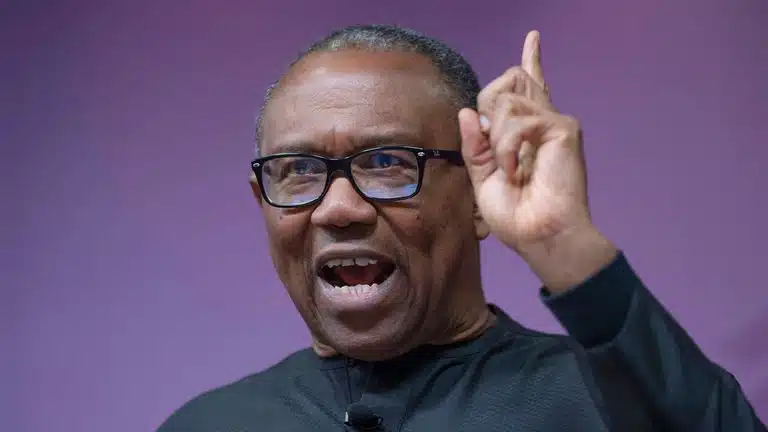
The presidential candidate of the Nigeria Democratic Congress (NDC), Peter Obi, has outlined plans to move Nigeria from a consumption-based economy to one driven by production, agriculture, manufacturing and small businesses.
Speaking during an interview on Channels Television’s Sunday Politics, Obi said Nigeria has the land, natural resources and workforce needed to become a major producer and exporter if the right policies are put in place.
The former Anambra State governor argued that increasing local production and reducing dependence on imports would help address unemployment and poverty.
“The only way to pull Nigeria out of poverty, or even genuinely grow GDP, is through production, not consumption. That production starts with agriculture, which gives you the food you need, raw materials for your factories, and jobs. That’s a win-win,” he said.
Obi said agriculture would be the foundation of his economic plan, insisting that Nigeria could earn more from farming and agro-processing than it currently makes from crude oil.
“This country can produce enough of what we can eat, and we can actually make more money from agriculture than we make from oil because, as it is today, we have vast uncultivated land,” he said.
Using rice production as an example, Obi said Nigeria was not making full use of its agricultural potential.
He blamed years of relying on cheap food imports for weakening local farming and discouraging farmers.
“We’ve used cheap importation to kill our farmers. We can do more,” he said.
Obi compared Nigeria with Bangladesh, noting that the Asian country produces far more rice despite having a smaller land area.
“Bangladesh today produces about 15 to 16 million tonnes of unmilled rice… they are now the third or fourth largest producer globally,” he said.
He said Nigeria could achieve similar success by investing in modern farming, infrastructure and agricultural businesses.
Obi also pointed to the Netherlands as an example of how agriculture can become a major source of foreign exchange.
“The Netherlands earns over €120 billion, about $130 billion, from agricultural exports every year. That’s three times what we earn from oil,” Obi said.
He also mentioned Morocco, Ethiopia and Kenya as countries that have built strong agricultural export industries.
“Around Valentine’s Day, planes are flying out with flowers we could be cultivating ourselves,” he said, referring to Kenya’s flower exports.
Obi stressed that improving security is essential to reviving agriculture, saying many fertile farming areas have been abandoned because of insecurity.
He cited Niger State as one of the regions with huge agricultural potential that has been affected by terrorist activities.
“Niger State today is virtually occupied by terrorists, yet it has vast, fertile, cultivable land. If you put resources behind it, you can turn it around,” he said.
He also spoke about the Sambisa Forest, saying it should eventually become an economically productive area.
“Sambisa is about 60,000 square kilometres, twice the size of Belgium… Belgium feeds itself and exports food,” he said.
Obi added that Taraba State and the Mambilla Plateau have the right climate for large-scale tea and coffee production for export.
He said agriculture alone would not be enough without a strong manufacturing sector to process raw materials, reduce imports and create jobs.
“From there you move into manufacturing,” he said.
According to him, Nigeria must develop industries that process its natural and agricultural resources instead of exporting them in their raw form.
“To build a strong economy, you need a strong manufacturing base, and you must export,” Obi added.
Obi also said small businesses would play a key role in his economic agenda, with the government creating an environment that supports private enterprise.
“I never said government would produce. We will encourage the private sector, entrepreneurship, and small businesses,” he said.
He argued that small and medium-sized businesses in Nigeria are struggling because of high interest rates, poor infrastructure and limited government support.
Referring to Indonesia, he said small businesses are major employers because they receive government-backed financing.
“How can you run a small business with no government support, no training, and interest rates at 35 per cent? It’s impossible,” he said.
He also cited China, where small businesses account for a large share of employment, particularly in urban areas.
Obi said Nigeria needs affordable loans, skills development and a more stable business environment to achieve similar results.
Asked whether he would immediately ban food imports if elected, Obi said such a move would only happen after local production becomes strong enough to meet demand.
“Not without first building up local production and employment,” he said.
He referred to India and Vietnam as countries that gradually reduced dependence on food imports before becoming major producers and exporters.
Obi acknowledged that building a production-driven economy would take time but said Nigerians need to see steady progress.
“People always say you can’t do it, but let’s start, let people see it. Nobody achieves anything overnight. Rome wasn’t built in a day, but people saw its foundation and saw it going up,” he explained.
He added that visible progress would restore confidence in the country.
“What drives a process is hope; hope gives people faith,” Obi said.
He maintained that improving security, boosting agriculture, expanding manufacturing and providing affordable financing for businesses would help create jobs, reduce poverty and reposition Nigeria as a competitive productive economy.