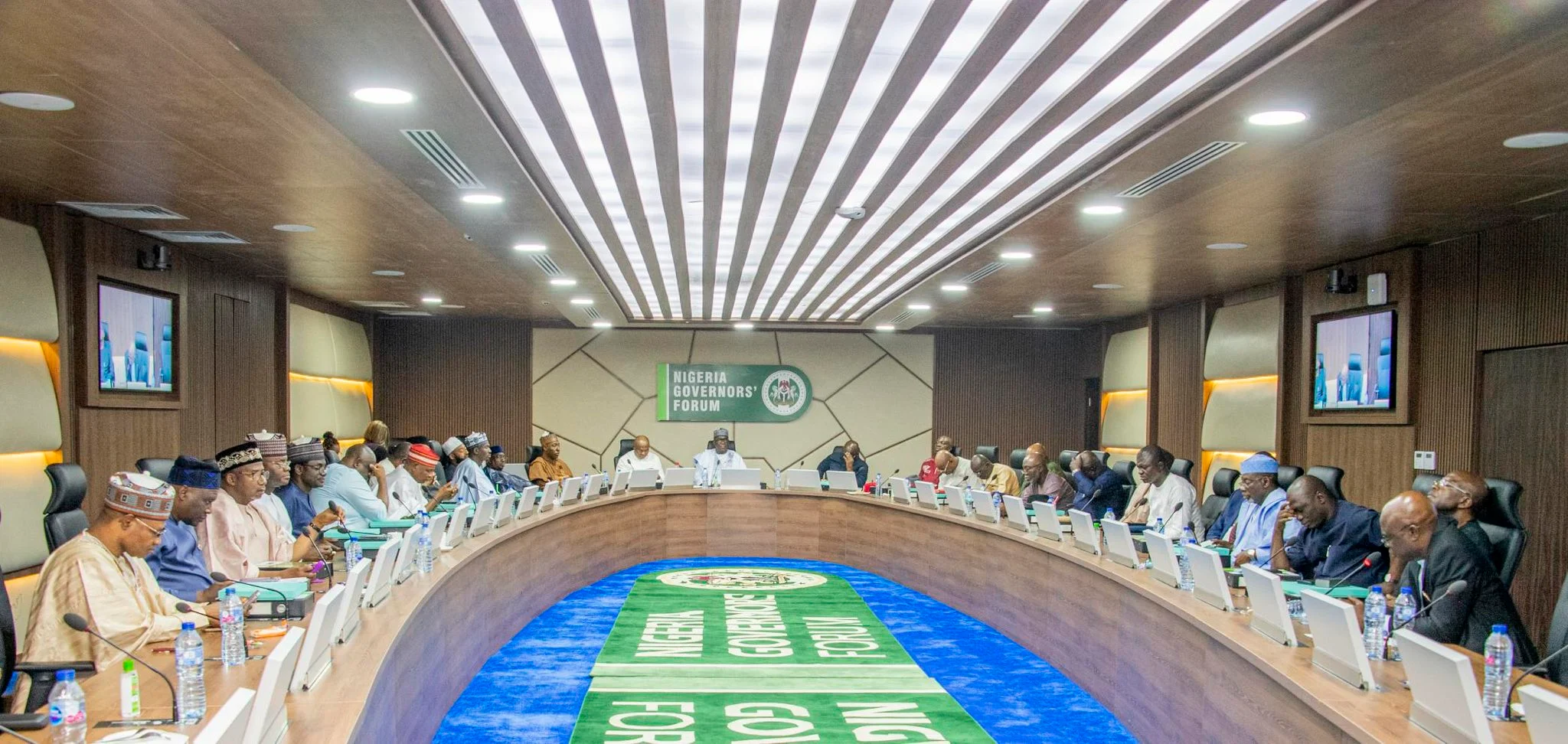
Governors from all parts of Nigeria convened in Abuja on Wednesday for an emergency session of the Nigeria Governors’ Forum (NGF), amid escalating national security concerns.
The high-level meeting, held at the NGF Secretariat in the nation’s capital, drew a full house with governors and deputy governors from the country’s 36 states in attendance.
While the official agenda was not immediately released to the public, the presence of key federal security figures, including the National Security Adviser, Nuhu Ribadu, and Minister of Defence, Mohammed Badaru, strongly pointed to the centrality of national security in the day’s deliberations.
Their attendance underscored the urgency of recent developments, particularly with the surge in violent attacks across various regions, including the North-Central states.
The meeting comes in the wake of renewed insecurity, ranging from banditry and communal violence to terrorist threats, which have prompted increasing calls for decisive and coordinated responses from both federal and state governments.
In response to the ongoing crisis, the Progressive Governors’ Forum (PGF), a body composed of governors elected under the ruling All Progressives Congress (APC), publicly reaffirmed its support for President Bola Tinubu’s efforts to address insecurity across the country.
Following a three-hour closed-door session, the chairman of the PGF and governor of Imo State, Hope Uzodimma, addressed journalists and outlined the governors’ collective position on the security crisis.
Governor Uzodimma noted that the forum is currently considering the creation of state police as part of a broader effort to enhance local security frameworks and support the federal government’s strategy. He specifically referenced a proposal by Benue State Governor Hyacinth Alia, who has been an outspoken advocate for localized security arrangements in light of the persistent violence in his state.
“We are not only backing Mr. President in his security agenda, but we are also exploring practical steps to improve security at the grassroots,” Uzodimma said. “One of the options on the table is the introduction of state police, in line with what Governor Alia of Benue has proposed.”
Governor Alia had earlier made his case for state policing during President Tinubu’s recent visit to Benue State, where the president commiserated with victims of a deadly attack in the Yelwata community, Guma Local Government Area. The attack claimed dozens of lives and displaced thousands, prompting renewed discussions about how best to protect vulnerable rural communities.
“Let me also reiterate my firm support for the establishment of state police as a sustainable solution to the persistent insecurity in our state and perhaps elsewhere,” Alia had said during the president’s visit. “While I acknowledge the concerns surrounding its implementation, I believe the federal government can address these by setting clear state-specific guidelines and regulatory frameworks to prevent any potential misuse.”
With calls for state policing growing louder, the governors’ alignment on the issue marks a significant shift in national security discourse. Historically, proposals for state police have been met with reservations over fears of abuse, particularly regarding political interference.
However, the current crisis appears to have changed the tone of the debate, with more leaders now viewing it as a necessary reform.
As discussions continue behind closed doors, Nigerians await a formal communiqué from the NGF that could reveal further steps or policy recommendations. Analysts suggest the meeting could set the tone for a broader national push toward restructuring the country’s security architecture, especially as pressure mounts on both the presidency and state executives to deliver concrete results.
What You Should Know
An emergency meeting of Nigeria’s governors was held in Abuja to address worsening insecurity nationwide. While no formal communiqué has been released, there is a strong push among governors, especially in the Progressive Governors’ Forum, to back President Tinubu’s efforts and consider implementing state police as a localized security solution.