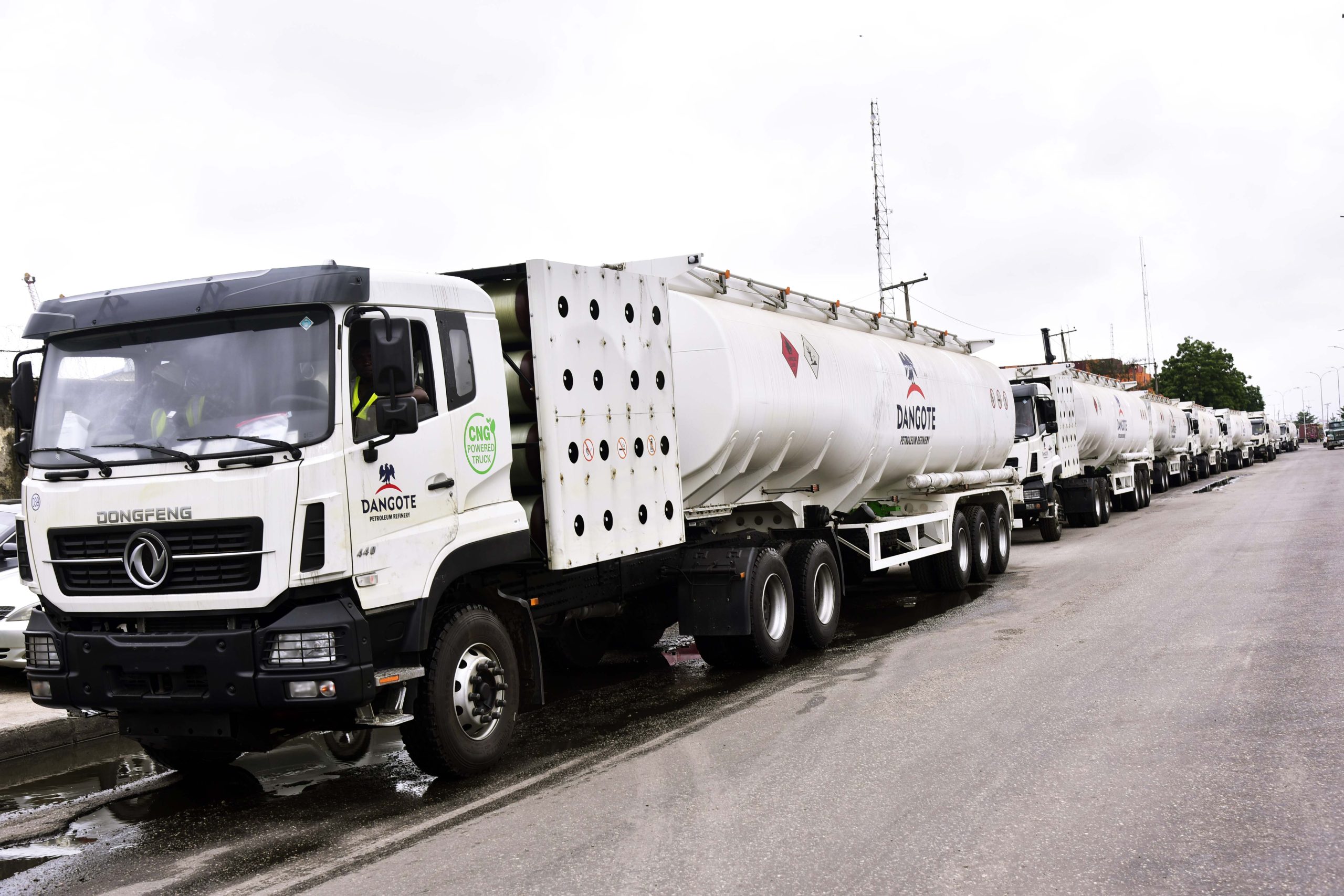
On Saturday morning, petrol tankers lined the Lagos-Ibadan Expressway, not a sign of scarcity this time, but of supply.
The gridlock, ordinarily a source of frustration for commuters, was, in this instance, a signal of something far more consequential: the Dangote Petroleum Refinery & Petrochemicals is ramping up, and Nigerians are beginning to feel it at the pump.
Motorists at MRS stations on Saturday morning were met with fuel priced at N1,282 per liter, noticeably lower than the N1,295 to N1,380 per liter commanded at rival stations.
The price drop follows the refinery’s announcement last Saturday that it had slashed its ex-depot price for Premium Motor Spirit (PMS) to N1,250 per litre, down from N1,275, while diesel (AGO) prices were cut from N1,800 to N1,700 per litre.
For ordinary Nigerians who have endured years of volatile fuel prices and crippling scarcity, the movement on the dial, however modest, is being watched closely.
In a statement released on Friday, the refinery disclosed that in a performance test conducted by its process licensors, the facility achieved a crude oil processing capacity of 700,000 barrels per day (bpd), surpassing its own nameplate capacity of 650,000 bpd by 50,000 barrels.
The achievement, the refinery says, validates its ability to extract more output from the same infrastructure while maintaining operational efficiency across all production units.
It is a significant milestone for a plant that only commenced fuel production in 2024 and has since been on an aggressive upward trajectory.
Devakumar Edwin, Vice-President for Oil and Gas at Dangote Industries Limited, described the record as part of a wider ambition. “This is not the ceiling,” he said in effect; the refinery’s sights are set on 1.4 million barrels per day within 30 months, a figure that would make it, unambiguously, the largest single refinery on the planet.
Aliko Dangote’s refinery has moved with striking speed from a domestic fuel supplier to a player in global energy markets. Refined petroleum products from Lekki now reach consumers across multiple African nations and have landed in the United Kingdom, France, Spain, Italy, and the Netherlands.
Gasoline has been shipped to the United States, and jet fuel has been delivered to Saudi Arabia, a country that sits atop some of the world’s largest oil reserves and yet is buying refined products from Nigeria.
In April, industry data firm S&P Global Commodities confirmed what many had begun to suspect: Dangote Petroleum Refinery had become the world’s largest exporter of jet fuel.
In a global energy landscape still rattled by Middle East tensions that disrupt traditional supply chains, the refinery has emerged, according to its own assessment, as “a stabilizer in the oil and gas industry,” with several African nations now actively redirecting procurement to Lekki for energy security.
For a country that once spent billions of dollars annually on imported refined petroleum products and watched a significant share of its foreign exchange reserves drain into overseas refiners’ accounts, the shift is more than commercial. It is structural.
The refinery’s expansion aligns with a long-standing national ambition to end Nigeria’s paradoxical dependence on imported fuel despite sitting on some of Africa’s largest crude oil reserves. Analysts have long argued that the country’s failure to refine its own oil represented one of the most costly policy failures in its economic history.
By eliminating that import dependency, the Dangote refinery is, in theory, plugging a hemorrhage in Nigeria’s balance of payments and freeing up foreign exchange that can be deployed elsewhere in the economy.
Beyond fuel, the facility promises to supply LPG, polypropylene used widely in packaging, and Linear Alkylbenzene (LAB), a key feedstock for detergent manufacturing. These are not peripheral products. They feed into the everyday lives of tens of millions of Nigerians and have the potential to anchor a broader downstream manufacturing ecosystem.
Dangote has publicly committed to achieving a processing capacity of 1.4 million barrels per day by 2028. If realized, it would be a feat with few precedents in global industrial history: the construction of the world’s largest refinery, on the African continent, in under a decade.
The ambition has drawn increased attention from global crude suppliers and commodity trading firms, many of whom are now actively seeking feedstock supply arrangements with the facility. The refinery sources crude both domestically and internationally to sustain its output growth.
Whether the 2028 target is met on schedule remains to be seen. Mega-projects of this nature rarely proceed without setbacks.
But as tanker queues stretch down the Lagos-Ibadan Expressway on a Saturday morning and as petrol prices tick even slightly downward at neighborhood filling stations, the evidence that something consequential is underway is increasingly difficult to ignore.
WHAT YOU SHOULD KNOW
Dangote Refinery is no longer a promise; it is a functioning industrial force reshaping Nigeria’s energy reality.
Having broken its own capacity ceiling at 700,000 barrels per day, slashed petrol prices, and established itself as the world’s largest jet fuel exporter, the facility is systematically dismantling Nigeria’s costly dependence on imported refined petroleum.
With an audacious target of 1.4 million barrels per day by 2028, what began as a domestic fuel solution is rapidly becoming a global energy power built in Africa, for Africa, and increasingly, for the world.