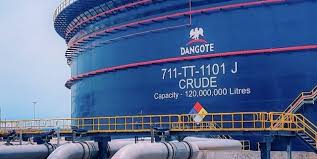
Dangote Petroleum Refinery, Africa’s largest oil refining facility, announced a fresh upward review of its ex-depot price for Premium Motor Spirit (PMS), effective Wednesday.
The refinery hiked the ex-depot price of petrol from N1,200 to N1,275 per liter, a N75 jump, while coastal supply prices simultaneously climbed to N1,215 per liter.
The 3.15 percent adjustment, though modest in percentage terms, is expected to reverberate across the downstream petroleum sector, with marketers widely anticipated to pass the additional cost burden directly to millions of Nigerian consumers at the pump.
The latest price review does not occur in isolation. Wednesday’s announcement comes as Brent crude trades at $114.80 per barrel, levels not seen in years amid escalating geopolitical tensions in the Middle East that have sent global oil markets into a tailspin.
Industry observers warn that marketers are likely to transfer the additional cost to consumers, potentially pushing up transportation and production expenses nationwide.
This is not the refinery’s first price revision in recent months. In March alone, the 650,000-barrel-per-day refinery raised its gantry price from N1,175 to N1,245 per liter before eventually settling back to N1,200, a brief respite that has now been eclipsed by Wednesday’s announcement.
Diesel has also been caught in the updraft, rising N200 per liter to N1,950, dangerously close to the psychologically sensitive N2,000-per-liter threshold.
For many Nigerians, the news lands like a fresh blow to already strained household budgets. Since the removal of fuel subsidies in 2023, ordinary citizens have shouldered the full weight of market-determined fuel pricing.
Nigeria operates a deregulated downstream petroleum sector, where fuel prices are largely determined by market forces—including international crude prices, exchange rates, logistics costs, and refinery operations.
Experts who spoke on the broader context of these recurring price hikes have been measured in their assessments. Professor Emeritus of Petroleum Economics, Wumi Iledare, described the increases as a direct consequence of global crude oil dynamics rather than domestic policy shortcomings, arguing that despite Nigeria’s improved local refining capacity and the crude-for-naira initiative, domestic fuel pricing still reflects international market realities. “You cannot isolate Nigeria from what is happening in the international oil market,” he noted.
Dangote Refinery, for its part, has consistently maintained that Nigeria remains comparatively shielded from the worst of the global price storm.
The refinery has cited data showing that petrol in Nigeria is priced significantly below the global average and that within West Africa, Nigeria compares favorably with neighbors such as Togo, Benin, Ghana, and Cameroon, where pump prices are considerably higher.
Yet for the truck driver navigating Lagos traffic or the Kano trader dependent on diesel-powered generators, such comparative figures offer cold comfort.
As Brent crude continues its volatile climb, all eyes remain on whether Wednesday’s adjustment will be the last or merely the latest step in what has become a relentless upward march.
WHAT YOU SHOULD KNOW
Dangote Refinery has raised petrol’s ex-depot price to N1,275 per liter, and Nigerians should brace for higher pump prices as marketers will inevitably pass this cost on to consumers.
The root cause is not a local policy decision; it is the relentless surge in global crude oil prices driven by Middle East geopolitical tensions.