The Dangote Petroleum Refinery and Petrochemicals is being flooded with inquiries as African governments scramble to secure fuel supplies after the Iran war disrupted flows from the Middle East.
What was once a continental ambition—a homegrown refinery capable of reshaping Africa’s energy landscape—has, within weeks, become the continent’s most sought-after lifeline.
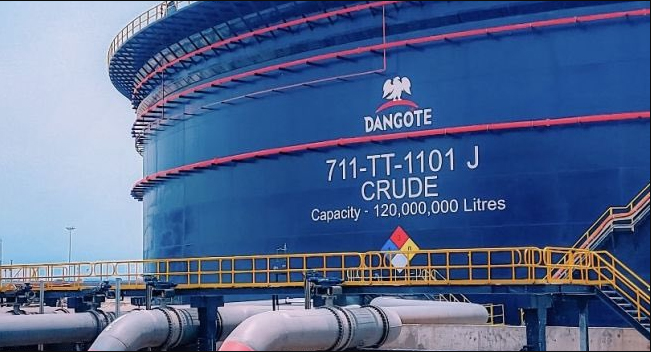
The 650,000-barrel-a-day facility has been approached by South Africa, Ghana, Kenya, and several other countries, as a company executive confirmed, with South Africa reportedly seeking a standard 12-month supply contract with Nigeria, according to people familiar with the discussions who asked not to be identified because the talks are private.
To understand the panic now gripping African energy ministries, one must first understand the structural fragility that the Iran war has so brutally exposed.
The Middle East accounts for roughly three-quarters of refined-fuel imports to East and Southern Africa—a dependence built over decades of underinvestment in domestic refining capacity.
Africa, which accounts for about 7% of the world’s crude output, had seen refining capacity shrink by about a third in the past two decades before Aliko Dangote started his facility in Nigeria two years ago.
That contraction left entire regions exposed. The refined-fuel supply crunch is especially severe across East and Southern Africa, where the margin for error is thin. Dormant refineries litter the eastern corridor—from Mombasa and Lusaka to Durban—monuments to years of neglect that now haunt governments desperately seeking alternatives.
The consequences are already playing out on the ground. In Kenya, the biggest fuel suppliers are “rationing product,” according to Martin Chomba, chairman of the Petroleum Outlets Association of Kenya, with some distributors experiencing stock-outs in rural villages.
In Ethiopia, Prime Minister Abiy Ahmed asked citizens to be frugal in their use of fuel as the government directed energy to “basic and essential needs.”
In boardrooms and government ministries from Pretoria to Nairobi, the conversation has shifted in a way that would have seemed unimaginable months ago.
“Right now it is not about pricing; it’s about availability,” Dangote told The Economist. “I think the situation will continue for a while.”
Those words, delivered with the measured confidence of a man whose $20 billion gamble on African refining is suddenly looking prescient, encapsulate the new calculus facing the continent. Governments that might once have haggled over cents per liter are now willing to sign long-term commitments simply to guarantee that fuel will arrive at all.
South Africa’s response has been particularly revealing. The country’s Department of Mineral Resources and Energy, facing heat from a public reeling from fuel price shocks, moved quickly to reassure while acknowledging the precariousness of the situation.
Jacob Mbele, director-general at South Africa’s Department of Mineral Resources, said in an interview in Cape Town, “We’re looking everywhere” for supply options, adding, “We’re comfortable that in the coming weeks or so, we are safe,” while acknowledging that “the situation is fluid; it changes every day.”
For years, critics questioned whether the Lagos mega-refinery would ever fully live up to its ambitions. The Iran war has provided the most dramatic possible answer.
Dangote’s refinery is emerging as a rare bright spot. The plant outside Lagos has been ramping up to full capacity since starting operations in 2024. Alongside smaller facilities, Nigeria is now well positioned to meet domestic fuel demand of about 493,000 barrels a day, with surplus volumes available for export.
Yet the refinery is navigating its own pressures as it attempts to play this expanded regional role. Dangote said it receives about five crude cargoes a month from the state oil company NNPC, which it pays for in naira, but requires 13 cargoes to sustain domestic supply—sourcing additional crude at prevailing international prices from local or foreign suppliers.
Refinery CEO David Bird has called for expanded crude allocations from the Nigerian government, noting the facility could “easily” absorb 13 or more cargoes per month. The implication is clear: if Nigeria is to serve as Africa’s fuel backstop, the state must first ensure the refinery itself is adequately fed.
Amid the volatility, the refinery has at various points both raised and cut its ex-depot prices in line with global crude movements, with one industry figure describing Dangote as “our salvation” given the broader market chaos.
The war’s disruption of the Strait of Hormuz has been the single most consequential chokepoint. The Strait is viewed as the world’s most important gateway for oil transport, and since the war broke out, the number of vessels travelling through it has dropped significantly, driving oil prices sharply higher.
The squeeze is exposing how refinery closures and underinvestment have left much of the continent dependent on a single trade route now at the center of a widening conflict.
And while wealthier importing nations across Asia and Europe have the financial muscle to secure alternative supply contracts, African nations face a harder reality. Securing fuel will be harder for developing nations, as richer buyers may be able to outbid them.
Whatever the conflict’s ultimate trajectory, energy analysts and policymakers agree that the Iran war has permanently altered how African governments think about fuel security. The rush to Dangote’s door is not simply a crisis response—it is the beginning of a structural realignment.
Ghana currently holds about two months of fuel stocks, providing temporary breathing room, but officials there know that comfort is fleeting. The longer the Middle East crisis persists, the greater the pressure on every government in the region to build lasting supply alternatives.
For Nigeria—long a petrostate whose citizens paradoxically bought imported fuel at subsidized prices—the moment carries a particular historical resonance. A country that spent decades exporting crude and importing refined products now finds itself the supplier of last resort for a continent in crisis.
WHAT YOU SHOULD KNOW
The Dangote Refinery, once a subject of skepticism, has emerged as Africa’s most critical energy alternative, fielding supply requests from multiple nations simultaneously.
Africa’s energy vulnerability is not a new problem—the Iran war has simply made it impossible to ignore.
The continent’s salvation may well lie in investing in its own refining infrastructure, and Dangote’s 650,000-barrel-per-day facility is proving, in real time, that African energy self-sufficiency is not just an aspiration—it is an urgent, achievable necessity.