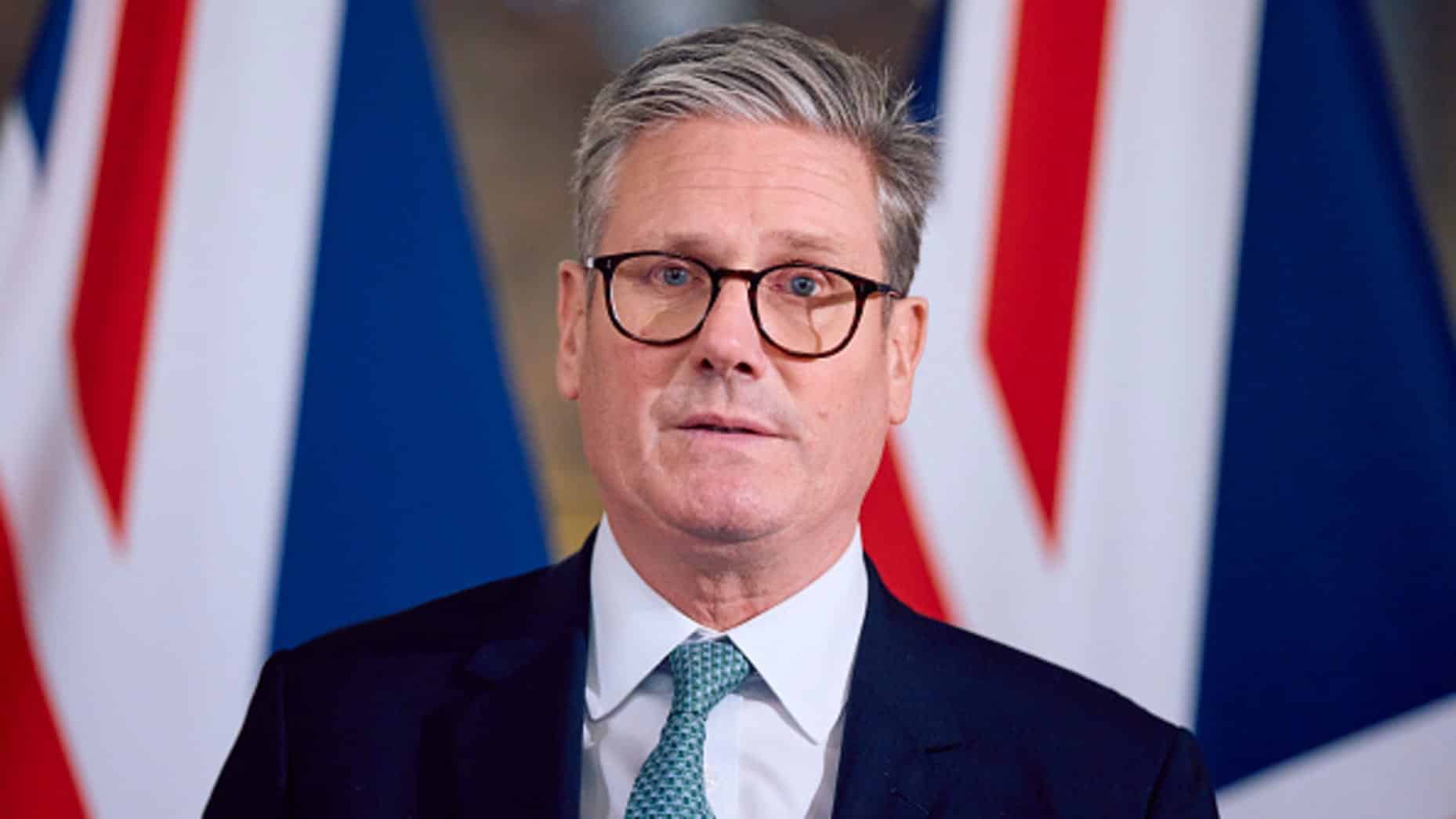
British Prime Minister Keir Starmer on Monday declared an all-out war on social media companies, announcing a total ban on platform access for children under the age of 16, a landmark policy shift that sets Britain on a collision course with some of the world’s most powerful technology corporations.
Standing before the cameras at a Downing Street press conference, Starmer was unequivocal. “Social media is making our children unhappy and unsafe,” he said, “and as a parent, as much as a prime minister, I just can’t let that go on anymore.” It was the language not of a technocrat parsing policy details but of a father, and it was clearly deliberate.
In an era of growing public fury over the mental health crisis among British youth, the Prime Minister appeared to be betting that the politics of child protection would carry him further than caution ever could.
The scope of the announcement is broad. The ban will cover social platforms, including Snapchat, TikTok, YouTube, Instagram, Facebook, and X, while messaging services like WhatsApp and Signal are not intended to be included.
The distinction matters: the government appears to be drawing a line between open, algorithmically driven platforms that expose children to strangers and addictive content loops and private, one-to-one communication tools used widely by families.
But Starmer made clear this was only the beginning. The government said it would go further still, taking what it described as “world-leading action” on gaming services and live-streaming platforms that have long operated in a regulatory grey zone when it comes to child safety.
“Is there a situation in the offline world where you would just let your child pair up with a stranger? An adult that you don’t know about? No,” the prime minister said pointedly, raising the specter of predatory adults exploiting gaming and streaming platforms to gain access to children.
The government also confirmed it is actively considering overnight curfews for under-18s online and mandatory breaks in the infinite scroll features that drive engagement and, critics argue, addiction on platforms. Further details are expected in July.
Monday’s announcement did not come out of nowhere. It follows a government-led national consultation that drew approximately 116,000 responses, the second-largest ever received on any policy issue in British history.
The message from the public was resounding: more than 83 percent of parents said the risks of social media outweigh the benefits for children, and 91 percent backed a minimum access age of 16.
That groundswell of public opinion reflects a shift years in the making. For more than a decade, child welfare campaigners, psychologists, and grieving parents, many of whom lost children to suicide linked to online harm, have argued that governments were moving far too slowly.
Over 60 lawmakers from Starmer’s own Labour Party had written to the prime minister, urging action, declaring that “successive governments have done far too little to protect young people from the consequences of unregulated, addictive social media platforms.”
Starmer himself had previously been more cautious on the issue, but the political and public pressure combined with the evidence gathered during the consultation, in which British teenagers trialed social media bans and time limits on apps, appears to have moved him decisively.
Starmer explicitly cited Australia as the inspiration for Britain’s move. Australia, which in December became the first nation to implement such a ban, holds technology companies liable with fines of up to 49.5 million Australian dollars if they fail to take reasonable steps to remove the accounts of children younger than 16.
British ministers have been studying the Australian model closely, and Starmer’s government appears prepared to adopt a similarly robust enforcement framework.
Britain is not alone in its direction of travel. Canada’s culture minister last week introduced legislation that would ban children under 16 from having social media accounts and require AI chatbot services to limit the production of harmful content.
Indonesia began enforcing its own social media ban for under-16s in March. And Spain, Greece, and Slovenia have since announced they plan similar bans, signaling that what once seemed like a radical fringe position is fast becoming international consensus.
A spokesperson for YouTube warned that a blanket ban would push children towards “less safe services,” an argument that child safety advocates have heard before and largely reject, noting that the status quo has demonstrably failed to protect young people.
Some child-protection groups, too, have raised concerns that a ban could push harmful activity into less regulated spaces or create a sharp “cliff edge” at age 16. These are not trivial concerns; enforcement has historically proved extremely challenging, as children routinely circumvent age restrictions already in place.
The government has also yet to formally define in law what precisely counts as “social media,” a definitional gap that must be resolved before any ban can take legal effect.
Some major pornography sites have already chosen to block British users entirely rather than comply with existing age-check requirements, a precedent that raises questions about how platforms might respond to the new rules and whether VPN use by minors could undermine enforcement.
The government is reportedly considering restricting VPN access for minors as part of the broader package.
Monday’s announcement sits within a broader government offensive on online child safety. Just a week earlier, Starmer’s administration told tech giants, including Apple and Google, that they had three months to introduce safety features that block children from taking and accessing nude images on their devices.
If they fail to comply, legislation will be introduced to force the technology into use.
According to analysis by the Internet Watch Foundation, 91 percent of online child sexual abuse reports recorded in 2024 contained self-generated content images and videos created by the children themselves, often under coercion.
The government described this as evidence of a system-wide failure, calling on technology companies to accept their “moral responsibility” to protect children from coercion, abuse, and sextortion.
Starmer’s government intends to bring the social media legislation to Parliament before Christmas, with the ban expected to come into force in spring next year. The timeline is ambitious, and the implementation challenges are formidable.
But the politics appear to be on the government’s side: the proposal has drawn support not only from within labor but also from the opposition Conservative Party.
What is clear is that the era of self-regulation for social media giants, at least when it comes to children in Britain, appears to be drawing to a close. Whether governments can enforce what they are now promising is the next great test.
The platforms have fought these battles before, in courtrooms and corridors of power from Brussels to Washington. But the tide, it seems, is finally turning.
WHAT YOU SHOULD KNOW
Britain has drawn a definitive line in the sand: children under 16 will be banned from major social media platforms, with legislation expected before Christmas and the ban taking effect in spring.
Driven by overwhelming public support, with 83% of parents back the move, and inspired by Australia’s pioneering ban, Prime Minister Starmer is betting that protecting children’s mental health and safety outweighs the tech industry’s objections.