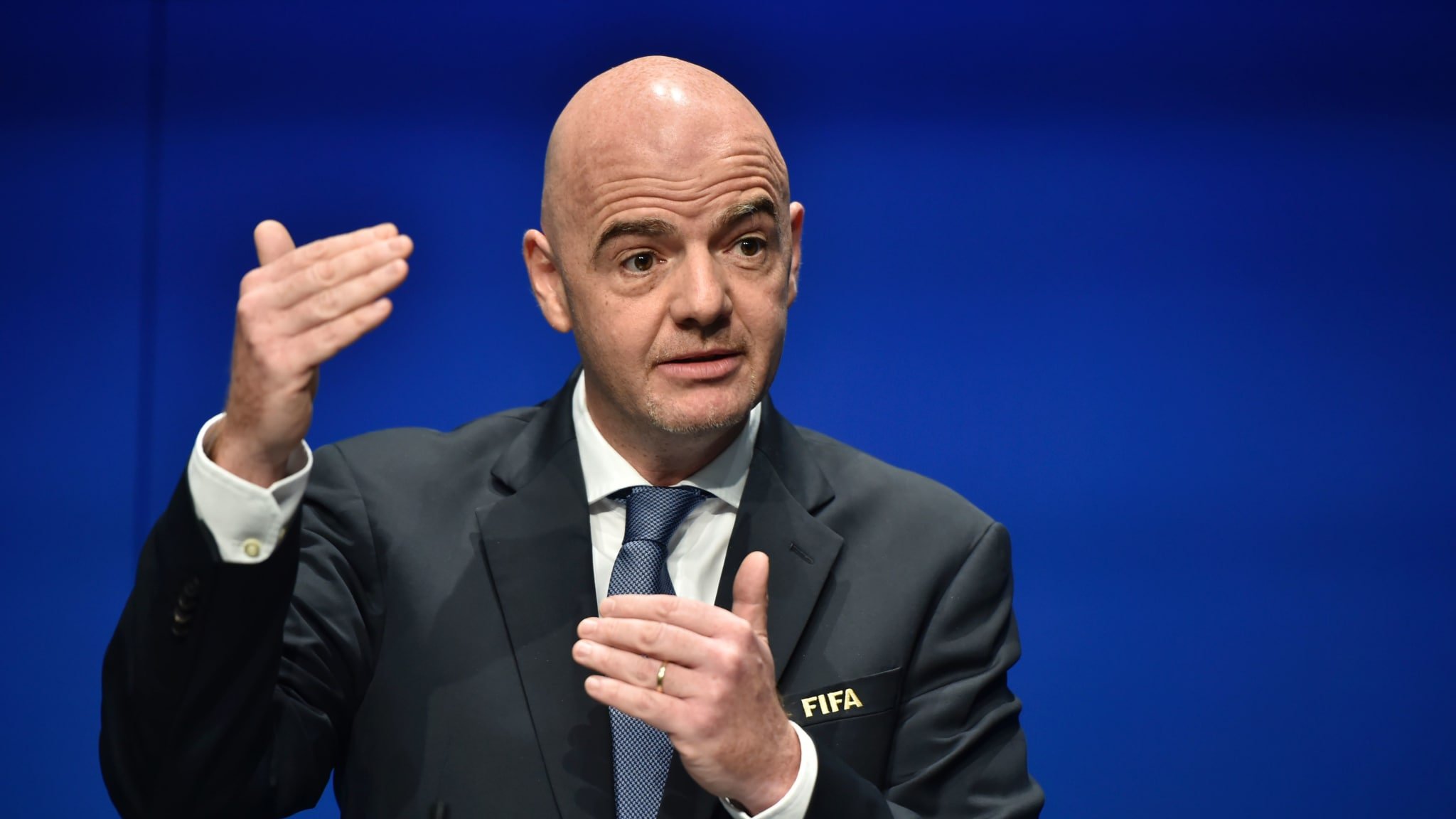
Wales became the first football association to publicly withdraw support for Gianni Infantino’s re-election as FIFA president on Monday, deepening the crisis at world football’s governing body sparked by the collapse of his plan to sell a World Cup stake to private investors.
The Football Association of Wales (FAW) confirmed its withdrawal of the candidature of Mr. Gianni Infantino for re-election as FIFA president for the 2027-2031 term, an election due to be held in Rabat next March.
In blunt language, the FAW said recent failures in good governance, processes, leadership, values, stakeholder management, communications and sound judgement had led it to conclude that Infantino had lost the confederation’s confidence to remain at the helm of world football, adding that failing to put the best interests of football first was a failure it could not accept.
The move is especially striking given the FAW’s history with Infantino. Sky Sports noted that its correspondent had witnessed Infantino being warmly hosted by the Welsh association at an IFAB meeting in Cardiff earlier this year and Wales had backed his original candidacy a decade earlier, when the association was represented by chief executive Jonathan Ford at the 2016 Zurich election that first put the Swiss lawyer in charge of FIFA following Sepp Blatter’s downfall.
Sky’s chief correspondent Kaveh Solhekol described the situation as now “approaching game over” for Infantino, coming barely two weeks after he stood alongside US President Donald Trump handing the World Cup trophy to Spain in New Jersey.
The controversy stems from a proposal, revealed publicly in media reports last week, to create a new entity, FIFA Forward Enterprise (FFE), that would run FIFA’s competitions, including the men’s and women’s World Cups, and sell roughly a fifth of it to private investors.
According to reporting, the plan was aimed at raising some $20 billion, with financier Joshua Kushner’s Thrive Eternal earmarked as lead investor a detail that drew added scrutiny given Kushner’s family ties to the Trump administration.
Crucially, member associations say they only learned of the scale of the plan through media leaks rather than through FIFA’s own channels. That triggered a rapid and furious backlash: UEFA’s 55 members voted at an emergency meeting to “unequivocally reject” the proposal and resolved that European nations would boycott all FIFA competitions, including the World Cup, if it went ahead.
CONCACAF’s 41 members followed with their own rejection, and the Asian Football Confederation’s 47 members joined them, with AFC noting fundamental weaknesses in FIFA’s consultation and decision-making processes that needed to be addressed. Combined, ESPN calculated, opposition from those three confederations alone represented well over half of FIFA’s 211 member associations.
Facing that wall of opposition, Infantino abandoned the plan in the early hours of Saturday, insisting in a statement that the FIFA Forward Enterprise project had been intended to strengthen member associations and the sport worldwide, especially in countries where support was most needed. FIFA had earlier dismissed the furore as the product of “erroneous reporting,” but the retreat did little to calm the storm.
UEFA used its Saturday statement not merely to welcome the U-turn but to launch a direct attack on Infantino’s leadership, declaring that the FIFA president had failed to deliver on the promises of transparency he made on taking office in 2016, and had failed to use member associations’ money for the benefit of the game despite reserves standing at over $5 billion.
CONCACAF was similarly scathing, describing the episode as symptomatic of leadership that had “stopped putting football first” and calling for what it termed “a comprehensive reckoning with this presidency.” The pressure was compounded when Infantino’s own senior adviser, Carlos Cordeiro, resigned in protest, saying he could not stand by while FIFA considered such a sale.
Reports also suggested that the $40 million payments dangled to member associations in exchange for backing the plan separate from FIFA’s existing Forward development funding had deepened suspicions about how the proposal had been engineered and by whom, with UEFA demanding accountability for those responsible.
England’s FA moved almost immediately to align itself with UEFA’s position, issuing a statement on Saturday declaring its full support for the European body’s stance. By Monday, Sky Sports reported that the FA was going further still, preparing to write to FIFA to formally withdraw a previous letter of support for Infantino’s candidacy, a coordinated step described as part of a broader European push to force him from office as quickly as possible.
Infantino, according to Sky’s reporting, is not going quietly. He has reportedly been encouraging federations in the Asia, Africa, and South America regions traditionally more sympathetic to his leadership to publicly reaffirm their support in an apparent effort to build momentum ahead of the March congress.
Notably, CONMEBOL, South America’s governing body, had already thrown its backing behind a fourth Infantino term before this crisis broke.
Whether Wales and England’s moves prove to be the start of a broader unravelling of Infantino’s decade-long hold on FIFA, he has been re-elected unopposed twice since 2016 or an isolated European rebellion that African, Asian and South American confederations ultimately resist, is likely to become clearer in the weeks ahead as the search for a potential unity candidate to challenge him gathers pace.
WHAT YOU SHOULD KNOW
Gianni Infantino’s authority at FIFA is under genuine threat for the first time in his decade as president, not because of a single scandal, but because his botched attempt to sell a stake in the World Cup to private investors, without properly consulting member associations, has united UEFA, CONCACAF and the AFC (representing well over half of FIFA’s 211 members) against him.
Wales’s public withdrawal of support, quickly followed by England, shows that confederations are no longer content to simply block the deal; they’re now questioning whether Infantino should lead FIFA at all.