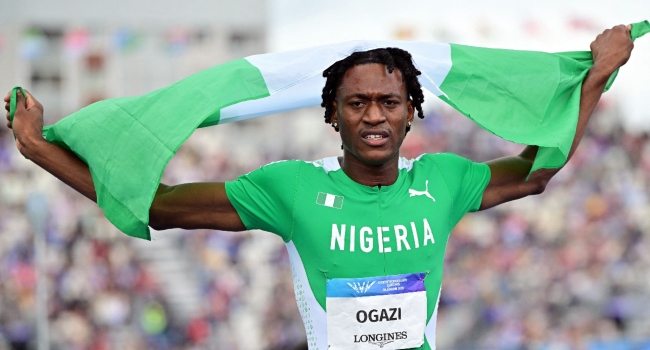
Team Nigeria’s athletics squad delivered another thrilling chapter in Glasgow on Saturday, as 20-year-old Samuel Ogazi etched his name into the history books with a commanding victory in the men’s 400 metres final at the 2026 Commonwealth Games.
Racing under the lights at Scotstoun Stadium, Ogazi crossed the line in 44.25 seconds to become the first Nigerian ever to claim gold in the event, a milestone that had eluded the country’s quarter-milers for over three decades.
The closest a Nigerian had come to the title previously was in 1994, when Sunday Bada settled for bronze. Ogazi’s run also placed him agonizingly close to the history of another kind: he finished just 10 milliseconds shy of the Commonwealth Games record of 44.24 seconds, set by Grenada’s Kirani James back in 2014.
The race itself was a study in composure and controlled aggression. Drawn in lane five, Ogazi came under early pressure from Trinidad and Tobago’s Jereem Richards, who matched him stride for stride through the first 200 metres. But the young Nigerian, arriving in Glasgow as the world’s fastest man over the distance in 2026, showed why he’d been installed as the man to beat.
He timed his surge to perfection, pulling clear of the field in the final 150 metres to seal victory, ultimately crossing the line 0.57 seconds clear of defending champion Richards, who had to settle for silver. South Africa’s Zakithi Nene rounded out the podium with bronze in 45.21 seconds.
For Ogazi, already a teenage Olympic finalist from Paris 2024 and the fourth-fastest 400m runner in history, this was uncharted territory in one important sense: it marked his first senior international title, despite having arrived in Glasgow as a rising superstar.
He didn’t shy away from acknowledging the weight of expectation. “I wouldn’t say I had extra pressure on me,” he said afterward. “It was just a bit of weight on my back to carry. I didn’t want to come out here and disappoint.”
Speaking with the confidence of a man who has just announced himself on the world stage, Ogazi added that the win was personal validation of a long-held ambition to put his country on the map, declaring himself ready to take on any challenger going forward.
Nigeria’s celebrations didn’t end there. Moments later, Ella Onojuvwevwo added further shine to the country’s athletics campaign, claiming bronze in the women’s 400m final in 51.00 seconds, missing out on silver by the barest of margins, just 0.01 seconds behind Barbados’ Sada Williams, who clocked 50.99. Jamaica’s Dejanea Oakley powered to gold in 50.21 seconds.
The result marked the first Nigerian medal in the women’s 400m at the Commonwealth Games in almost three decades, and Onojuvwevwo was quick to credit the network behind her rise, speaking warmly of the encouragement she’d drawn from home throughout the campaign.
Ogazi’s triumph also carried broader significance for Team Nigeria’s overall campaign in Glasgow; it was reported as the country’s 10th gold medal of the Games, underscoring athletics as one of Nigeria’s most productive disciplines at this edition of the Commonwealth Games.
With more finals still to come, Team Nigeria’s contingent will be hoping the momentum from Scotstoun carries through to the closing days of competition.
WHAT YOU SHOULD KNOW
Samuel Ogazi’s 44.25-second run didn’t just win gold; it made history, delivering Nigeria’s first-ever Commonwealth Games title in the men’s 400m, a feat that had eluded the country for over 30 years.
Paired with Ella Onojuvwevwo’s bronze in the women’s race, Glasgow 2026 marked a landmark day for Nigerian athletics on the global stage, signaling the emergence of a new generation ready to compete at the very top.