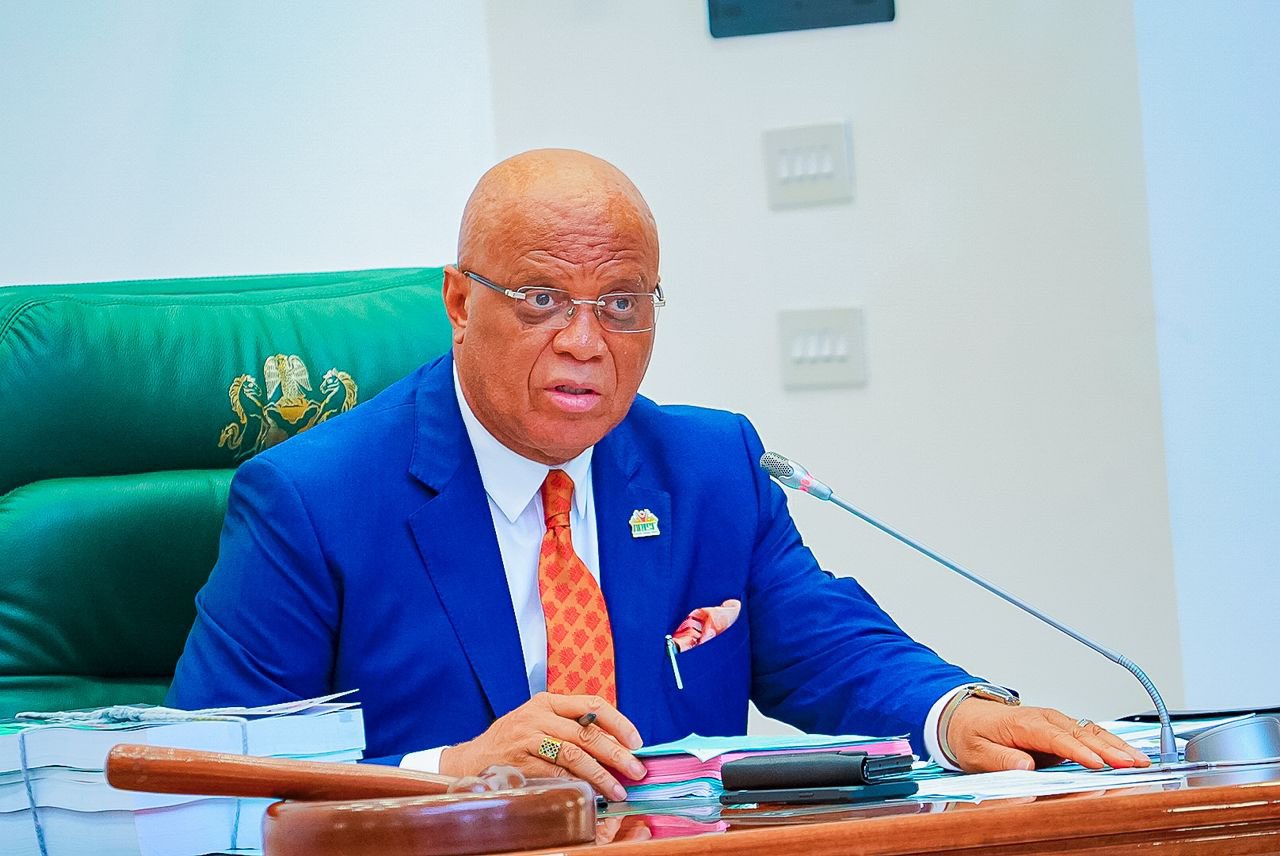
Akwa Ibom State Governor Umo Eno on Wednesday put his signature to fourteen executive bills, a sweeping package that touches nearly every arm of governance from land administration and healthcare to public finance, broadcasting, and tourism.
The signing ceremony, confirmed in a statement from the Government House media unit in Uyo, was framed by the governor not merely as routine legislative housekeeping but as a structural milestone in his administration’s ARISE Agenda, the policy framework under which Eno has sought to rebuild the state’s institutions from the ground up.
“These bills, fourteen in all, spanning all critical sectors, will help expand the gains of our ARISE Agenda, provide the legal backing to fill existing gaps with concrete actions and deepen our growth and development so we may spread more dividends of democracy across our society,” the governor said, according to the statement.
The scope of the new legislation is unusually wide-ranging, even by the standards of an administration that has prided itself on rapid institutional expansion.
Among the flagship measures is the establishment of the Akwa Ibom State Geographical Information Service (AKWA-GIS), a body designed to drag the state’s land administration system into the digital age, simplifying the notoriously cumbersome processes of land verification, acquisition, and transfer that have long frustrated residents, investors, and civil servants alike.
Also created is a Senior Citizens Centre, giving formal institutional weight to welfare programs for the elderly that, until now, may have existed more as policy gestures than as legally anchored obligations of the state.
The tourism sector gets its own dedicated regulator in the form of the Hotels and Tourism Development Commission, tasked with setting standards for hospitality operators and driving the kind of coordinated tourism development that fragmented oversight has often stalled elsewhere in Nigeria.
Media and public broadcasting were not left out. The new Ibom Broadcasting Corporation law is intended to strengthen the state’s public broadcasting apparatus and, notably, position the station for eventual commercial operations, a signal that the government sees the outlet not just as a mouthpiece but as a potential revenue-generating enterprise.
Rounding out the package are laws creating the Emergency Medical Services and Ambulance Systems Agency, the Public Procurement Regulatory Agency, the Betting and Lottery Regulatory Agency, the Fiscal Responsibility Board, the Internal Revenue Service, the Office of the Public Defender, the Water Users Association, and a new tertiary institution, the University of Education, Afaha Nsit.
Perhaps the most operationally significant of the fourteen is an amendment to the Hospitals Management Board Law, which decentralizes hospital administration by creating zonal management boards and formally providing for district hospitals, a move aimed squarely at improving efficiency and access in a healthcare system where centralized control has often meant slower response times for facilities far from Uyo.
Governor Eno used the occasion to disclose a related administrative decision: doctors currently occupying desk and administrative roles will be redeployed back into clinical practice.
He argued that keeping trained physicians away from patient care for extended periods risks eroding their clinical skills and, by extension, compromising patient safety a rationale that suggests the reform is as much about protecting service quality as it is about reshuffling personnel.
Two of the new laws drew particular commentary from the governor himself.
On the Public Procurement Regulatory Agency, Eno was explicit about the stakes, telling those present that strict adherence to procurement rules had been a key ingredient in whatever success his administration could claim so far, framing the new agency less as a bureaucratic add-on than as a safeguard for the government’s credibility.
The Betting and Lottery Regulatory Agency prompted a more personal reflection. Aware that regulating gambling might sit uneasily with his public identity as a pastor, Eno moved to pre-empt criticism directly: “This is a regulatory agency.
As a pastor, I believe in law and order. I do not encourage betting, but where it exists, it must be properly regulated,” he said, drawing a clear line between moral disapproval and the practical necessity of consumer protection, positioning the law as a shield against fraudulent operators rather than an endorsement of the practice itself.
Eno signaled that Wednesday’s signing is not the end of the legislative pipeline. An Environmental Sanitation Bill is due to be transmitted to the State House of Assembly shortly, one that would hand the government new enforcement powers, including the ability to clean up neglected properties, bill the cost back to negligent owners, and seal premises that remain non-compliant.
The governor tied this forthcoming bill to civic pride, noting that Akwa Ibom’s residents have long been known for cleanliness, and expressing hope that firmer legal teeth would help the state preserve that reputation while backing up the operational work already being done by the Ministry of Environment and the state’s Environmental Protection and Waste Management Agency.
He also flagged that further health-sector reform bills are in the pipeline, suggesting Wednesday’s hospital board amendment is an opening move rather than the full extent of the administration’s ambitions for the sector.
The governor was generous in his praise for the Assembly, singling out Speaker Udeme Otong, members of the House, and the Special Adviser on Legislative Affairs, Hon. Emmanuel Bassey, for what he called exemplary cooperation between the two arms of government.
That sentiment was echoed from the other side of the aisle. Speaking earlier at the event, the speaker described the fourteen-bill package as among the most significant legislative achievements in the history of the 8th Assembly, noting that the House had never before processed and passed such a large volume of executive bills in so short a window.
He characterized the bills collectively as “people-oriented,” predicting tangible impact on governance, healthcare, economic development, and public service delivery across the state.
The Speaker reserved special praise for the hospital’s management board amendment, calling the creation of zonal management boards a landmark reform likely to translate into more efficient healthcare administration for ordinary citizens.
“These are all people-oriented bills that will affect the lives, the growth, and the development of Akwa Ibom State,” the Speaker said. “We will continue to work with the executive to move the state forward.”
Taken together, the fourteen laws represent an attempt to give durable legal architecture to policy ambitions that might otherwise have remained vulnerable to shifting political winds or administrative discretion.
From land records to hospital zoning, from procurement discipline to gambling oversight, the Eno administration appears to be betting deliberately, this time within the law, that institutionalization, not just intention, is what will ultimately determine whether the ARISE Agenda’s promises translate into lasting change for Akwa Ibom residents.
Whether these new agencies and boards can be adequately staffed, funded, and insulated from the bureaucratic drift that has undermined similar bodies elsewhere in Nigeria remains the open question that will define how this legislative moment is remembered.
WHAT YOU SHOULD KNOW
Governor Umo Eno has signed 14 executive bills into law, giving legal backing to major reforms across land administration, healthcare, tourism, broadcasting, procurement, and public finance in Akwa Ibom State.
The standout measure is the decentralization of hospital management into zonal boards, paired with a plan to redeploy administrative doctors back into clinical practice, a direct move to improve healthcare access and patient care.
This isn’t just symbolic lawmaking; it’s an attempt to lock policy gains into durable institutions, with more health and environmental bills still to come. The real test now is whether these new agencies get the funding, staffing, and follow-through to actually deliver for residents.