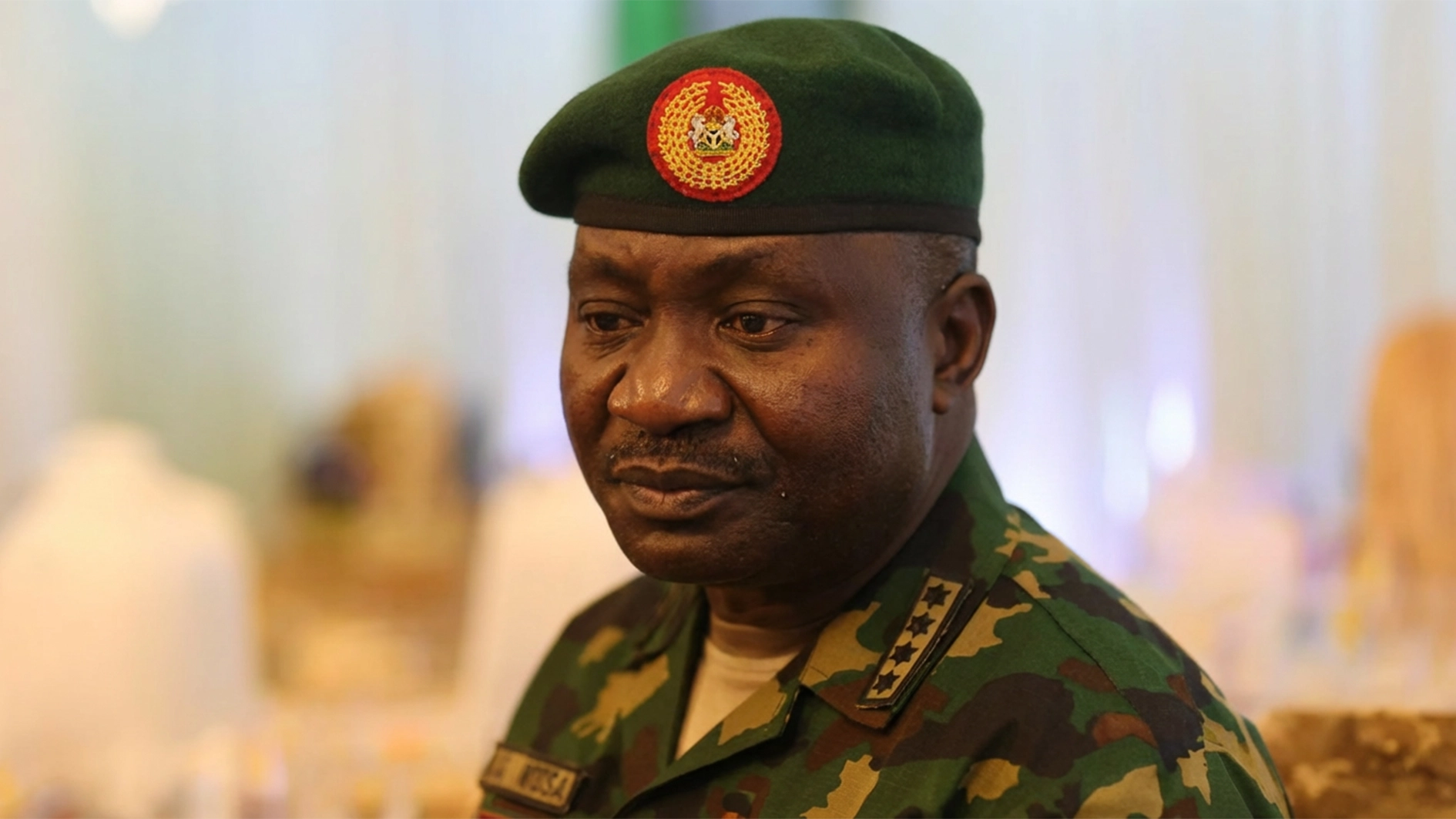
A single television interview has cracked open one of the most contentious fault lines in Nigerian public life: the gulf between what the government says about security and what millions of citizens live through every day.
Minister of Defence, retired General Christopher Musa, walked into that fault line on Friday when he appeared on ARISE News to mark three years of the Bola Tinubu administration.
In a candid, self-assured assessment that would consume social media for the rest of the weekend, Musa awarded the government a score of between 65 and 70 percent on security, a rating that, within hours, had drawn ridicule, fury, and deeply personal rebuttals from across the country.
“I’ll give us 65 to 70 percent. No nation is totally free from crime and criminality. The level of terrorism across the country has actually drastically reduced,” the minister said, his tone measured and deliberate.
For supporters of the administration, the statement was a sober, if imperfect, acknowledgement of genuine military gains, particularly in the North-East, where years of sustained operations have degraded Boko Haram and its offshoots. For critics, and there were many and loud, it was something closer to an insult.
The backlash was swift and unsparing. Human rights activist and former presidential candidate Omoyele Sowore, never one to let an official statement pass without scrutiny, was among the first to push back.
“The reality Nigerians face daily does not reflect this performance rating. Security is still collapsing in many parts of the country,” he wrote on X, as the platform’s trending section began to fill with the minister’s name.
Investigative journalist David Hundeyin followed with a pointed challenge: “You cannot be scoring yourself 70 percent when children are still being abducted from schools and communities are paying ransom weekly.”
His words cut to the heart of a crisis that has scarred the national psyche; the specter of mass school abductions, which first shocked the world with the 2014 Chibok kidnapping, has never fully receded.
Ordinary Nigerians joined the debate with a rawness that no official metric could capture. “Did this man understand the meaning of percentage?” wrote Amin Magaji. Urulor Patrick’s verdict was terser still: “How? Oga, pack well.”
Another user, Imran Muhammed, asked the question that perhaps resonated most widely: why do parents in troubled regions still fear sending their children to school if the security situation has truly improved?
The criticism extended beyond mockery into a deeper indictment of what some perceived as the minister’s political capture. “Nigerians were seriously disappointed about this man,” wrote Akintulerewa Victor Alaba. “He has not acted professionally but like a politician. “Others noted a familiar pattern in Nigerian governance.
“Adebisi Segun argued that public officials often resort to self-praise when confronted with poor performance,” a charge that will feel familiar to anyone who has watched successive administrations grapple with the country’s enduring security deficit.
Musa did not retreat from his position. In the interview, he made a broader, more sociological argument, one that shifted some of the burden of Nigeria’s insecurity away from the state and onto the fabric of society itself.
The minister disclosed that Nigerian security forces had recently carried out a covert operation resulting in the killing of a deputy ISIS commander, the product of months of painstaking intelligence work.
He said Nigeria’s counter-terrorism efforts were receiving meaningful international backing from the United States, Britain, France, Brazil, and Turkey, a detail that, if accurate, speaks to a degree of global recognition of Nigeria’s security challenges that rarely makes domestic headlines.
But it was his remarks on kidnapping that generated perhaps the most unsettling commentary. Musa described a phenomenon that security analysts have quietly noted for years: the erosion of traditional social bonds that once served as an informal deterrent to crime.
“We have fathers kidnapping children, children kidnapping each other, brothers kidnapping sisters,” he said. “It tells you that something is wrong with the family, and we need to look inward.”
The observation, however uncomfortable, is not without empirical grounding. The proliferation of ransomware-style kidnappings, particularly across the North-West and parts of the South, has increasingly involved actors with no affiliation to formal armed groups, motivated purely by economic desperation in a country where the cost of living has risen sharply over the past three years.
“People need to understand that to make money, you must work very hard. Don’t look for shortcuts.” Musa added a line that drew sarcasm online, though it reflected a broader government narrative that treats economic reform as ultimately inseparable from the security question.
The debate over the minister’s score illustrates a fundamental challenge that faces any assessment of security in a country as vast and varied as Nigeria: whose experience counts?
Security analyst Zagazola Makama, who closely tracks military operations in the Lake Chad Basin, offered a more measured perspective. Terror groups, he noted, had lost significant territory, and several high-ranking commanders had been eliminated through sustained operations. “There is progress, though challenges remain,” he stated, a formulation that neither validated the minister’s optimism in full nor dismissed the military’s genuine achievements.
Former Aviation Minister Femi Fani-Kayode also backed the armed forces, arguing that critics underestimate the complexity of asymmetric warfare. “The Armed Forces have done well under difficult circumstances. Critics ignore the complexities of asymmetric warfare,” he said.
But in Borno, in Kebbi, on the Plateau, and in parts of Oyo State, the debate over percentages is a luxury. Farmers cannot tend their fields. Travellers are ambushed on federal highways. Communities are effectively held to ransom by armed groups whose identities shift constantly.
Raymond Duru, one of many Nigerians who posted from lived experience rather than analytical distance, put it simply: “This man was really overrated. Insecurity is currently worse than before.”
What the minister’s interview has done, perhaps unwittingly, is force into the open a conversation that governments everywhere resist: who has the right to grade their own performance?
In a democracy, the answer ought to be clear. But in a country where the gap between official narrative and lived reality has long defined political life, a self-awarded score of 65 to 70 per cent on security will always carry the risk of sounding less like an honest reckoning and more like a provocation.
Musa drew a warning from an unlikely comparison: Turkey’s decades-long battle against insurgency, which he cited as an example of what happens when terrorism is not dealt with decisively and early.
The lesson may be apt. But for many Nigerians who heard the interview, the more immediate lesson was simpler: when citizens are still paying ransoms, still burying their dead, and still pulling their children from school out of fear, a passing grade is a very hard thing to defend.
WHAT YOU SHOULD KNOW
Nigeria’s defence minister awarding his own government a 70% security score while kidnappings, banditry, and community attacks remain a daily reality for millions of citizens exposes the most persistent dysfunction in Nigerian governance: the chasm between official narrative and lived experience.
Whatever genuine military progress exists in the North-East, it means little to a farmer ambushed on a federal highway or a parent afraid to send a child to school.
Until the government measures its performance by the safety of its most vulnerable citizens rather than by its own estimation, that score will continue to ring hollow.