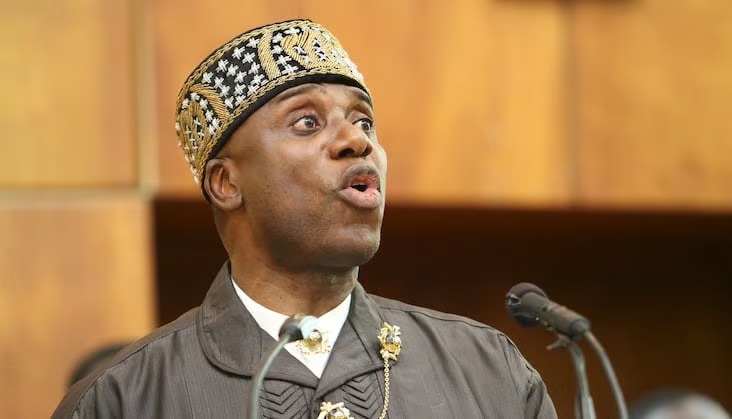
Former Transportation Minister and ex-Rivers State Governor, Rotimi Amaechi, has directly challenged President Tinubu‘s claim that he single-handedly engineered Buhari’s historic 2015 presidential victory.
Speaking with characteristic bluntness on Arise TV on Friday, May 22, Amaechi did not mince words. “Tinubu didn’t make Buhari president,” he declared flatly, in remarks that are already reverberating across Nigeria’s charged political landscape. “Not only was I the Director-General of the campaign, everyone knows that I did all the battle, not Tinubu.”
To understand the full weight of Amaechi’s statement, one must revisit the political theater that defined Nigeria’s 2023 presidential race. In the build-up to that election, then-candidate Tinubu deployed a now-infamous Yoruba phrase, “Emi lo kan,” loosely translated as “It is my turn,” as a rallying cry to consolidate support within the All Progressives Congress (APC).
The subtext was unmistakable: Tinubu was calling in a historic debt, arguing that his pivotal role in delivering Buhari’s 2015 presidential victory entitled him to the party’s presidential ticket.
The claim was bold, largely unchallenged at the time, and arguably effective. Tinubu secured the APC nomination and subsequently won the 2023 presidential election, becoming Nigeria’s current head of state. But Amaechi now says that narrative was built on a shaky, if not entirely false, foundation.
Perhaps the most revealing aspect of Amaechi’s interview was not the accusation itself, but his candid admission of why he stayed silent for so long. The former minister confessed that responding to Tinubu’s claims while still serving in Buhari’s cabinet would have been, in his own words, “suicidal.”
“When I was a minister, Tinubu was claiming he made Buhari president, and I couldn’t respond because that was suicidal,” he said. “Buhari could have fired me because I was still serving as a minister.”
It is a rare moment of naked political honesty, an acknowledgment that in Nigeria’s high-stakes power corridors, truth is often a casualty of self-preservation. For years, Amaechi sat with what he describes as an inaccurate historical record, calculating that speaking out would cost him more than staying quiet.
That calculation has now clearly changed.
Amaechi’s counter-claim rests on a specific and verifiable role: he served as the director-general of Buhari’s 2014/2015 presidential campaign. This organizational engine room coordinated the historic effort to unseat then-incumbent President Goodluck Jonathan, making Buhari the first Nigerian opposition candidate to defeat a sitting president at the polls.
As DG, Amaechi was the public face of that campaign machinery, crisscrossing the country, mobilising resources, and navigating the complex web of regional and ethnic alliances that ultimately delivered the presidency to Buhari.
It was a grueling, high-risk operation in an era of significant political tension, and Amaechi has long been credited at least in certain circles as one of its principal drivers.
His position now is that this record speaks for itself and that Tinubu’s retrospective appropriation of that victory is a rewriting of history for personal political gain.
Amaechi’s timing is not accidental. With the 2027 presidential election cycle beginning to crystallise, the former minister has made little secret of his ambitions, positioning himself as a credible challenger.
In that context, dismantling the historical mythology surrounding Tinubu, particularly the “kingmaker” narrative that helped propel him to the presidency, is as much a political strategy as it is a personal score-settling.
By asserting himself as the true power behind Buhari’s 2015 win, Amaechi is implicitly making his own case: that if any politician deserves recognition for reshaping Nigeria’s democratic trajectory, it is he, not the man currently occupying Aso Rock.
As of the time of this report, the presidency had not issued an official response to Amaechi’s remarks. Whether President Tinubu, known for his sharp political instincts, chooses to engage, dismiss, or ignore the challenge will itself be a telling indicator of how seriously his inner circle regards Amaechi’s growing visibility ahead of 2027.
What is certain is that the contest over the legacy of 2015 is far from over. Nigeria’s political class has always understood that history, in a nation where political capital is accumulated over decades, is not merely the past; it is currency.
Amaechi has just placed a very public bet that the real account of 2015 belongs to him. Whether Nigerians and, more critically, the electorate of 2027 choose to believe him will depend on more than words delivered on a morning television program. It will require him to make the case, consistently and convincingly, across the long road that lies ahead.
WHAT YOU SHOULD KNOW
Rotimi Amaechi’s public challenge to President Tinubu’s “Emi lo kan” narrative is more than a dispute over historical credit; it is an opening shot in Nigeria’s 2027 presidential battle.
By finally breaking his silence and asserting that he, not Tinubu, was the true architect of Buhari’s 2015 victory, Amaechi is doing two things at once: dismantling the political mythology that helped Tinubu reach Aso Rock while simultaneously building his own case for the presidency.