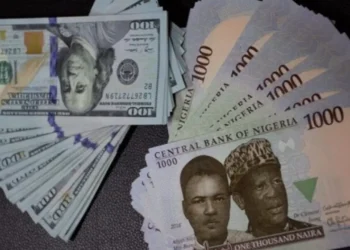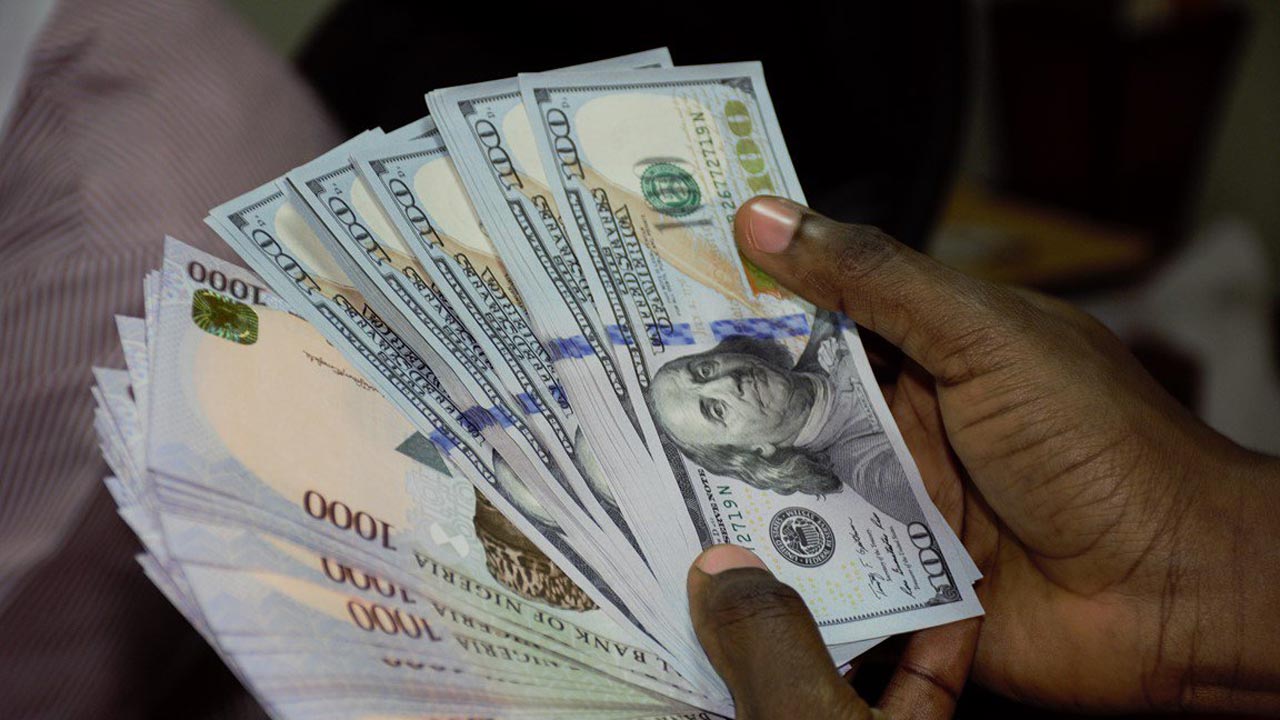
The Naira steadied against the Dollar on Thursday after the Central Bank of Nigeria held its benchmark interest rate unchanged, reaffirming its commitment to curbing inflation and preserving foreign exchange stability.
The Naira opened at ₦1,371.25 to the dollar in the Nigerian Foreign Exchange Market (NFEM), the official window for formal currency trade, marking a modest but meaningful improvement from the daily average of approximately ₦1,373 recorded in sessions earlier in the week.
The narrow gap between Thursday’s opening rate and recent averages underscores a pattern of controlled, range-bound trading that market participants say has become the defining feature of the official window in recent days.
The currency’s composure came on the back of the Monetary Policy Committee’s resolution at its 305th meeting, held over two days on May 19 and 20, in which all 11 attending members voted to retain the Monetary Policy Rate (MPR) at 26.5 percent.
The committee equally maintained the Standing Facilities Corridor around the MPR at +50 basis points on the upper band and -450 basis points on the lower band, leaving the entire architecture of the CBN’s rate framework undisturbed.
CBN Governor Olayemi Cardoso, who addressed journalists at the close of the two-day sitting, made clear that the decision to hold was neither accidental nor passive. Rather, it was a deliberate and calibrated response to an economic environment still wrestling with stubborn inflationary headwinds.
“The committee maintained all key policy parameters at their current levels,” Cardoso noted, in remarks that signaled the apex bank’s continued resolve to prioritize price stability over looser monetary conditions that could otherwise stimulate short-term growth but risk unraveling the hard-won exchange rate gains of recent months.
The CBN confirmed that persistent inflationary pressures and the imperative to sustain macroeconomic stability were the twin pillars underpinning the rate-hold decision, a stance that, while offering little relief to borrowers and businesses grappling with elevated credit costs, has so far delivered a degree of predictability that foreign exchange traders appear to welcome.
On the trading floor, the calm Naira opening reflected more than just policy optics. Dealers and market operators report that liquidity levels inside the official window have remained robust, driven by consistent interbank turnovers that have anchored the spot rate within a tight and navigable corridor over the past week.
Speaking on conditions of familiarity, traders indicated that deliberate supply interventions by the CBN, combined with steady transaction matching between buyers and sellers, have effectively neutralized the kind of sharp morning volatility that has at times rattled the market in previous months.
“Supply has been relatively well-matched with demand,” one trader familiar with early-session dynamics noted. “There haven’t been any significant gaps that would push the rate sharply in either direction. The CBN’s posture has kept things in check.”
This disciplined liquidity management is seen as integral to the broader monetary strategy. With the MPR locked at 26.5 percent, the policy environment continues to lean heavily on tight monetary conditions, a framework designed to curb excess Naira in circulation, cool inflationary momentum, and, in turn, reduce pressure on the exchange rate.
For currency strategists and macro-watchers, Thursday’s early Naira performance offers a window into the CBN’s evolving playbook. The rate hold, now maintained across successive MPC meetings, suggests that the committee sees little room to ease policy without risking a resurgence in inflation or renewed depreciation pressure on the Naira.
Nigeria has navigated a turbulent foreign exchange journey over the past two years, marked by multiple rounds of devaluation, a unification of exchange rate windows, and efforts to attract foreign portfolio investors back into a market once plagued by settlement delays and dollar scarcity.
The relative stability now visible in the NFEM, with the Naira trading in a corridor that, while elevated by historical standards, is at least predictable, represents a hard-fought achievement that the MPC appears deeply reluctant to jeopardize.
Economists note that sustaining the MPR at 26.5 percent continues to make Nigerian fixed-income instruments attractive to carry traders and foreign investors, providing the CBN with a useful tool to support dollar supply through capital inflows, even as the underlying structural drivers of currency demand, import bills, fuel costs, and external debt obligations remain ever-present.
Traders and analysts will be watching closely in the sessions ahead to see whether Thursday’s measured open translates into a stable close or whether end-of-day pressures are often more pronounced as corporate and retail dollar demand picks up through the business day, introducing fresh friction into the market.
For now, however, the message from Abuja and the CBN’s trading desks appears consistent: stability, not stimulus, remains the order of the day.
As long as inflation stays elevated and the external environment remains uncertain, Nigeria’s monetary guardians look set to keep one firm hand on the tiller, and, for the moment at least, the Naira appears to be holding course.
WHAT YOU SHOULD KNOW
The Naira opened at ₦1,371.25 to the dollar on Thursday, holding steady as the Central Bank of Nigeria kept its benchmark interest rate unchanged at 26.5%.
The CBN’s Monetary Policy Committee, at its 305th meeting, unanimously opted to maintain all key policy parameters, citing persistent inflation and the need for macroeconomic stability.
Backed by active liquidity management and consistent interbank supply interventions in the official window, the currency has traded within a narrow, predictable range — a sign that the CBN’s tight monetary stance is delivering the exchange rate stability it was designed to protect.