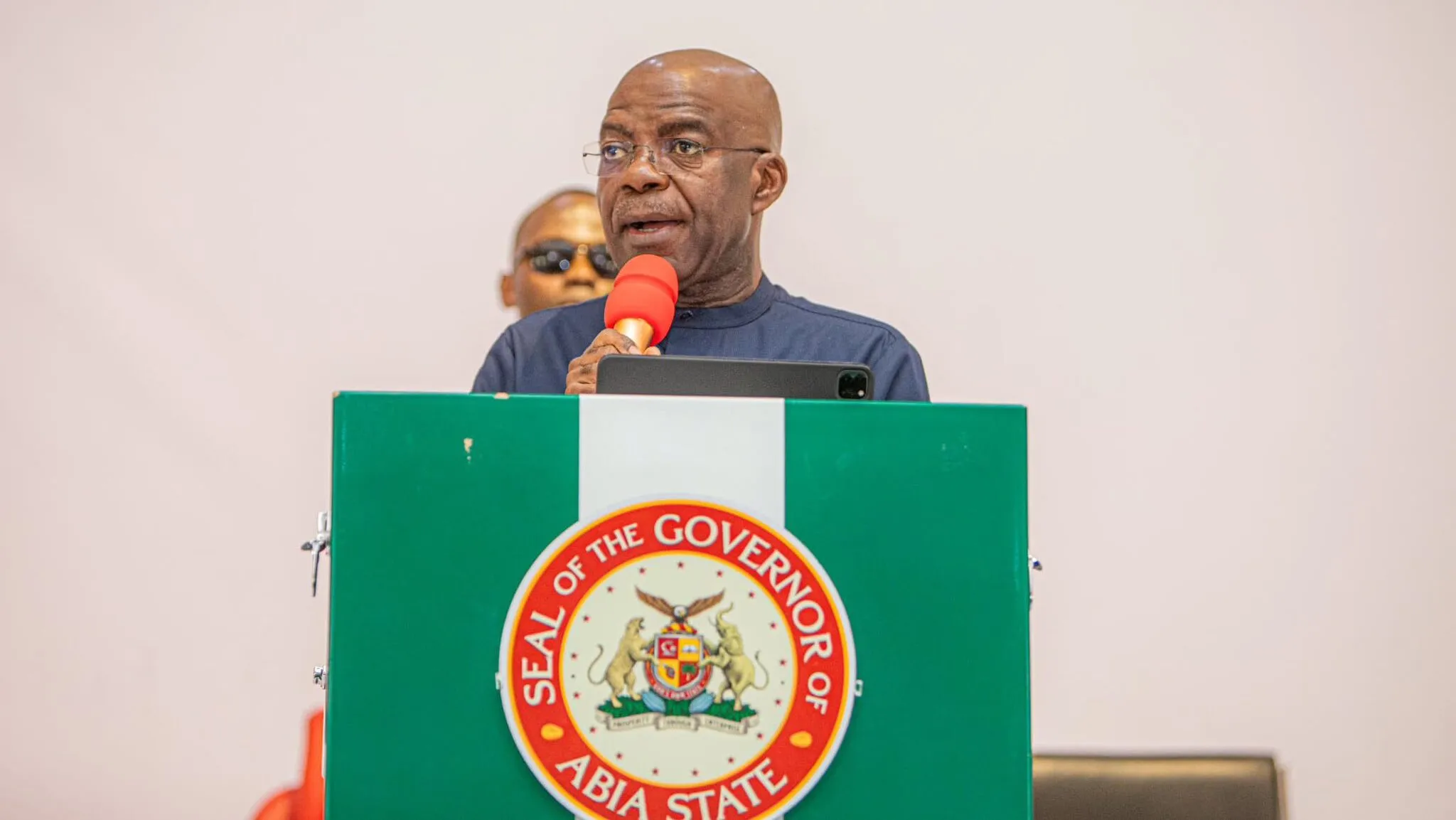
Industrial life stirred once more in Aba on Wednesday as Governor Alex Otti commissioned a $35 million beverage plant, a moment many are calling a turning point for the city’s manufacturing economy.
The facility, belonging to Ultimum Limited, a subsidiary of the pan-African Kadji Group, was unveiled at the Osisioma Industrial Layout in Egbeluowor, Osisioma Ngwa Local Government Area, on March 25, 2026.
The commissioning ceremony, attended by business leaders, government officials, and investors, was announced in an official statement by the chief press secretary to the governor, Ukoha Njoku Ukoha.

Aba has always carried a reputation that precedes it. For decades, the city earned continental fame as the heartbeat of Nigerian grassroots manufacturing—the place where leather goods, textiles, garments, and a thousand other commodities were produced with an ingenuity that once drew admiration from across West Africa. Yet in more recent years, crumbling infrastructure, insecurity, and a hostile business environment conspired to dim that storied flame.
Wednesday’s commissioning, Governor Otti suggested, may well mark the turning of the tide.
“By committing over $35 million to build a state-of-the-art production facility and pledging to increase this to $100 million here in Egbeluowor, Osisioma Ngwa LGA, today’s event offers the ultimate validation to our position that indeed the phoenix has risen from the ashes of its ruins,” Otti declared at the ceremony, invoking the imagery of resurrection that has become something of a leitmotif for his administration.
The Aba facility will serve as Ultimum Limited’s primary production hub in Nigeria, manufacturing four variants of its Razzl brand of carbonated soft drinks—Pamplemousse, Cola, Orange, and Lemon—for distribution across multiple markets both domestically and potentially beyond Nigeria’s borders.
Ultimum Limited operates within Nigeria’s highly competitive fast-moving consumer goods (FMCG) sector, where it joins a crowded but lucrative market of beverage producers jostling for shelf space and consumer loyalty across the country’s 200-million-strong population.
The plant’s strategic location at the Osisioma Industrial Layout is no accident. Osisioma has long been designated as Abia’s primary industrial corridor, and the arrival of a capital-intensive facility of this scale could trigger a multiplier effect, drawing ancillary businesses, suppliers, and service providers into its orbit.
Beyond the factory gates, the company projected that the facility would generate significant employment across production, administration, and distribution functions. Crucially, Ultimum said it anticipates that the economic benefits would extend well beyond its direct workforce, supporting a broader ecosystem of raw material suppliers, packaging vendors, logistics operators, and downstream distributors.
In a country where youth unemployment remains one of the most pressing socioeconomic challenges, such commitments—if realized—carry considerable weight.
The Kadji Group, the Belgian-Cameroonian conglomerate backing the investment through Ultimum, has significant operational experience across Central and West Africa. The decision by such an investor to plant roots specifically in Aba, rather than in Lagos or Abuja—Nigeria’s more conventional investment destinations—is itself a statement.
Whalen Kadji, Chairman of Ultimum and representative of the Kadji Group, was unsparing in his praise of the Otti administration, describing it as “a government that does not just talk about development but actively creates the conditions for it to happen.”
Kadji confirmed that the group’s decision to site the plant in Aba was influenced by the city’s established commercial base and its improving infrastructure—and offered particular appreciation to Governor Otti for the swift reconstruction of the 1.2-kilometer access road leading directly to the production facility. In many parts of Nigeria, a degraded feeder road has been enough to kill an investment outright. Here, it was fixed before the ribbon was cut.
For Governor Otti, who assumed office in May 2023 on a reformist platform promising to revive Abia’s economy through private sector-led growth, Wednesday’s commissioning represents tangible proof of concept. His administration has repeatedly staked its credibility on the argument that improving governance, security, and infrastructure would, in time, attract serious investors.
“Investors respond to environments that offer relative stability and prospects for returns,” Otti noted at the event, in a line that read as much like a pitch to future investors watching from the sidelines as it did a commentary on the day’s proceedings.
The $35 million plant is only the first phase of what the Kadji Group has indicated will ultimately be a $100 million commitment to the Osisioma axis—a figure that, if fully deployed, would rank among the most significant single private-sector investments in Abia State’s recent history.
Of course, Nigeria’s investment landscape is littered with announcements that never fully materialized, and experienced observers are right to temper celebration with scrutiny. The true test of Wednesday’s commissioning will not be in the speeches or the ribbon-cutting, but in the months and years ahead—in whether the plant operates at capacity, whether promised jobs are created and sustained, and whether the broader $100 million investment commitment is honored.
But for Aba, a city that has weathered so much and held so tightly to its identity as a place where things are made, the commissioning of the Ultimum Beverages plant offers something increasingly rare in Nigerian public life: a reason for measured, evidence-based optimism.
WHAT YOU SHOULD KNOW
The commissioning of Ultimum Beverages’ $35 million production plant in Aba marks a significant turning point for Abia State’s economy. Backed by the international Kadji Group, the facility signals genuine foreign investor confidence in a city long defined by its manufacturing spirit but held back by poor governance and decaying infrastructure.
The most critical takeaway is this: purposeful governance works. Governor Otti’s deliberate efforts to improve Aba’s business environment — fixing roads, restoring security, and creating investor-friendly conditions — directly attracted a commitment that could grow to $100 million and generate hundreds of jobs.
Aba’s revival is no longer just a promise; it is, brick by brick, becoming a reality.