In a decisive move that could transform parts of Ghana’s economy from illicit shadows into regulated opportunity, the Narcotics Control Commission (NACOC) has flung open the doors to formal cannabis cultivation and management licenses for the first time.
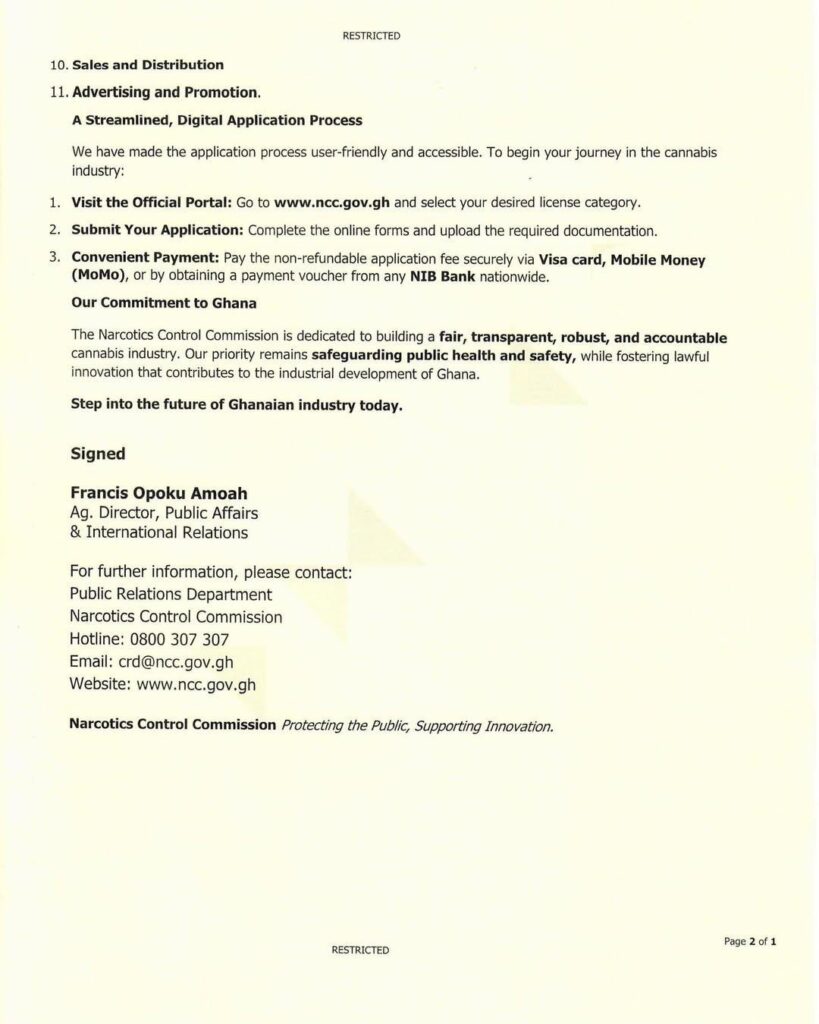
Announced yesterday in an official statement, the long-awaited licensing window marks the operational start of a framework first enabled by the Narcotics Control Commission Act, 2020 (Act 1019), and refined through Legislative Instrument 2475.
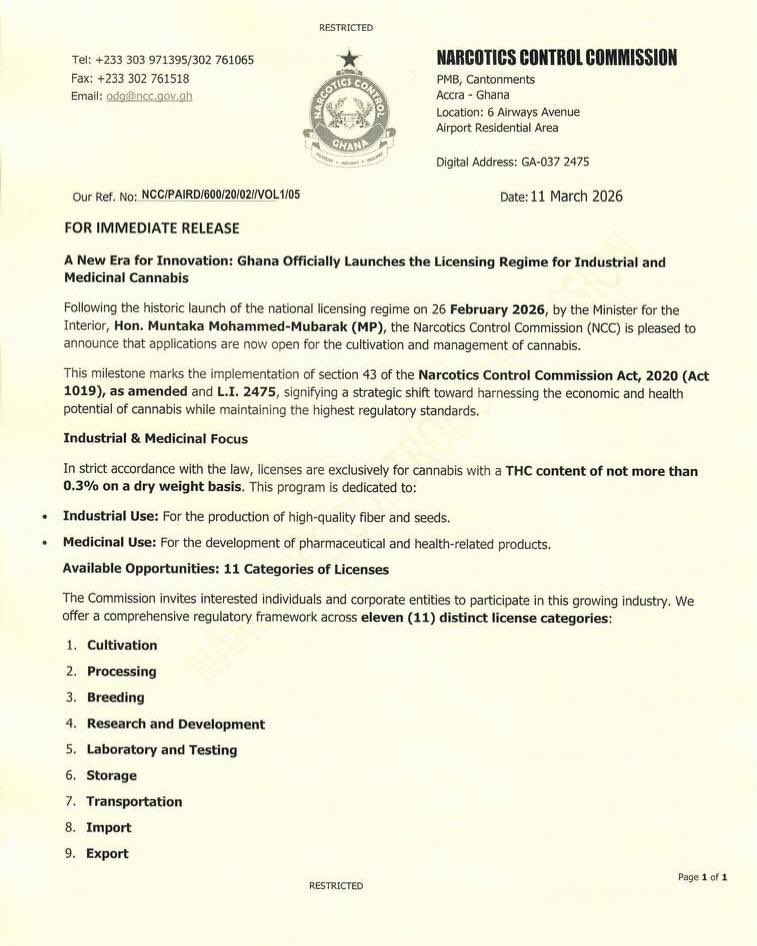
Interior Minister Muntaka Mohammed-Mubarak formally launched the national regime on February 26; applications are now live.
Cultivation is permitted strictly for industrial fiber, seeds, and pharmaceutical products. Only low-THC varieties are allowed: “In strict accordance with the law, licenses are exclusively for cannabis with a THC content of not more than 0.3% on a dry weight basis,” the Commission emphasized, echoing the exact wording of the enabling law. Anything above that threshold remains firmly in the realm of prohibited narcotics.
This is not recreational cannabis by another name. Recreational use stays illegal.
The programme is deliberately narrow: industrial hemp for high-quality fiber and seeds destined for manufacturing, and medicinal strains for pharmaceutical and health-product development.
Eleven distinct licence categories cover the entire value chain—cultivation, breeding, processing, research and development, laboratory testing, storage, transportation, import, export, sales and distribution, and even advertising and promotion. Individuals and companies alike may apply, provided they meet stringent security, traceability, and quality-assurance standards.
Applications are entirely digital. Prospective operators must log on to the official NACOC portal at www.ncc.gov.gh, complete the online forms, upload required documents, and pay a non-refundable fee via Visa, Mobile Money, or NIB Bank vouchers.
The Commission has stressed that no middlemen or “facilitators” are needed and warned applicants to deal exclusively with NACOC’s Cannabis Regulations Department.
Officials describe the move as a calculated bet on Ghana’s future. “Our priority remains safeguarding public health and safety, while fostering lawful innovation that contributes to the industrial development of Ghana,” the statement declared.
The hope is that regulated cannabis will create rural jobs, attract foreign investment, generate tax revenue, and give local pharmaceutical firms access to homegrown raw material—all while choking off the black-market trade that has long plagued parts of the country.
For context, Ghana has spent decades wrestling with cannabis. Vast tracts in the forest zones have been cultivated illegally for export, fueling arrests, seizures, and occasional violence.
The 2020 law represented a pivot: lawmakers recognized that the plant itself is not the enemy if THC levels are kept negligible and the supply chain is locked down. Neighboring African nations such as Lesotho and Zimbabwe have already built modest export industries around medical and industrial cannabis; Ghana now appears determined to catch up—and perhaps surpass them—with a fully digital, transparent system.
Farmers with access to land, processors seeking new revenue streams, and researchers eyeing clinical trials will be among the first to test the waters. Yet the Commission has made clear that every licence holder will face unannounced inspections, GPS-tracked fields, and rigorous testing. One misstep, diversion, over-THC plant, or inadequate security—and the licence vanishes.
Whether this bold regulatory experiment delivers the promised economic and health dividends will depend on execution. But after years of parliamentary debate and regulatory fine-tuning, Ghana has finally moved from policy on paper to permits in practice.
The application portal is open. The clock is ticking. For a country long known more for cocoa and gold, a new cash crop—grown under license and capped at 0.3% THC—may soon take root.
WHAT YOU SHOULD KNOW
Ghana has officially launched applications for licenses to cultivate and manage industrial and medicinal cannabis—a landmark shift from decades of prohibition to regulated opportunity.
Only low-THC cannabis (≤ 0.3% THC) is permitted, strictly for industrial fiber, seeds, and pharmaceutical purposes. Recreational use remains illegal, and the entire program is tightly controlled by the Narcotics Control Commission to prevent diversion and protect public health while opening new economic pathways.