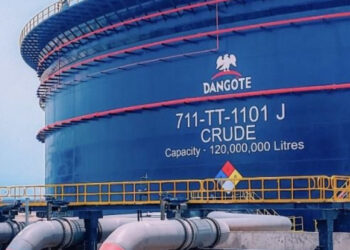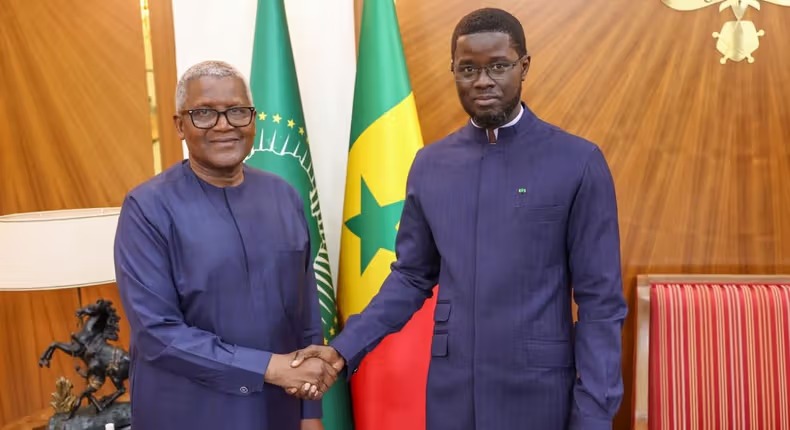
The government of Senegal has acquired a 10% equity stake in Dangote Cement Senegal, the country’s dominant cement producer and a key subsidiary of Nigerian billionaire Aliko Dangote’s pan-African conglomerate.
Disclosed in Dangote Cement Plc’s 2025 annual report, the transaction reduces the parent company’s direct ownership from 99.99% to 89.99%, formally bringing the Senegalese state on board as a minority shareholder in one of the nation’s most vital industrial assets.
While financial details of the deal—such as the purchase price—remain undisclosed, the move signals a deliberate realignment of ownership in a sector critical to national development.
The acquisition arrives against a backdrop of headwinds for the Dakar-based operation. Dangote Cement Senegal saw revenues contract sharply in 2025, dropping from NGN 192.2 billion (approximately US$138.6 million) in 2024 to NGN 151 billion, a 21.4% decline.
The downturn stemmed primarily from a 19.8% fall in sales volumes, which stood at just 1.2 million tonnes for the year. Industry observers point to softer market conditions in the construction sector, possibly exacerbated by post-election uncertainties in Senegal and broader regional economic pressures, alongside operational challenges at the plant.
Despite these short-term difficulties, the subsidiary retains substantial strategic importance. Established in 2015, Dangote Cement Senegal operates a modern facility with an installed production capacity of 1.5 million tonnes per annum.
It supplies high-quality cement to meet robust domestic needs—driven by ongoing urbanization, housing initiatives, and major public infrastructure projects—while also exporting to neighboring countries in the sub-region.
Since inception, the company has generated thousands of direct and indirect jobs for Senegalese workers, contributing meaningfully to local economic empowerment and skills development.
For Dangote Cement Plc, the deal reinforces its long-term commitment to West Africa, one of the continent’s most promising growth corridors.
By welcoming a government partner, the group maintains strong operational control while deepening institutional ties in a dynamic market.
This approach aligns with the company’s broader strategy of localizing operations, navigating demand fluctuations, and building resilient footprints across its 10+ African countries of operation.
From Senegal’s perspective, the stake purchase forms part of a wider policy trend seen across the continent: governments taking targeted minority positions in essential industries to secure influence without stifling private-sector efficiency.
Cement, as the backbone of construction and infrastructure, remains indispensable to Senegal’s ambitious national development agenda, including urban expansion and public works programs.
With this equity stake, the government gains access to a portion of future dividends and a formal voice in key decisions related to production, pricing, and strategic direction—tools to better align the sector with public priorities.
Experts view such arrangements as pragmatic hybrids, blending state oversight with the agility and investment firepower of private operators like Dangote. In a region where infrastructure demand is projected to remain strong despite cyclical slowdowns, cement producers continue to serve as reliable engines of economic growth.
As Senegal and Dangote Cement navigate the current market softness, this partnership could pave the way for enhanced collaboration, potentially stabilizing operations and supporting renewed expansion in the years ahead.
For now, the deal stands as a clear signal: strategic industries in Africa are increasingly shared endeavors between ambitious governments and Africa’s leading industrial players.
WHAT YOU SHOULD KNOW
Senegal has strategically acquired a 10% stake in Dangote Cement Senegal, transforming from a virtually fully foreign-owned operation into one with meaningful government participation.
This move gives the Senegalese state a direct equity interest and a formal voice in one of the country’s most critical industrial assets — cement — at a time when infrastructure and urban development remain central to national growth, even amid a temporary 21% revenue drop at the subsidiary.