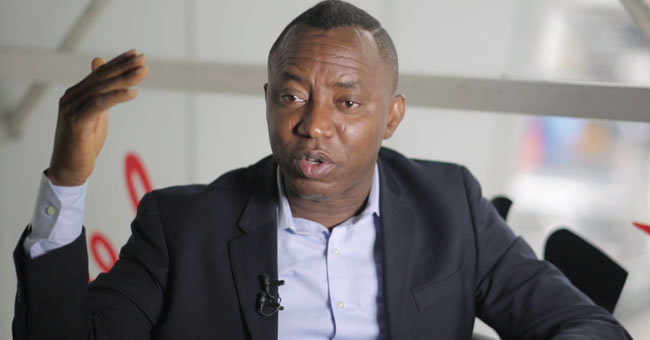
The Federal High Court sitting in Lagos has determined that the Nigeria Police Force acted outside the bounds of the law when it declared human rights advocate and Sahara Reporters publisher, Omoyele Sowore, wanted in 2025.
In a judgment delivered on Friday, Justice Musa Kakaaki concluded that the action taken by the police contravened constitutional safeguards and represented a misuse of authority.

As part of the ruling, the court ordered the Nigeria Police Force, the Inspector-General of Police, Kayode Egbetokun, and the Lagos State Commissioner of Police, Moshood Jimoh, to jointly pay ₦30 million in damages.
In a firm and detailed decision, Justice Kakaaki reiterated that no citizen of Nigeria can be treated as a criminal for exercising constitutionally guaranteed rights, including freedom of expression, peaceful assembly, and the right to demand accountability from public officials.
The court faulted what it characterised as the “lawlessness” of the Lagos State Commissioner of Police and further held that the Inspector-General of Police bears responsibility for actions carried out under his leadership.
While reviewing the historical background of declaring individuals wanted in Nigeria, Justice Kakaaki noted that current legal standards impose strict procedural requirements before such a step can be taken.
He stressed that a declaration of wanted status must be supported by a valid court-issued warrant, proper notification, and reliable evidence showing that the individual is intentionally avoiding lawful judicial proceedings.
The court also found that the directive issued by Commissioner Jimoh on 27 October 2025, instructing Sowore to keep away from Lagos State, was arbitrary, unconstitutional, and exceeded the lawful powers granted to the police.
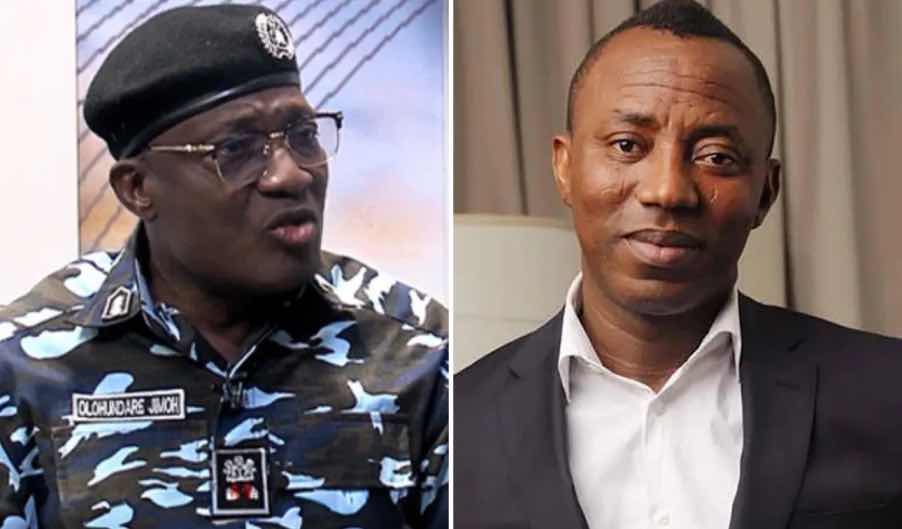
In the same vein, the public announcement made on 3 November 2025 declaring Sowore wanted was described as illegal, ultra vires, unconstitutional, and a serious abuse of power.
On 3 November 2025, Lagos State Commissioner of Police, Moshood Jimoh, publicly announced that Omoyele Sowore was wanted, alleging that he was attempting to organise a protest on the Third Mainland Bridge in response to the demolition of properties in Oworonshoki.
That declaration came after an earlier instruction in October 2025 directing the activist and former presidential candidate to stay out of Lagos State.
In response, Sowore instituted legal proceedings against the commissioner, the Inspector-General of Police, Kayode Egbetokun, and the Nigeria Police Force, seeking judicial enforcement of his fundamental rights.
Through his application, Sowore requested that the court affirm his rights to dignity, personal liberty, freedom of movement, freedom of expression, and peaceful assembly, as protected under the Nigerian Constitution and the African Charter on Human and Peoples’ Rights.
In a sworn affidavit supporting the action, the activist asserted that he had been declared wanted without receiving any prior invitation from the police, without an arrest warrant, and without any formal charge being filed against him. He argued that the step taken by the authorities not only violated his constitutional rights but also damaged his standing as a journalist, activist, and former presidential candidate.
Represented by his legal team led by Tope Temokun, Sowore maintained that he would have complied with any lawful invitation properly extended to him by law enforcement authorities.
He therefore asked the court to restrain the police from harassing, intimidating, or arresting him and to set aside the public notice labelling him as “wanted.”
Additionally, he sought ₦500 million in general and exemplary damages, contending that his fundamental rights had been unlawfully and oppressively infringed upon.
The police contested the suit, arguing that the commissioner acted within the scope of his lawful powers in declaring Sowore wanted. They maintained that any person dissatisfied with the decision had the right to challenge it in court.
During an appearance on Sunrise Daily on Channels Television on 5 November 2025, Jimoh defended his position, stating that Sowore had not complied with an agreement to report to the police.
“My declaration that Sowore is wanted is still in force,” the commissioner said during the interview.
He explained that Sowore’s lawyer had reached out to him via text message while he was attending to a riot incident and was then referred to the Officer-in-Charge of the Legal Department. According to him, the lawyer agreed that Sowore would present himself at the State Criminal Investigation Department in Yaba, where the matter was under investigation.
“But throughout yesterday, he failed to report,” Jimoh said, adding, “We will do everything within the ambit of the law to get him arrested, investigated, and prosecuted.”
The commissioner also rejected claims made by Sowore that the Inspector-General of Police had directed that he be “shot on sight,” describing the allegation as “major misinformation.” He insisted that the IGP would not issue such an order.
What you should know
The Federal High Court in Lagos has ruled that the Nigeria Police Force acted unlawfully in declaring Omoyele Sowore wanted in 2025 and awarded ₦30 million in damages against the police authorities.
The court held that the declaration violated constitutional provisions and failed to comply with established legal procedures, including the requirement of a court-issued warrant.
Sowore had challenged the action as a breach of his fundamental rights, while the police maintained that their decision was lawful. The court ultimately found in favour of the activist.